Five AI mindsets from a nine-minute pitch, and the three that survive Monday
A whiteboard film of 8 minutes 57 seconds lists five AI mindsets. Transcribed and checked line by line, three of them become work you can do on Monday, one is a warning, and one stops halfway and turns into a sales pitch.
In one line Three of the five can start on Monday, the constraint, the role definition and the learning loop. The other two are a warning and a method that stops halfway and turns into a workbook pitch.
1. Five lines on a whiteboard#
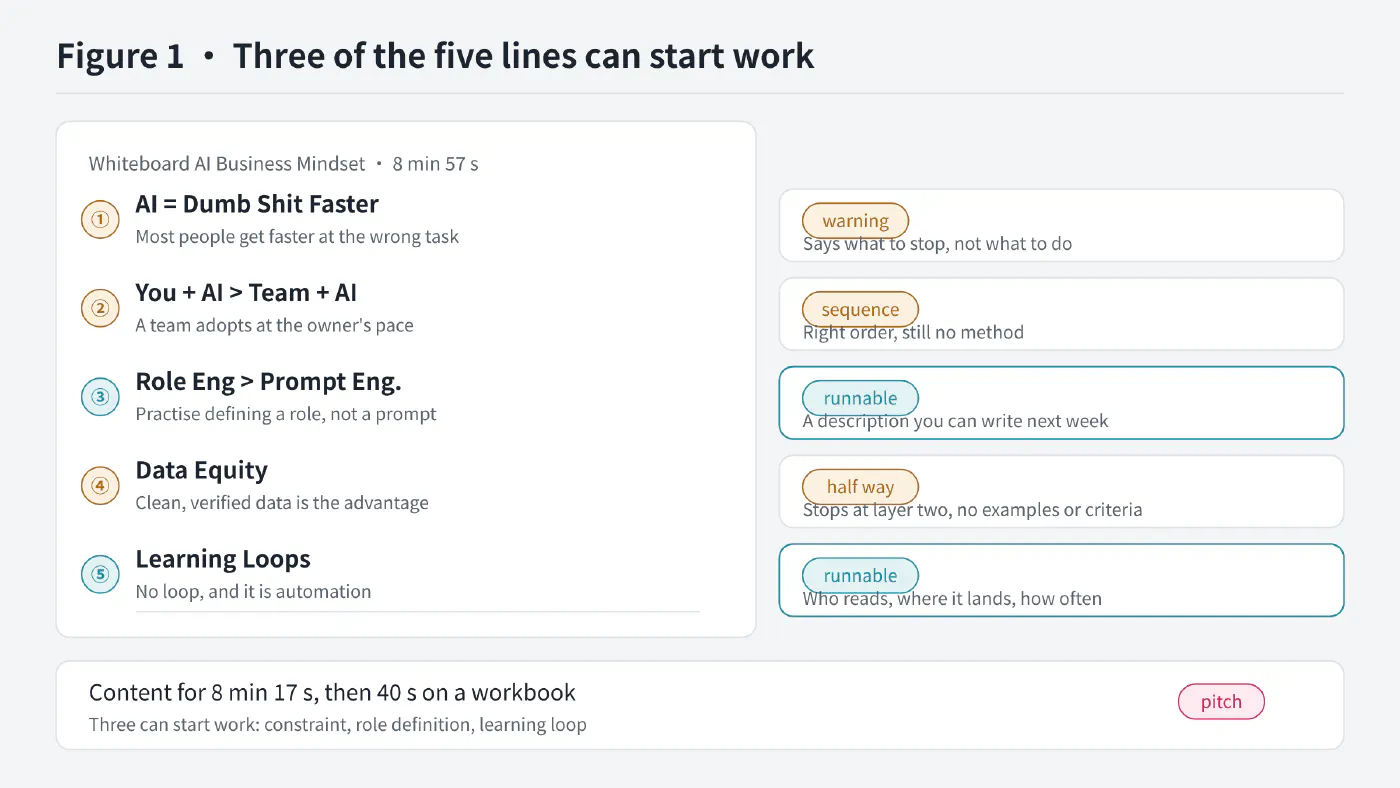
8 minutes 57 seconds, one take, one man standing at a whiteboard. The top of the board reads AI Business Mindset, and five lines are written under it. I copied them down in the order they appear.
| No. | Whiteboard | Where in the film | The claim as spoken |
|---|---|---|---|
| ① | AI = Dumb Shit Faster | 00:26 | Most people use AI to do the wrong thing faster |
| ② | You + AI > Team + AI | 01:21 | A team’s adoption of AI is a byproduct of the owner’s adoption |
| ③ | Role Eng > Prompt Eng. | 02:19 | The skill to practise is defining a role, not writing prompts |
| ④ | Data Equity | 03:44 | The same models and tools are not an advantage, cleaned and verified data is |
| ⑤ | Learning Loops | 05:22 | What has no feedback loop is automation, and it is not an agent |
The speaker is Dan Martell. The last thirty seconds introduce the SCALE YOUR BUSINESS WORKBOOK, with his name on the cover, and the handwriting on the board matches the man on camera. He says he has coached thousands of founders, with clients at $10M, $25M and $50M in revenue. Those figures have no public source, so I treat them as self-reported.
There is no deck, no second person, no screen recording. The first half is dense, and the last part changes job. The final forty seconds offer a free workbook, link in the description or scan the code on screen, preceded by the line that the material is worth a few thousand dollars. That line has no list price behind it, and it is a pitch.
I transcribed the audio into 201 segments and checked each line against the board. Every claim below carries a timestamp, so you can go back and watch it yourself.
2. The five do not carry equal evidence#
On one board, five sentences sit at very different distances from something you can check. Number 1 cannot be falsified. Number 2 has only his client list behind it. Numbers 3, 4 and 5 turn into an action on the spot.
| Claim | What he offers | What can be checked | Grade |
|---|---|---|---|
| ① Doing the wrong thing faster | Judgement, 00:26 | Nothing. It is a warning, and it is not a finding | Assertion |
| ② You + AI beats team + AI | Revenue bands of unnamed clients, self-reported | A team’s adoption does track its owner’s, which holds in engineering teams too | Self-report |
| ③ Role definition over prompts | The question itself is reusable, 02:52 | Ask someone to describe the next hire and the answer arrives as a job description | Runnable |
| ④ Data equity | A five-step sales process and no examples of it, 04:26 | The question about examples finds the gap immediately | Runnable |
| ⑤ Learning loops | A Slack review, once a week, 06:25 | Whether feedback actually lands in the rules can be read off the record | Runnable |
Numbers 3, 4 and 5 are runnable because each comes with a small move you can make today. Number 1 is a negation. It tells you what to stop and leaves the doing to you. Number 2 is about sequence. It argues about order and leaves method alone.
3. The constraint line gives a direction, not a method#
His words are that every business has exactly one primary constraint at any point in time, and that once you identify it you can surge the whole team at it, otherwise you only get faster at the wrong thing. The direction is right, and constraint theory has been saying it since The Goal in 1984. What a business needs at the point of use is which step is the constraint, and the film does not answer that.
Here is the version I use. Three questions, and you can point at a step when they are answered.
- Which step has the most work piled up in front of it. Look at the longest queue, including waits for approval, for information, for one person to reply. The busiest person is often somewhere else.
- If this step doubled its capacity, would the output of the whole chain double. If it would not, the constraint is elsewhere and that step is merely busy.
- What the waiting costs. Multiply the person-hours spent waiting each week by the hourly cost, and you have a number you can take into a meeting.
Take a hypothetical twelve-person team. Suppose leads are plentiful and delivery is stuck at checking customer records, with 40 person-hours of backlog every week at 200 yuan an hour, which is 8,000 yuan a week spent buying a queue. Once the third question is answered, the second usually answers itself, because the checked records then wait for scheduling, so the constraint sits at scheduling rather than at checking.
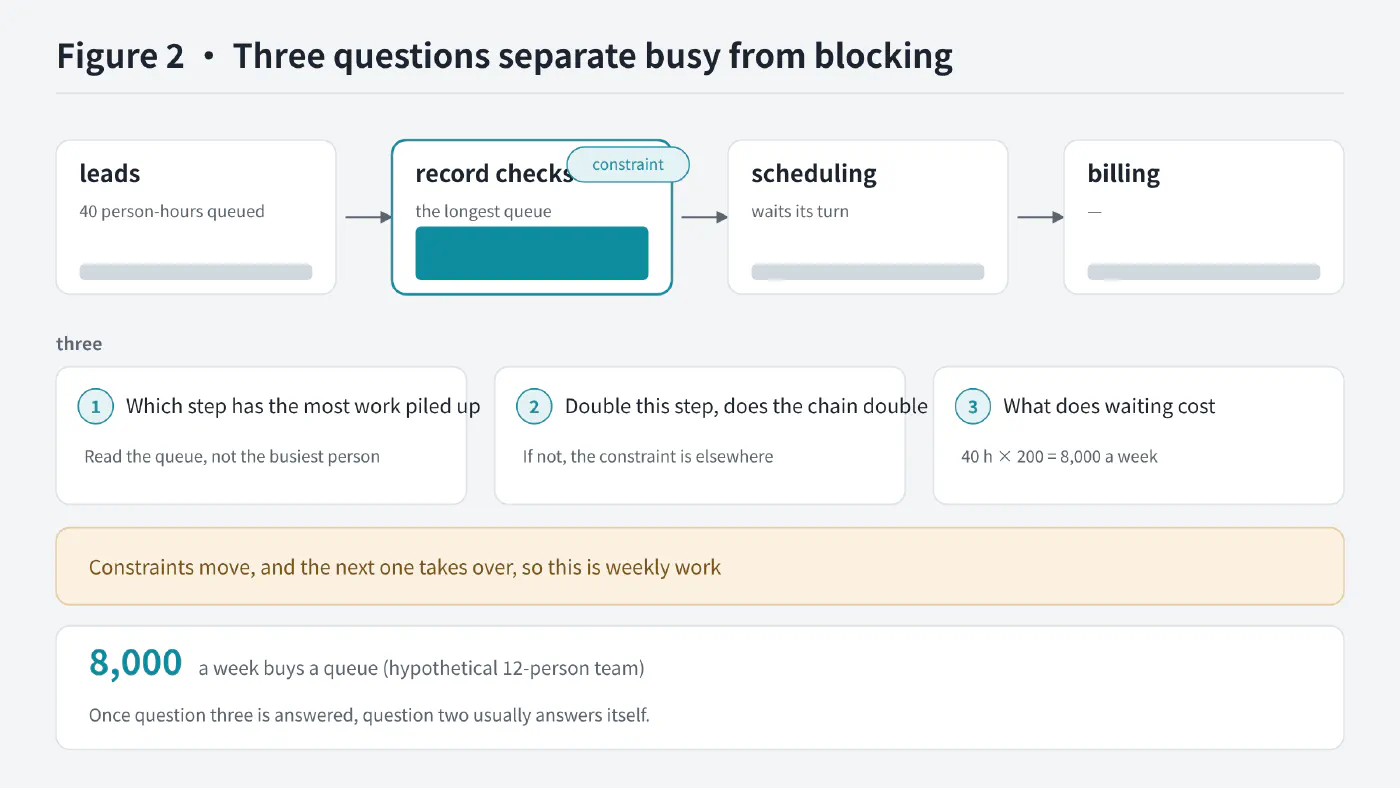
This method has a cost he does not mention. Constraints move. As soon as one step is relieved, the next one takes over, so the calculation is weekly work. An annual target will be stale by March.
4. A role definition replaces half your prompts#
The one line worth copying is a question. Who is the next person you would hire to free up the most of your own bandwidth. Then have them describe what that person would do all day. If you open the model app and speak that description, what you have produced is a job description, not a prompt.
He adds a time marker and says that after February 2026, with agents hosted by the model vendors, anyone still writing prompts is an amateur. I have no independent source for that date, so I record it as his claim. The practice stands without it.
Five paragraphs are enough. Scope, what the role owns and what it does not. Inputs, which materials arrive. Outputs, who receives what format. Acceptance, what counts as passing. Escalation, when the work comes back to a person. The acceptance paragraph is the hardest to write and the most useful, and whatever you cannot write there is what you have not decided.
My own usual mistake is worth stating. Eight hundred words of prompt with 17 requirements inside, and the model executes three per run. Nine of the 17 contradict each other, which looks like laziness on the model’s side. Rewriting the same thing as a role definition surfaces the conflict, because the format forces you to write down what the role does not do.
One self-check. If the document keeps naming the model, you have written configuration and not a role.
5. Data equity is described at half its size#
The sales process is the most concrete passage in the film. He splits it into five steps, an intake form, a sales call, an agreement, onboarding, entry into the system. Then he asks the owner whether there are examples of those steps. The answer is no. Without examples, he says, the model cannot take a task from start to finish and can only guess.
Split the phrase into four layers. Raw records, a cleaned copy, three good examples plus three bad ones, and one line that defines a win. The film stops at the second layer, and only the third and fourth can be accepted or rejected.
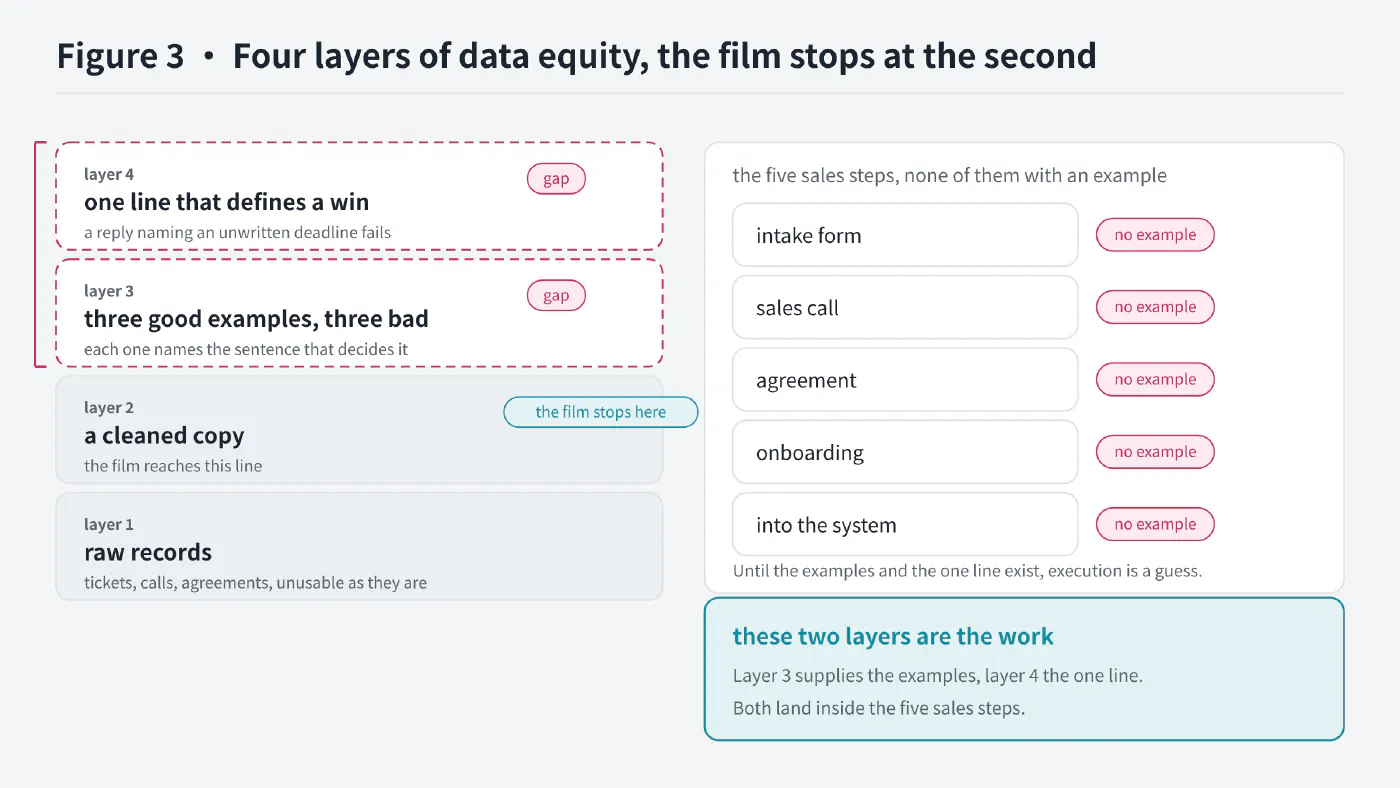
The third layer is cheap to reach. The three good examples do not have to be perfect, as long as you can point at the sentence that makes them good. The bad examples are harder, because you have to say why they fail. The fourth layer is one line, for example that a reply naming a deadline absent from the contract fails. Once that line exists the examples become evidence, and before it they are only material.
6. The fifty-two in the learning loop is arithmetic#
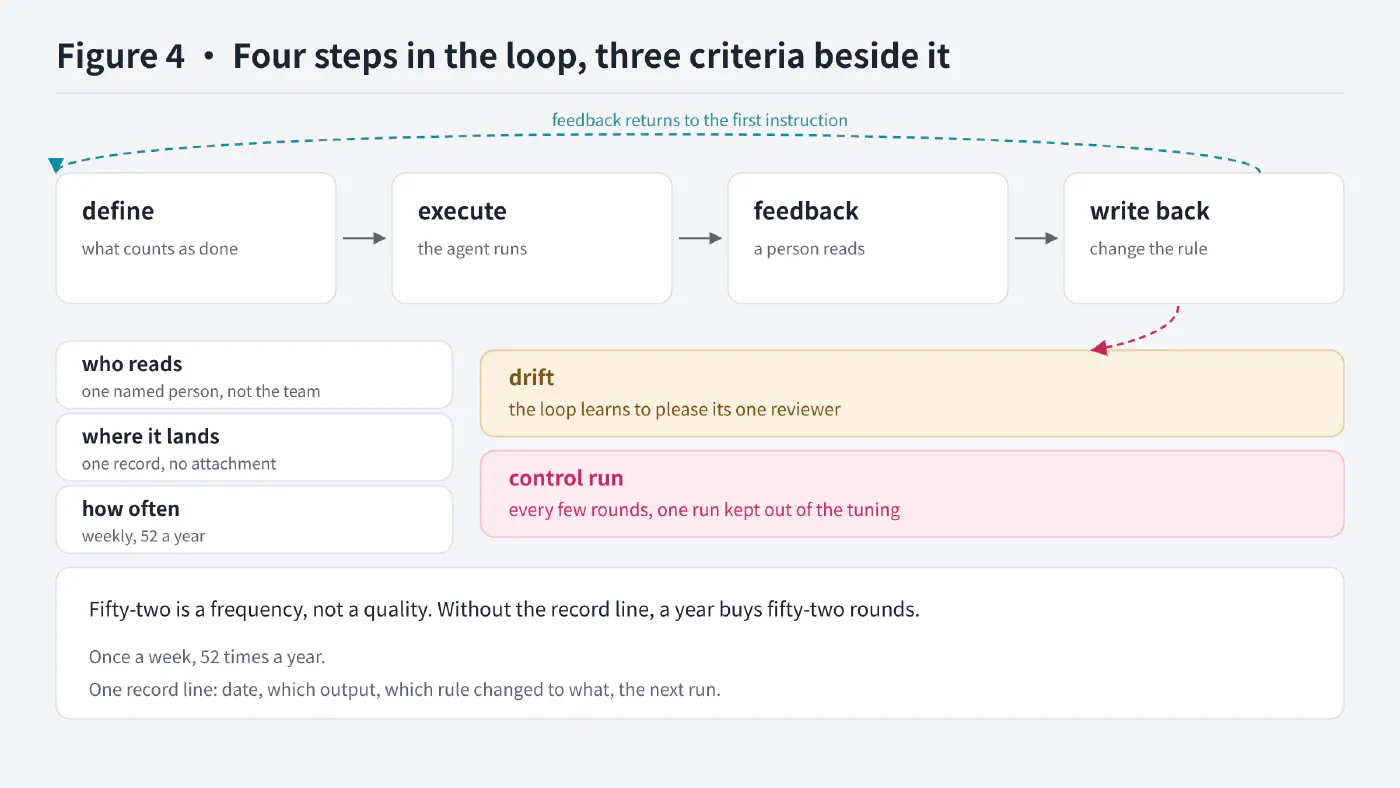
I agree with his definition. Define an outcome, let the system execute, collect feedback somewhere in the middle, feed that feedback back into the original instruction, and the next run executes with the new knowledge. His phrasing is blunter. You say you have bots, and what you have is automation, because nothing without a loop is an agent.
The example is the Slack channel. An agent posts an analysis, the team comments underneath, and the agent watches those comments and treats them as chances to upgrade its rules, its steps and its quality bar. Once a week, so 52 times a year.
Fifty-two gives you the frequency and says nothing about quality. A team can run the same loop for a year and learn nothing, as long as every round of feedback says it looks fine. Three criteria hold it down. Who reads the output, where the feedback is written, how often a round happens. Add one guard against drift, a run every few rounds that stays out of the tuning, otherwise the loop slowly learns to please the one person who always reviews it.
One line of record is enough. Date, which output, which rule changed to what, and what the next run showed. Without that line, 52 rounds stay 52 rounds.
7. Four places he steps around#
The first is how to identify the constraint, which the previous section fills in. Eight minutes cannot hold it, so I read the omission as a budget problem and not as secrecy.
The second is the line about your service as software. He puts it next to gross margin and says people do the people work while AI does the computer work, so margin rises. A denominator is missing. If human time is still seven tenths of delivery, removing three tenths of computer time leaves the margin structure alone and only means two fewer hires for the same work. Margin moves when the number of clients one person can carry moves, and that is an organisational problem.
The third is how role definition degrades in a small team. A five-person company cannot write ten role definitions, so it accumulates a prompt library and renames it. To run the practice, write only the one role you will hand over next week.
The fourth is that a loop freezes the taste of its reviewer. In the film the team is a plural, and in practice the comment thread has one person in it. The loop learns that person.
As for 2027 separating professionals from amateurs, that is a forecast with nothing to check against. I note it and draw no conclusion.
8. Four checks for this week#
| Check | How | Passing line |
|---|---|---|
| Constraint | Run the three questions over the worst queue | You can say which single step this week is for, and question two answers yes |
| Role | Write the five paragraphs for one agent | The model is never named, and acceptance is one sentence that can fail |
| Examples | Find three good and three bad | Every example has the sentence that makes it good or bad |
| Loop | Schedule one review and write one line | Next week’s run differs in a way that traces to a rule change |
The fourth is the one most often dropped, because it asks someone for twenty minutes a week. It is also the one that separates automation from an agent.
9. Two things I have not settled#
Whether a single constraint survives agents. If agents speed up four steps at once, the constraint jumps somewhere, and I have no data on where.
How to value data equity. The film says it makes you worth more to a buyer and does not say how the buyer computes it. By example count, by coverage of the acceptance criteria, or by the cost of the role it replaces. Those three give very different numbers.
References#
- Dan Martell, whiteboard talk, 8 minutes 57 seconds, the post
- Constraint theory, Eliyahu M. Goldratt, The Goal, 1984
- SCALE YOUR BUSINESS WORKBOOK, offered through the closing QR code, not downloaded