Four stages of an AI-native startup, and what each one has to prove
A 36-page founder playbook, taken apart: the exit condition for each of the four stages, the failure modes AI makes cheaper, and the bill the playbook does not price. Every number carries its source.
In one line: the playbook turns startup work into four gates, each with a question that takes a yes or a no. Once building got cheap, the failures piled up on the gate side.
1. Four gates, laid out#
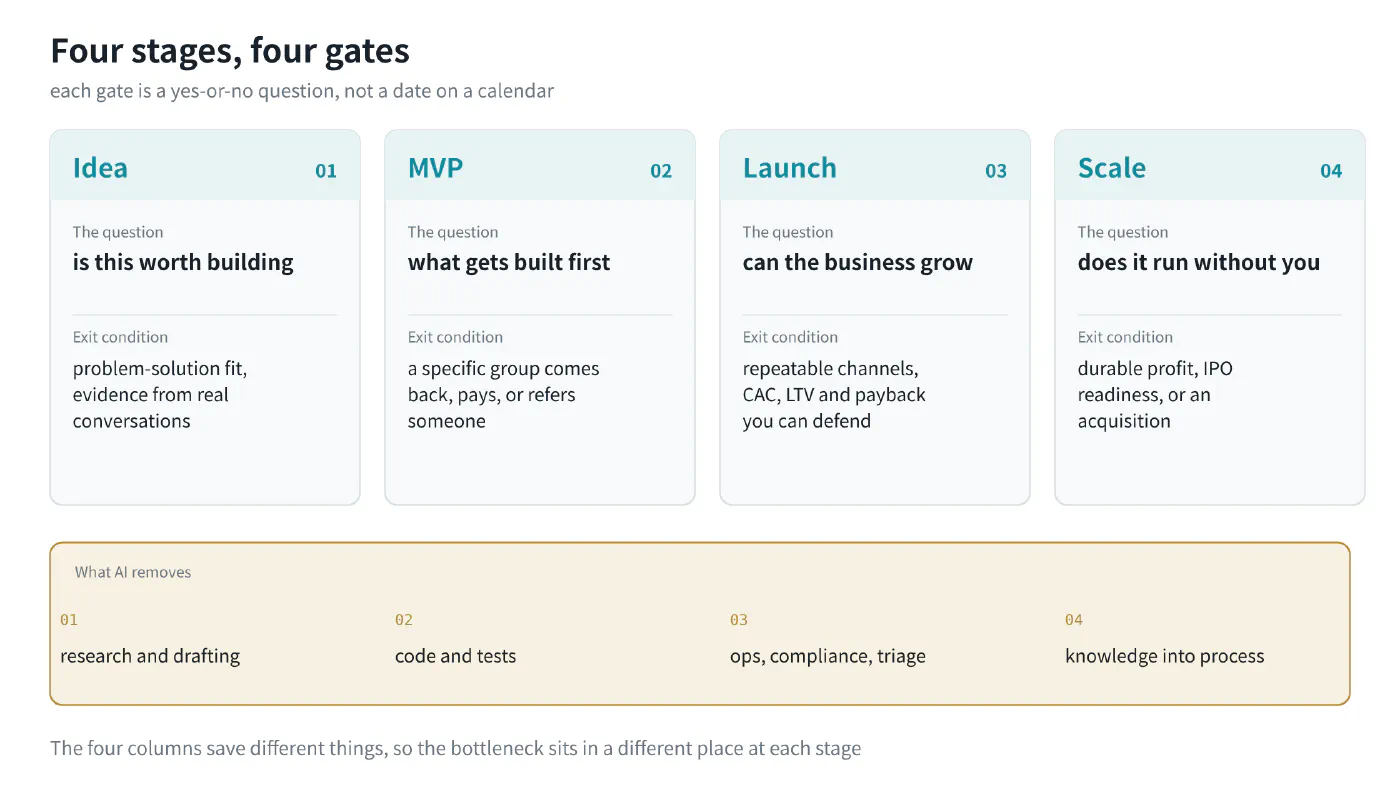
The document runs 36 pages and 7 chapters. Its skeleton is four stages. Each stage gets an exit condition written as a question a founder can answer yes or no to, not as a date on a calendar.
| Stage | The question | Exit condition |
|---|---|---|
| Idea | is this worth building | problem-solution fit, with evidence from real conversations |
| MVP | what gets built first | a specific group comes back, pays, or tells someone else |
| Launch | can the business grow | repeatable channels, and CAC, LTV and payback you can defend |
| Scale | does the company run without you | durable profit, IPO readiness, or an acquisition |
The old arc is written out as validate, raise, hire, build, raise again, grow, hire more, repeat. The playbook argues a founder no longer needs a new team, a new skill set and a new round at every hop, and puts a number on it, ten people or fewer running the functions of a much larger company.
What AI saves differs by stage. In the Idea stage it saves research and drafting time. In MVP it saves engineering hours. In Launch it saves the filing work behind operations and compliance. In Scale it saves the effort of turning company knowledge into process. That sentence is my summary of the chapters, not a line from the document.
Six facts to keep in view.
| Fact | Value | Source |
|---|---|---|
| Length of the playbook | 36 pages, 7 chapters, 4 stages | measured on the original |
| Startups that died building something nobody wanted | 42% | playbook quoting CB Insights |
| Sean Ellis threshold | 40% of active users answering “very disappointed” | playbook quoting a known convention |
| Carta Healthcare surgical cases | 22,000 a year, 66% less abstraction time | vendor case study |
| Anything users | 1.5 million | vendor case study |
| Interview cadence the playbook recommends | merge the evidence every 5 interviews | playbook advice, not data |
2. Three work surfaces, sorted by permission#
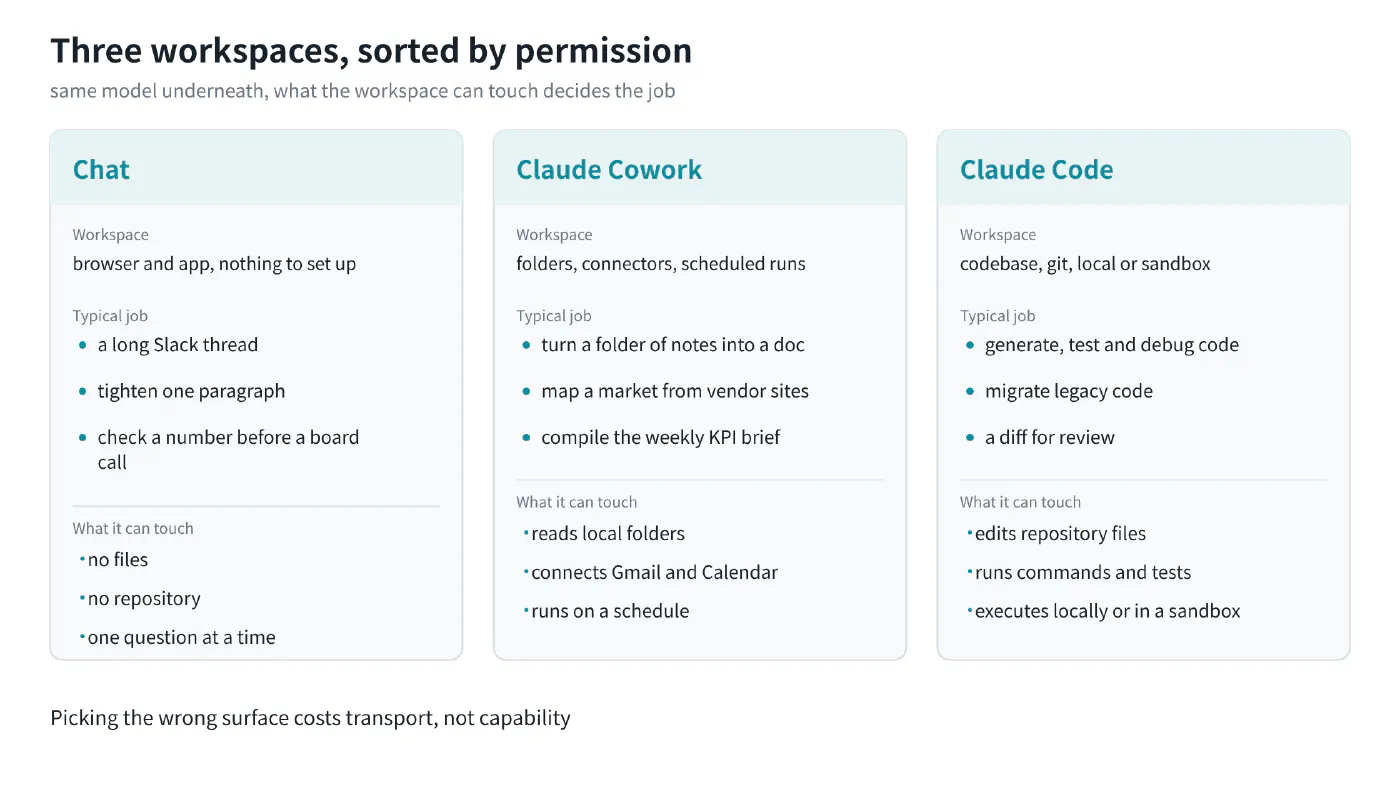
The tooling section is three desks, and the difference between them is what the workspace is allowed to touch. Same model underneath, different reach.
| Task | Surface | Why |
|---|---|---|
| tighten a paragraph, quick question, make sense of a long Slack thread | Chat | fast, nothing to set up |
| research across files, turn a folder of interview notes into a finished doc | Claude Cowork | reads folders, connects Gmail and Calendar, runs on a schedule |
| write code, run tests, migrate, produce a diff | Claude Code | codebase, git, a local or sandboxed environment |
The split has a testable consequence. Hand a folder-reading job to Chat and the human becomes the context pipeline. Hand a one-line rewrite to Claude Code and you spend the time waiting for the environment. Picking the wrong surface costs transport, not capability.
The playbook’s own summary is that all three run the same Claude and what changes is the workspace around it. Read that way, the Chat and Cowork boundary moves whenever a connector is added, and the Claude Code boundary is set by the repository and the sandbox.
Two documents worth keeping open, one on how Claude Code works and one on configuring CLAUDE.md .
3. The Idea stage exits on problem-solution fit#
The playbook breaks problem-solution fit into three yes-or-no questions.
- Is the problem real and specific. You should be able to name who has it, how often, how badly, and what they do about it today.
- Does your solution address the problem the validation surfaced. That is not always the problem you set out to solve.
- Is there enough signal to justify building. Certainty is not available here, and waiting for it is its own failure mode.
“Expense reporting is painful” is an observation. “Finance managers at mid-market companies spend over 4 hours a week reconciling submissions because the current tools do not talk to their accounting software” is a hypothesis you can test. The 4 hours comes from the playbook’s own example and I did not verify the distribution.
Five moves, each with an output, each with a stopping rule.
| Move | Output | Done when |
|---|---|---|
| Rewrite the hypothesis until it is testable | one sentence with a group, a frequency and a cost | all four fields are filled |
| Put AI on the opposing side | a list of disconfirming evidence, failed competitors included | the case against you is stronger than your first draft |
| Map competitors in four tiers | direct, indirect, likely acquirers, neighbours who could enter | each tier says why it is a real threat |
| Write interview questions by hand first, then audit them | questions about the past, not about intent | nothing like “would you use this” survives |
| Merge the evidence every five interviews | two lists, one supporting and one challenging | neither list is empty |
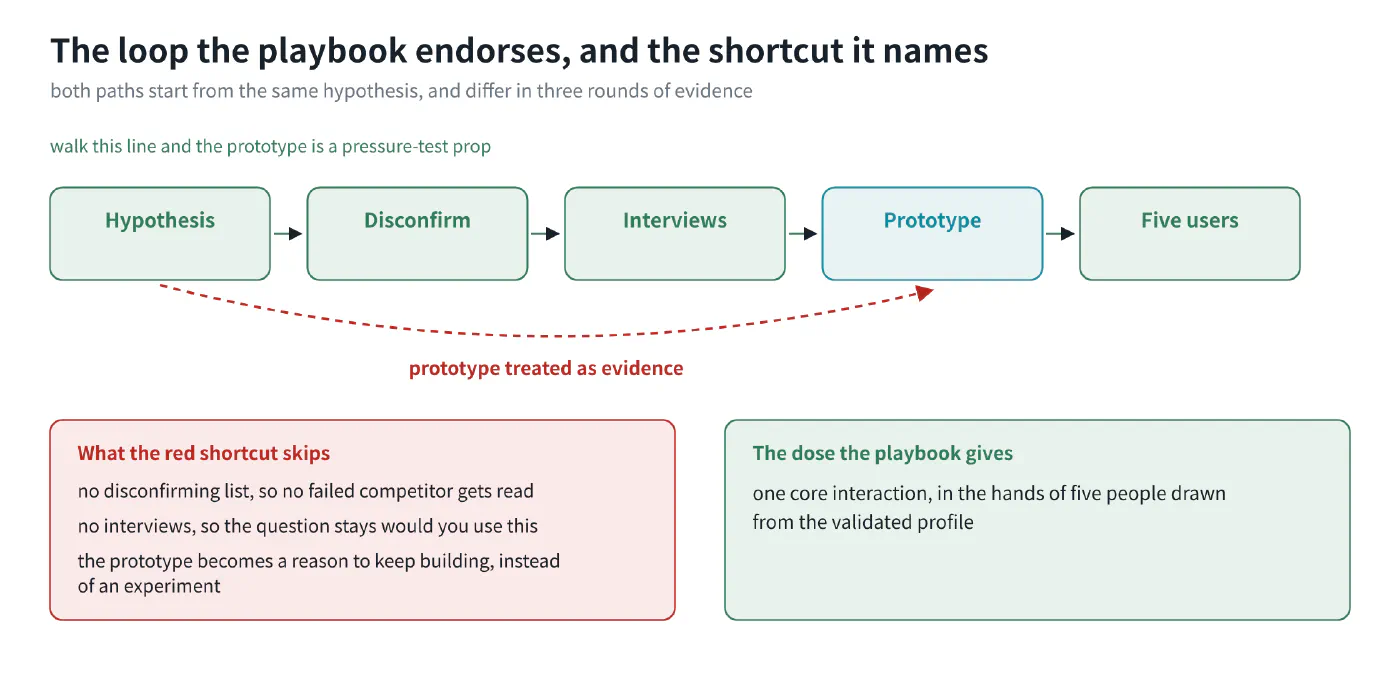
Asking AI to argue that a competitor will win and you will not is more useful than asking it to argue that your differentiation holds, because the first version goes looking for failed companies. The playbook treats structured devil’s advocacy as a permanent fixture rather than an Idea-stage exercise.
The interview section names the rookie mistake. The generic question about the future (“would you use something like this”) produces imagination. “Tell me about the last time you dealt with this” produces behaviour, and usually a description of the workaround they cobbled together.
4. Treating the prototype as evidence is the expensive mistake#
The playbook reuses an old number. 42% of startups died from building something nobody wanted. It comes from CB Insights’ post-mortem tally via the playbook, and I could not find the sampling basis of the original. At minimum it says this failure mode led the list before AI arrived.
The current problem is that a prototype is too cheap. Agentic coding collapsed the distance from “I have an idea” to “I have a product” into a few hours, so the flow becomes idea, prototype, treat the prototype as validation. In that position a prototype is a pressure-test prop. The evidence is the reaction of a real person. The dosage the playbook gives is five people drawn from the validated target profile.
The second mistake hides better. Ask AI for evidence that your idea works and it finds some. Ask it to size the market and it returns a number that makes the market look fundable. The tool follows your direction, so a founder who never asks a hard question can now assemble a well-researched-looking case for a bad idea while feeling thorough the whole way. The fix is the same tool pointed the other way, disconfirming evidence first, interviews second.
The third mistake is scaling ahead of demand. An agent will generate, test, debug and refactor around a wrong premise with the same enthusiasm it brings to a right one. The playbook’s own line is that the intelligence in the system is yours. That one deserves two readings.
5. Three documents before the first feature#
The MVP stage reads like construction. The playbook calls it evidence gathering again, with the object of evidence moved from the problem to the solution. It also says how you build now sets what is possible later.
Three documents go in before the first feature.
| Document | Answers | Cost of skipping it |
|---|---|---|
| architectural context, CLAUDE.md | which patterns to follow, which dependencies to avoid, which tradeoffs were taken | every session re-derives structure, and the codebase works without sharing one mental model |
| scope document | what the product does, what it deliberately does not do, which user evidence justifies an addition | every small feature is cheap, the product drifts past its boundary, and nobody notices the direction change |
| measurement framework | retention baselines, the activation definition, Day 7 and Day 30 targets, what a false positive looks like | metrics get chosen after launch, and the chosen ones are the flattering set |
The useful column in the second document is the deliberate non-goals. They turn “should we add this” from an argument into a lookup, answered only when a critical mass of users says the product cannot deliver value without it.
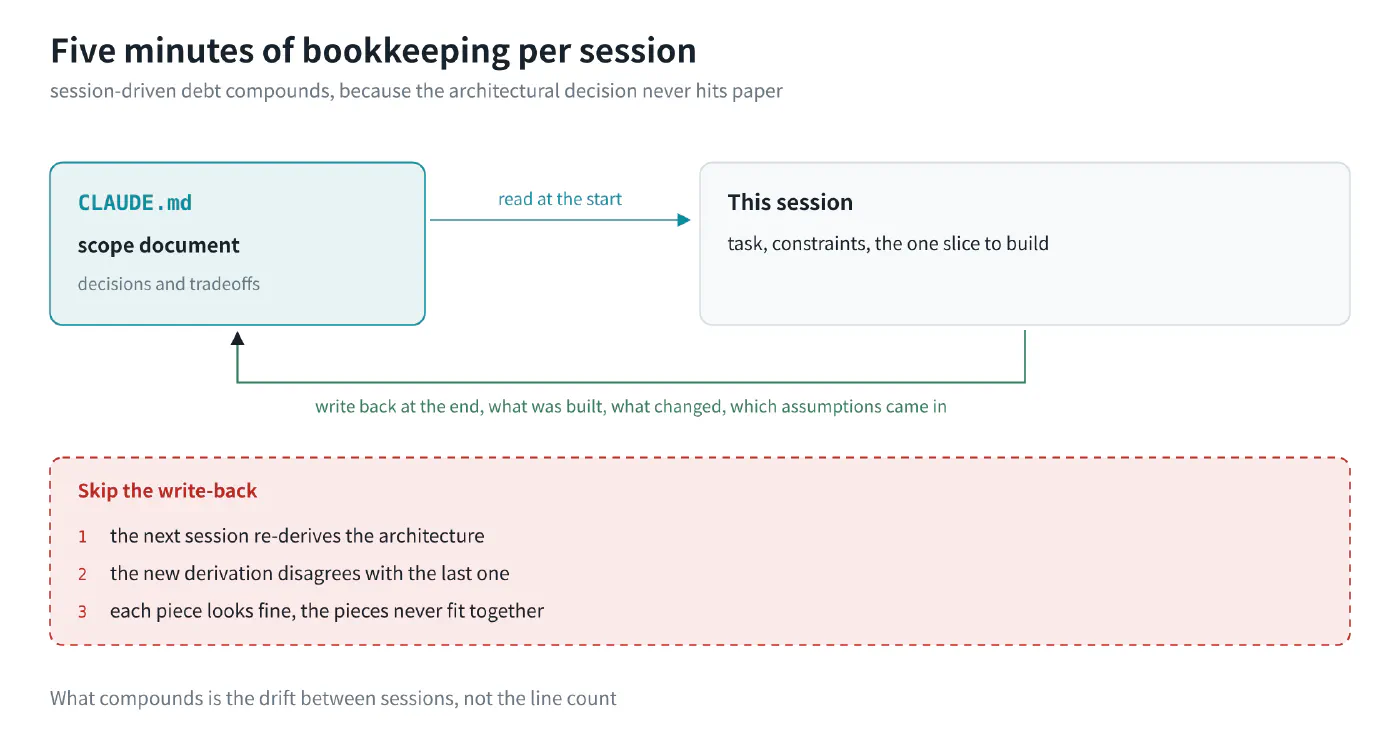
Technical debt behaves differently in an AI build. Ordinary debt accumulates and can be paid down in a dedicated sprint. Session-driven debt compounds, because nobody wrote the architectural decision down, so each new session derives it again, and the new derivation disagrees with the last one. Every piece looks fine. The pieces were never designed to fit.
The maintenance dose the playbook prescribes is five minutes per session. Read CLAUDE.md and the scope document at the start, write the session’s decisions back at the end, including what was built, what changed and which assumptions came in. Five minutes buys a codebase whose structure you can explain out loud.
6. Three false signals, and one thing that cannot be postponed#
Early momentum is the most addictive experience in a startup. The playbook names its ingredients, friends of the founder, prospective buyers at the investor’s other portfolio companies, a Hacker News headline. None of the three predicts week six or week twelve.
| False signal | What it looks like | A check you can run |
|---|---|---|
| signups without activation | the top of the funnel looks great, nobody reaches the core action | write the activation definition down, then read the funnel step by step |
| revenue without retention | the first month gets paid, the second does not | split the cohorts, look at month two and month three |
| launch-day enthusiasm | the loudest day is day one | read Day 7 and Day 30, ignore day one |
The playbook offers two thresholds. The Sean Ellis test asks active users how they would feel if the product disappeared, and more than 40% answering “very disappointed” counts as one PMF signal. The other is the effort test. Before fit, retention needs constant pushing, outreach, incentives, personal follow-up. After fit, the product starts pulling. That flip in effort is more reliable than any single metric.
The third item is security, and it cannot wait for the Launch stage. An agent produces code that runs, not code that is secure. A broken feature gives feedback. A vulnerability gives none until it is exploited. The playbook asks for a security review before any real user touches the product, covering sessions and authentication, data exposure in API responses, input validation and injection, and dependencies with known vulnerabilities. It also flags Claude Code Security as a limited beta at publication, and says plainly that an AI scan is not a substitute for security tooling or, at higher stakes, a human reviewer.
7. Launch is where the founder leaves the loop#
Launch has three exit conditions. Miss one and the company is still in MVP.
- Growth is repeatable and channel-driven, with CAC, LTV and payback numbers you can defend.
- The product survives production traffic, with security and compliance in order.
- Operations run without you, including support, triage, sprint planning and reporting.
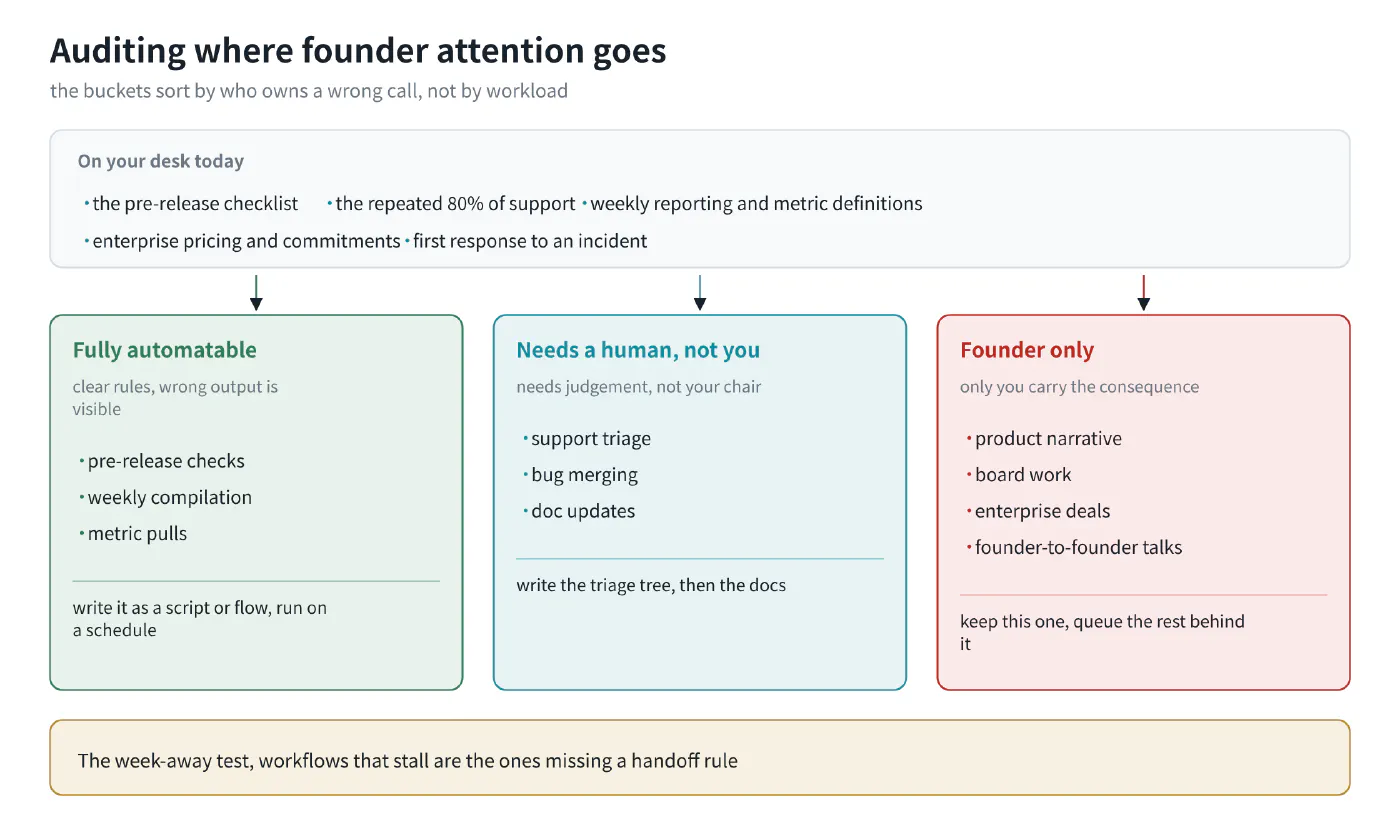
The third one is the hard one, because it is an identity change. A founder inside every loop is an asset at MVP and the constraint at Launch. The playbook lists three symptoms, an hour-long decision takes a week to reach you, support requests stack up because only you know the answer, and operational tasks happen only when you remember them.
One check anyone can run is the week-away test. List every workflow, decision and approval currently routed through you, then ask what happens to each one if you disappear for a week. The ones that stall are the ones missing a handoff rule, an escalation path or exception handling.
| What sits on your desk | Bucket | What to do with it |
|---|---|---|
| the pre-release checklist | fully automatable | turn it into a script or a flow, run it from Claude Cowork on a schedule |
| the repetitive 80% of support | needs a human, not necessarily you | write the triage tree, then move the answers into the docs |
| pricing and commitments on an enterprise deal | founder only | keep this one, queue the rest behind it |
Compliance becomes a product workstream at this stage. SOC 2, GDPR and HIPAA used to be a conversation for a later funding round, and they apply the moment customer data arrives. The playbook puts compliance inside the development cycle rather than running it as a one-off project, with documentation maintained continuously. An AI scan can help you prepare for an independent assessment and cannot replace a qualified compliance review.
8. At Scale the moat is three accumulations locked in time#
The Scale exit is a threshold event, not a milestone. Durable profitability counts. So does IPO readiness, and so does an acquisition. The playbook’s sharper question is whether your users would stay if a well-funded incumbent copied the product today.
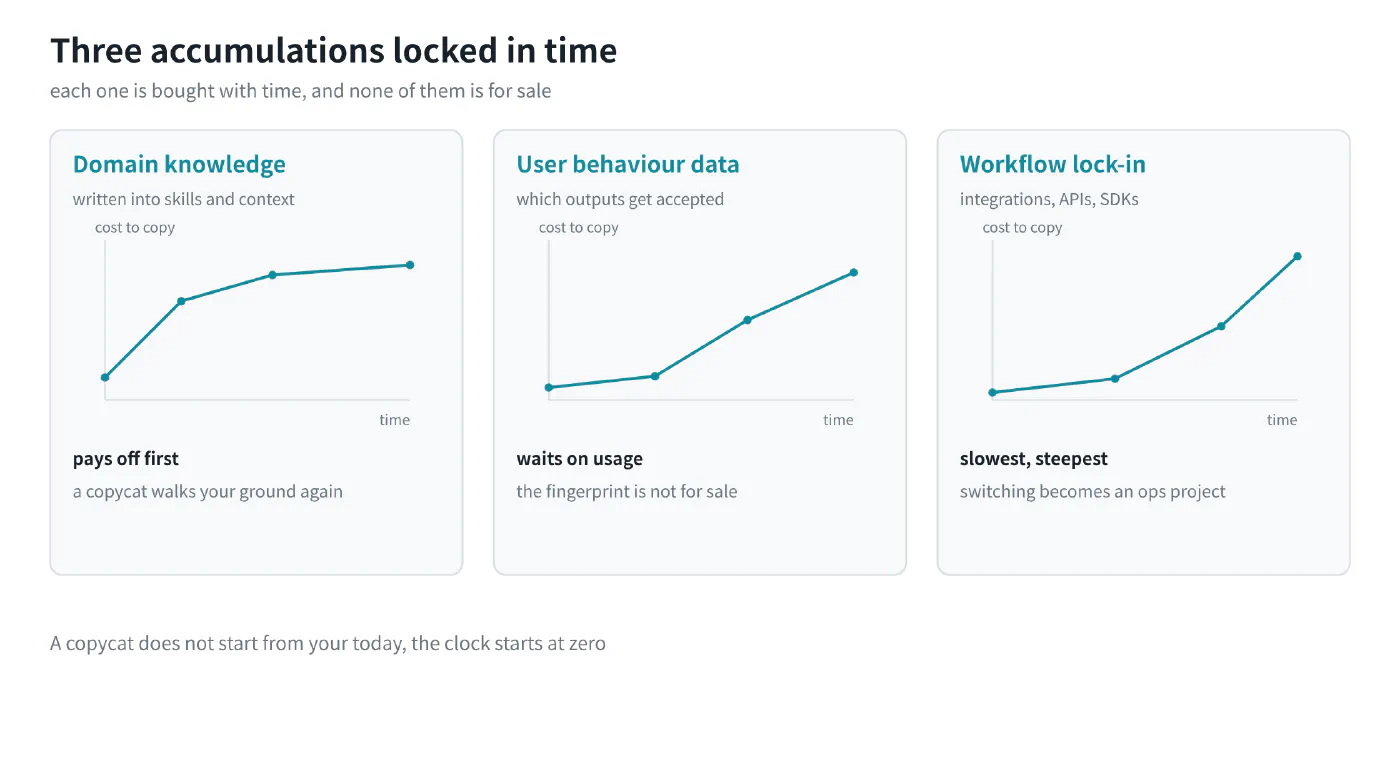
Its answer is three accumulations that share a property, each one is bought with time and cannot be purchased.
| Asset | How it accrues | What a copycat pays |
|---|---|---|
| domain knowledge | industry jargon, regulatory traps and edge cases written into skills and context | walking the same ground you already walked |
| user behaviour data | which outputs get accepted and which get rejected, fed back into improvement | the same months of usage |
| workflow lock-in | integrations, APIs, webhooks and SDKs that let users build on top | a full migration project |
The playbook is specific about the first. Write down how you audit a commercial lease or how you triage a patient intake form as a reusable routine, and after enough months it turns into a knowledge layer a general model cannot supply. The second is about time. The behavioural fingerprint of your users is not for sale, and a copycat starts the clock at zero. The third is the deepest lock the playbook describes, because users stop merely using the product and start building on it, which turns switching into an operations project.
Enterprise deals gate on a different thing. Before a multi-year contract, procurement wants documentation, SLAs, observability and incident response, none of which a Discord community needed. The gap analysis method is to take the three hardest prospects and ask what their procurement teams would demand, then sequence the technical work and the documentation work against that list.
9. Where the method breaks, and three checks for today#
This is a vendor’s document. Every recommendation lands on Chat, Cowork or Code, all six case studies are companies running Claude, none of them failed, and every case number is vendor-published. None of that makes the content wrong. It decides how to read it, as a set of operating instructions rather than as evidence.
The second break is more concrete. Building got cheaper and validation did not. An interview costs an hour of someone’s day, waiting for a user to come back costs weeks, and payment has no shortcut. Three of the four gates hinge on real people and real money, so compressing quarters into weeks holds for the preparation work and stops at the evidence.
The third break is organizational. At one person, the three work surfaces are three departments. At twenty, someone has to decide who may change the architecture, who approves a scope change, and how a session’s output enters review. The playbook is silent there. It assumes a very thin team, and it is honest wherever that assumption holds.
Three checks you can run this week.
- Add deliberate non-goals and an evidence bar to the scope document, then count how many features shipped last month cleared it.
- Run the week-away test, list every decision that only you can make, and treat more than ten as a system that is not built yet.
- Put one core interaction in front of five people from the target profile and record where each one first gets stuck.
Two questions I cannot answer. Why validation cost did not fall alongside build cost. And where the decision bandwidth of one founder plus a room of agents actually tops out.