Automatic Ontology Engineering: Reading NVIDIA's Auto-Ontology at the Source
Auto-Ontology compiles an ontology out of metadata and query history in four passes, then hands agents nine read-only MCP tools. After reading 1.1.0 end to end, I think it automates the first month — and that certification is a badge, not a gate.
In one line: Auto-Ontology automates the most expensive month of ontology engineering — it reads your metadata and query history, compiles a business ontology, and hands it to agents through nine read-only tools. What it hands over is a draft: in this codebase, certification is a badge rendered for display, not a gate on the query path.
English voiceover, 2 min 19 s. A Chinese cut covers the same ground.
NVIDIA announced it at GTC Berlin on 21 October 2026 as part of the Agent Knowledge Foundation, and open-sourced it under Apache-2.0 on 1 November. I read the whole backend at commit caced11 (cloned 4 November). Everything below traces back to that code.
1. The problem, as a scene#
An agent with database access can write SQL that runs. That is the easy part and the dangerous part, because a query that runs and returns a plausible wrong number produces no error.
This is the scene.
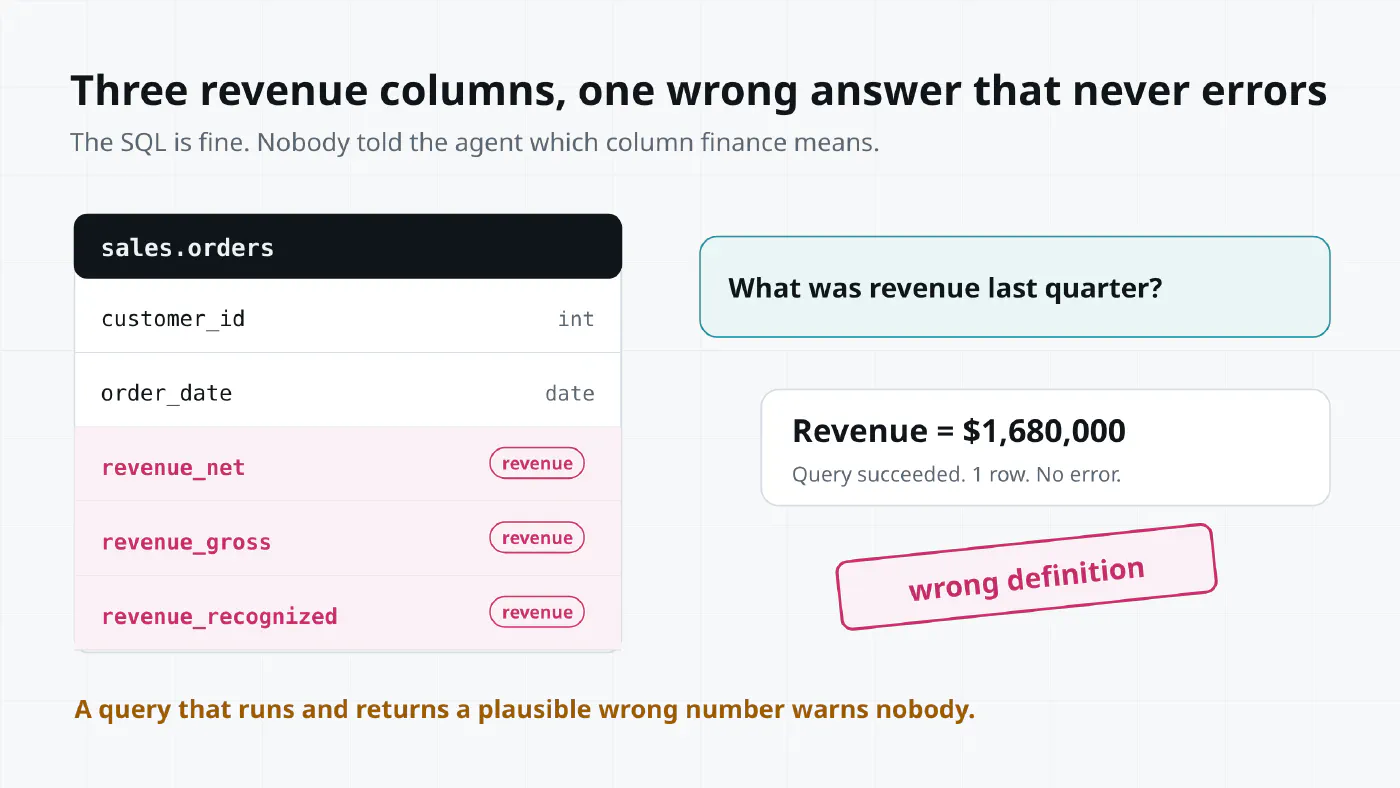
Finance has three columns that could be called revenue. Sales means bookings. A join to a one-to-many table doubles a total without complaint. Text-to-SQL research usually treats the hard part as generating valid SQL and scales the model. Auto-Ontology starts from the opposite premise: syntactically correct is not semantically correct, and what is missing is a context layer that says where the data lives, what it means, whether to use it, how to use it, where it came from, and what is similar.
That layer used to live in people’s heads. Its cost is concentrated in the first delivery — reading source tables, defining object relationships, reviewing metric definitions — which is why most semantic-layer projects die in week one: the platform is installed, and nobody can say which of six revenue definitions is the real one.
2. Where it sits#
“Put an ontology over the data, rewrite queries into it” is not new. What changed, twice, is who writes the ontology.
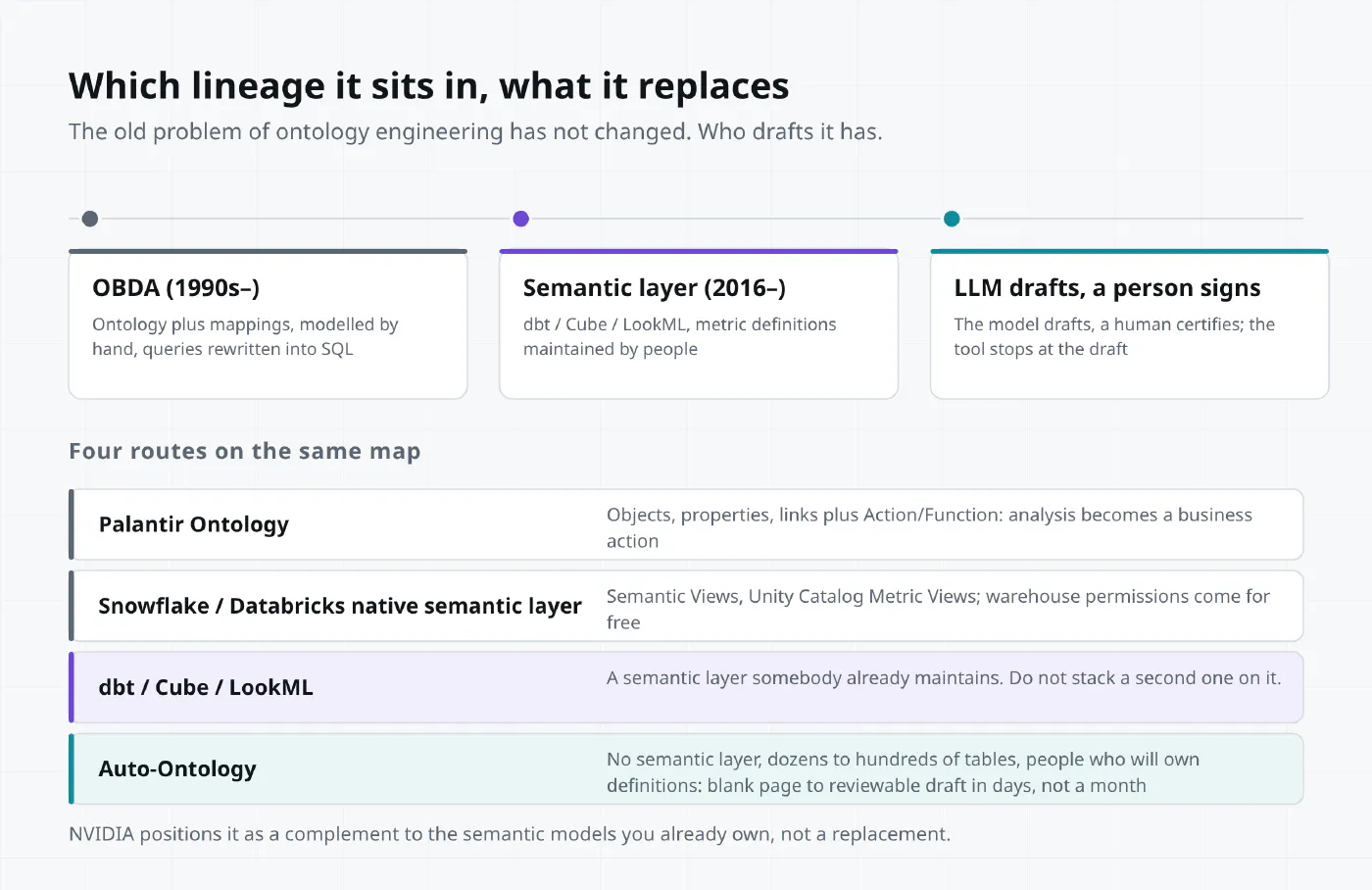
| Route | Who writes the ontology | Consequence |
|---|---|---|
| OBDA | A knowledge engineer models and maps it by hand | Expressive and provable; the cost kept it in proofs of concept |
| Semantic layer (dbt / Cube / LookML) | An analytics engineer writes YAML, a person reviews | Trustworthy definitions; weeks to months from blank page to v1 |
| LLM drafts, a person signs | The model drafts, a human certifies | Something reviewable on day one; the draft/authority line is yours to draw |
Both lineages have thirty years behind them. OBDA’s three levels — sources, mappings, ontology — are structurally the same as Auto-Ontology’s catalog, semantic foreign keys and terms. The only difference is that nobody builds the ontology by hand any more. The last three years rewrote this line with LLMs: Towards Agentic Schema Refinement (arXiv 2412.07786), Knowledge Base Construction for Knowledge-Augmented Text-to-SQL (ACL 2025 Findings), A Multi-Agent System for Semantic Mapping of Relational Data to Knowledge Graphs (arXiv 2511.06455) all push the same way — give the model the right context instead of a better SQL generator.
Mining query history is the industry converging on the same idea. Snowflake’s engineering blog describes building semantic models from query history; open-source projects cluster historic SQL into dbt YAML. The argument is solid: query history is the only behavioural evidence of how a company actually measures itself, and it beats documentation. Auto-Ontology’s fourth pass mines query history.
3. The design#
It is not another text-to-SQL engine. Four requirements have to hold at once.
- The ontology must be a retrievable graph, not a schema pasted into the prompt — otherwise tokens grow with every table and relationships cannot be expressed at all.
- Terms must land on columns and SQL expressions. “Revenue is a business concept” is useless; which columns, computed how.
- Relationships must be stronger than column names.
customer_idappearing in two tables is not evidence that they join. - “Cannot answer” must be a reachable state. It is the only mechanism that stops a confident wrong answer.
Two engineering principles decide the shape:
- The tool surface is designed, not generated. Every extra tool raises the chance the agent picks the wrong one.
- A person signs certifications, and something checks that they did. It implements half of this. Section 6.
4. The implementation#
4.1 Deployment shape#
It is not a library. It is a stack beside your database, and the README’s component table explains its boundary faster than the code does.
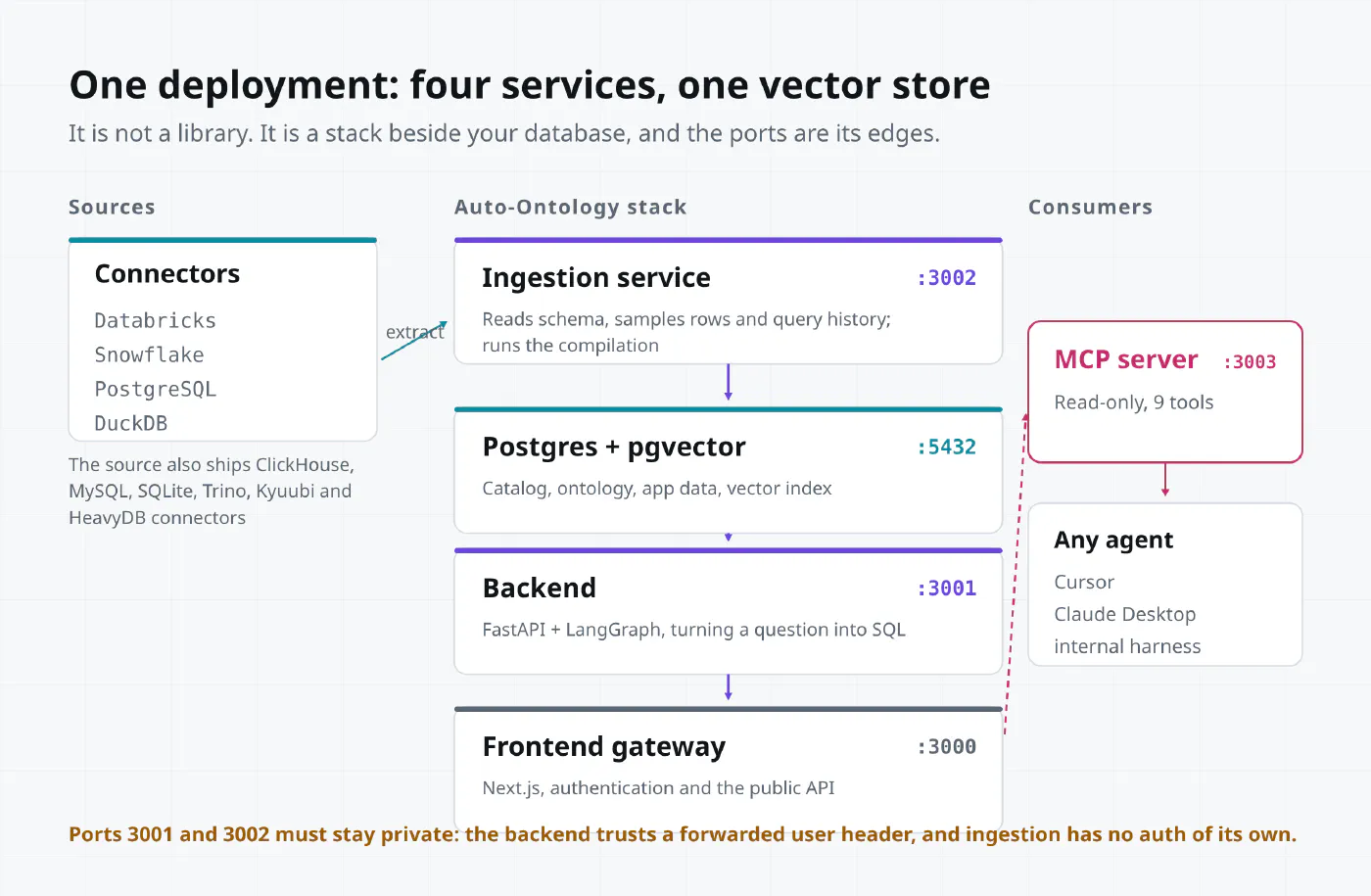
Models default to NVIDIA NIM (nvidia/nemotron-3-nano-30b-a3b for reasoning, plus Nemotron embedding and rerank), and every model role can point at any OpenAI-compatible endpoint. The documented sources are Databricks, Postgres, Snowflake and DuckDB; the source also ships ClickHouse, MySQL, SQLite, Trino, Kyuubi and HeavyDB connectors.
One security fact belongs before any deployment: the Next.js gateway resolves the user and forwards an x-auto-ontology-user-id header to FastAPI, which does not verify it independently, and the ingestion service’s ingest / delete / reset / compile endpoints have no authentication of their own. The README says plainly that 3001 and 3002 must not be exposed. In Kubernetes that is a NetworkPolicy, not a reminder.
4.2 The four compilation passes#
This is the core. The entry point is auto_ontology/semantic/compile.py, four strictly sequential stages:
# auto_ontology/semantic/compile.py
count      = compile_semantic_layer(...)          # 1. table-by-table taxonomy
fk_count   = resolve_semantic_fks(...)            # 2. semantic FKs / junctions
attr_count = suggest_sql_attributes(...)          # 3. metrics mined from history
bridge     = build_bridge_tables_sql_attributes(...)  # 4. bridge tables
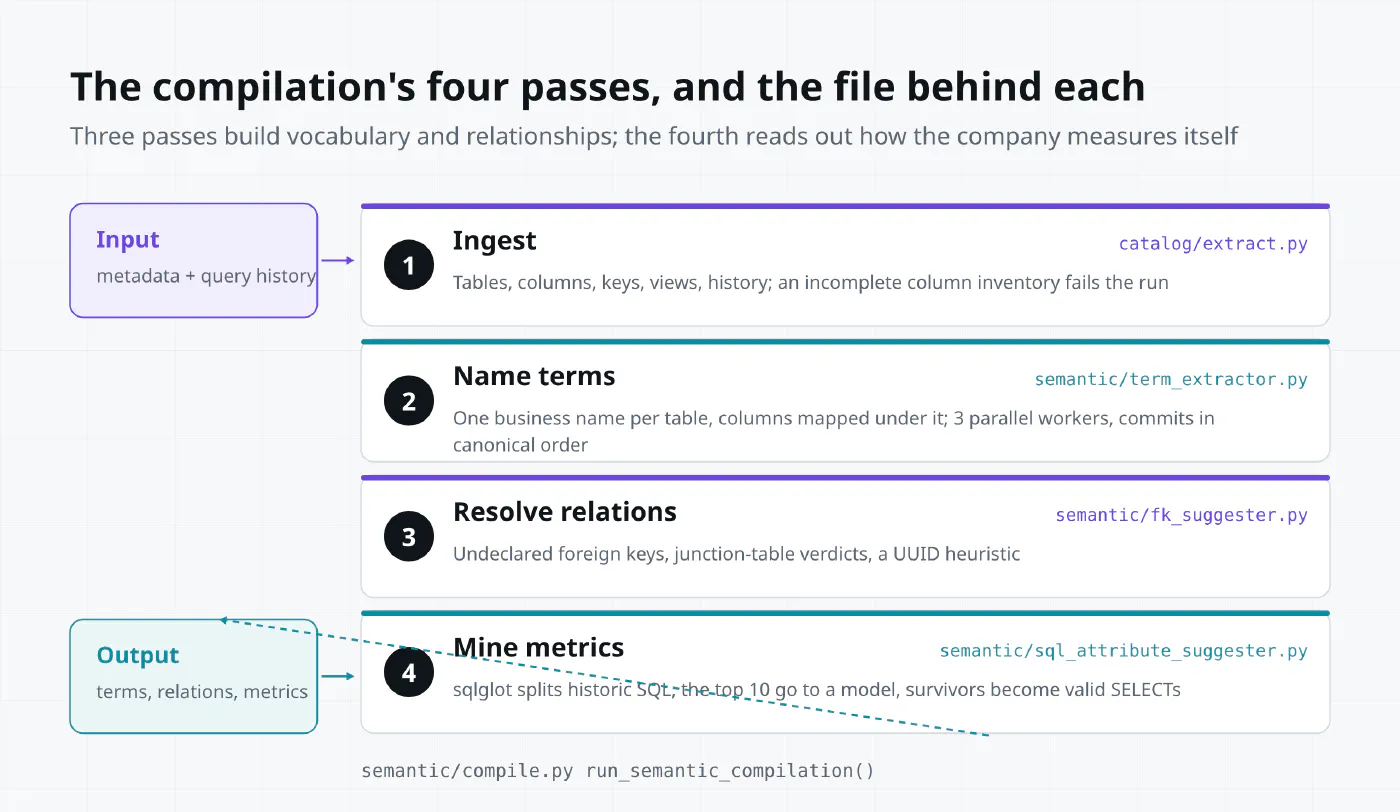
Pass 1, ingest (catalog/extract.py) pulls six kinds of entity: tables, columns, views, primary keys, foreign keys, queries. One detail worth copying: _validate_relation_column_coverage is fail-closed. If a relation appears in get_tables() with no rows in get_columns(), the whole extraction fails. The alternative is the hardest failure to diagnose: the catalog lands, retrieval offers the table, and every generated query against it fails.
Pass 2, name terms (semantic/term_extractor.py, driven by pipeline.py). One business name per table, every column assigned under a term with a human-readable display label. The prompt is restrained — “strongly prefer ONE Term per table” — and only a true junction table may split.
The engineering around the prompt matters more. pipeline.py runs three workers over tables, and each table fans out again into concurrent LLM calls; compile.py therefore caps the whole run with SEMANTIC_LLM_MAX_INFLIGHT=6, because the request rate is a product of table-level and within-table concurrency and the source comment records it once drove the endpoint into HTTP 503. Term commits go through an _OrderedCommitQueue that admits them in canonical table order, so when two tables contend for the same unqualified name the winner is deterministic. Expensive LLM work stays parallel; the write becomes sequential.
Pass 3, resolve relations (semantic/fk_suggester.py). Undeclared foreign keys are inferred from suffix (_id), type, description and sampled uniqueness (is_unique), along with a junction-table verdict and a UUID heuristic.
Pass 4, mine metrics (semantic/sql_attribute_suggester.py) is the clever one:
- For each term, fetch the historic SQL recorded against its tables.
- Parse with sqlglot and extract expressions — WHERE and JOIN ON predicates, aggregates, CASE, UNION branches — explicitly excluding bare column references and pure foreign-key equalities.
- Score by usage, take the top 10, and ask a model which deserve to become named
SqlAttributenodes. - Rebuild each survivor into a valid
SELECT, persist it, embed it.
The intent is clear: let the agent reuse a definition somebody already computed — active customer, gross margin — instead of inventing arithmetic per question. The scoring in step 3 currently does nothing. Section 6.
4.3 How a question becomes SQL#
The query path is a LangGraph state machine in retrieval/text_to_sql/text_to_sql_graph.py: twenty-odd nodes and an explicit edge table.
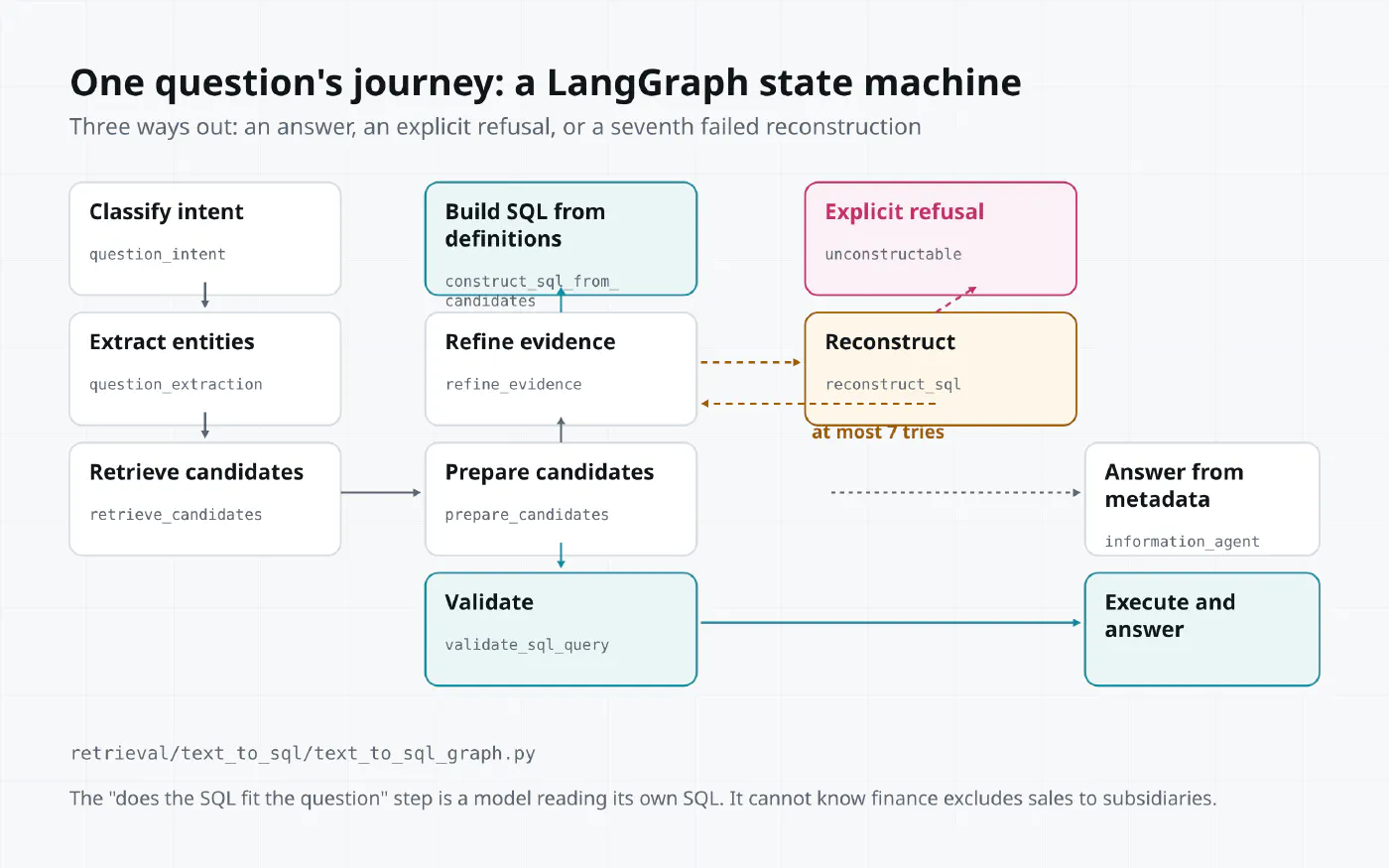
Three decisions are worth copying into any system you build:
- SQL is built from retrieved definitions, not from raw columns.
agents/sql_from_semantic.pyinjectsprimary_attribute,attribute_join_paths, reviewedsql_attributes, term synonyms and value anchors into the prompt. - Joins are checked against known relationships before execution.
db_probe/join_path_check.pyis its own node, because two columns sharing a name is not evidence that the tables join. - There is a terminal state for “this cannot be answered from what I know” that ends in an explanation rather than a guess. Reconstruction has a hard cap,
MAX_RECONSTRUCTION_ATTEMPTS = 7, after which the run entersunconstructable.
One honesty note: the “does the SQL fit the question” check is a model reading the SQL it just wrote (agents/sql_parse_validation.py). It catches self-comparisons and wrong filters. It cannot know that your finance team excludes sales to subsidiaries. That is a model judging SQL, not a semantic guarantee.
4.4 Answerability: a deterministic 0–1 score#
retrieval/entity_coverage/agents/coverage.py contains no model judgement, only arithmetic:
# auto_ontology/retrieval/entity_coverage/agents/coverage.py
def _compute_coverage(entities, col_attr_hits) -> float:
    if not entities:
        return 0.0
    return len(_covered_entities(entities, col_attr_hits)) / len(entities)
Extract entities, retrieve candidates, filter by distance, divide. That lets an agent run a cheap pre-flight before paying for ask_question. The README’s ad-spend example is exactly this: coverage 0.5; no term covers "ad spend", followed by a clarifying question instead of an invented number.
4.5 The tool surface: nine of eighty-seven#
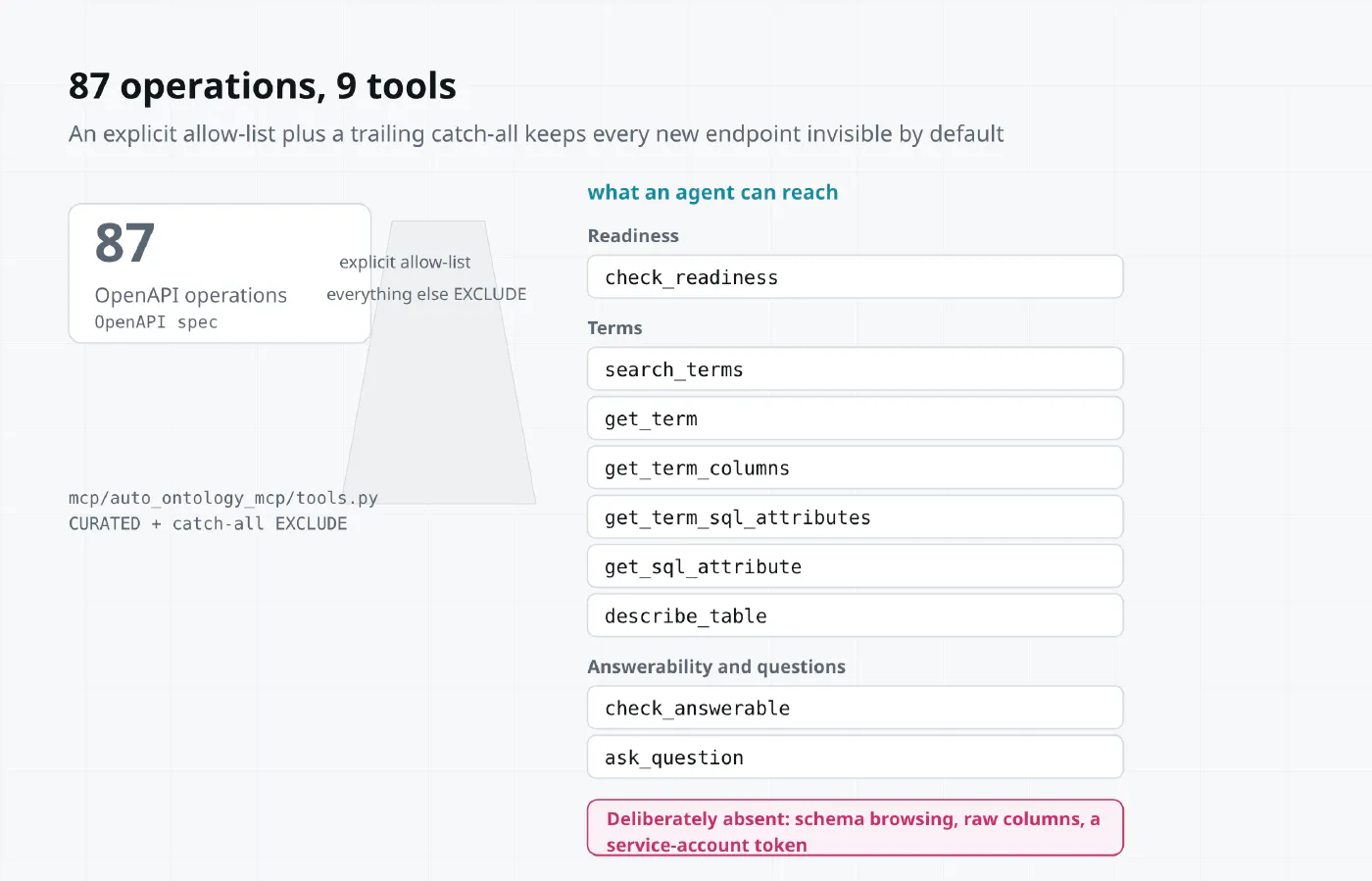
mcp/auto_ontology_mcp/tools.py is where the philosophy is concentrated: 87 operations in the public spec, 9 tools published, everything else swallowed by a catch-all EXCLUDE. Three choices matter more than the tools:
- No tool browses schemas or raw columns, deliberately. The comment’s words: a tool that lists schemas or columns “invites an agent to bypass it and reason about raw tables instead”.
- Tool descriptions are rewritten as prompts. Generated operation ids read
get_api_terms_term_id_, which tells a model nothing; each description now says when to reach for the tool, in the caller’s vocabulary. - No service-account token. Every call runs as the person who signed in, so a viewer gets a viewer’s answers.
5. Trade-offs, with their costs#
| Decision | Alternative | Why | Cost |
|---|---|---|---|
| Four services plus Postgres | One process plus SQLite | Compilation, answering and the gateway have different load and permission boundaries | Five things to run and secure, not one |
| Persist semantics at compile time | Infer from schema per question | Relationships and metrics are computed once; answering gets cheap | The ontology drifts from the source; you need a recompilation policy |
| Mine metrics from query history | Trust only hand-written dbt models | Behavioural evidence beats documentation | A dashboard refreshed hourly on a wrong definition becomes the most “used” expression |
| Allow-list tool surface | Generate from the whole spec | More tools means more wrong tool choices | A new endpoint is invisible until someone registers it |
| Certification as data, not a runtime gate | Refuse to answer from uncertified definitions | Gets the draft working, defers governance | See section 6 — this is the part you build |
6. Where it stands: two gaps in the source#
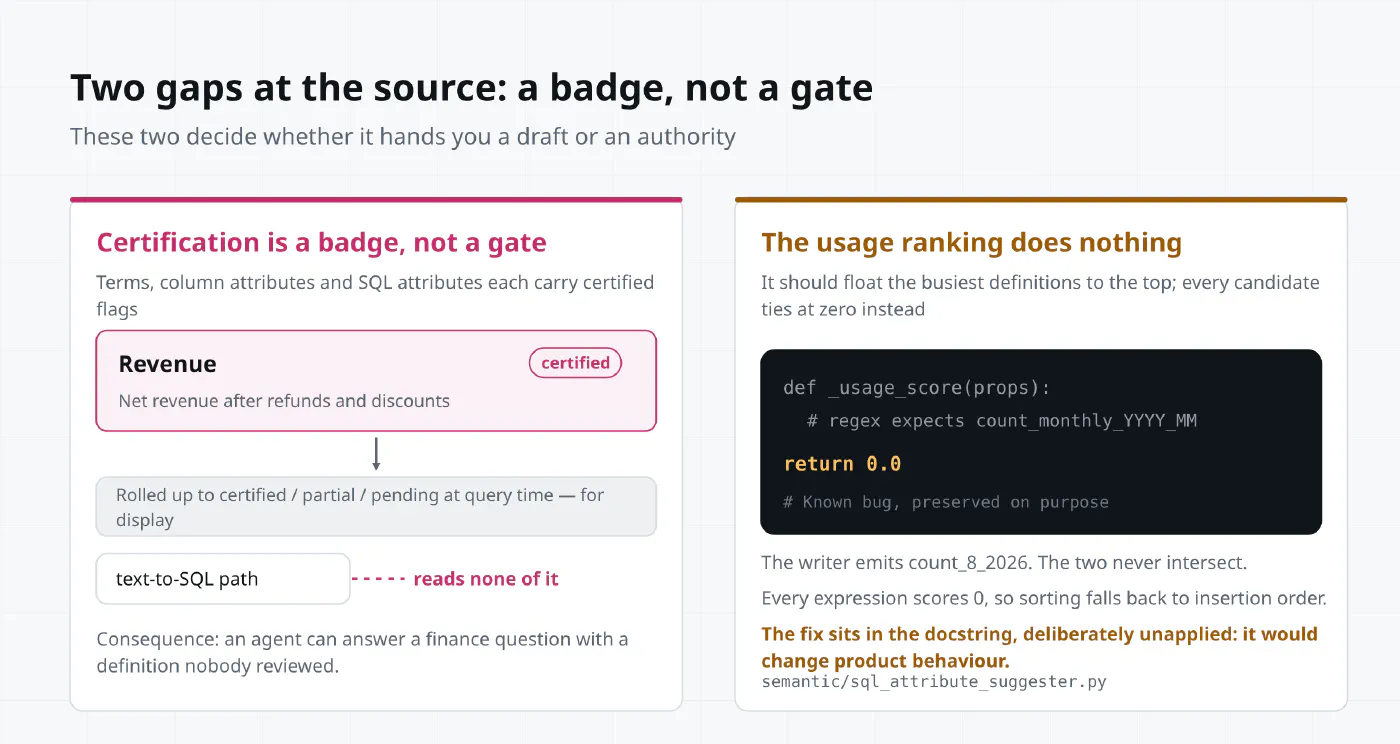
Gap one: certification is a badge, not a gate. Terms, column attributes and SQL attributes each carry certified flags; at query time they roll up to certified / partial / pending for display. I could find no reference to those flags anywhere in the text-to-SQL path, and NVIDIA’s own management skill concedes the current fields “are not an atomic review/promotion system”. The consequence is direct: an agent can answer a finance question with a definition nobody reviewed. If your rule is that only reviewed definitions may answer finance questions, you write that check.
Gap two: the usage ranking does nothing. The scorer in semantic/sql_attribute_suggester.py always returns 0.0, and the docstring says so out loud — “Known bug, preserved on purpose. Do not ‘fix’ this in passing.” The regex expects count_monthly_YYYY_MM while the writer emits count_8_2026, so no name it accepts has ever been written; every expression ties at zero and the sort falls back to dict insertion order. The fix (score by total_counter) is written in the same comment and deliberately not applied, because applying it would change which SqlAttribute nodes the product suggests.
That detail is a sample of this project’s engineering attitude: it would rather leave an inert function in place and explain why than ship a scorer that looks like it works. It also means “rank by usage”, which sounds like the headline feature, is not in effect.
Three more things to know before deploying: credentials are stored unencrypted on a Postgres row unless HashiCorp Vault is configured (a partial configuration falls back to plaintext with a warning); the project currently does not accept external contributions and the MCP package is not on PyPI, so install from the repo or the NGC container; and no accuracy number has been published.
7. Numbers, with sources#
| Metric | Value | Source |
|---|---|---|
| Licence | Apache-2.0 | repo LICENSE |
| Release | open-sourced 2026-11-01; announced 2026-10-21 at GTC Berlin with Agent Knowledge Foundation | press consistent across outlets |
| Default reasoning model | nvidia/nemotron-3-nano-30b-a3b | repo .env.example and coverage |
| Compilation concurrency | SEMANTIC_LLM_MAX_INFLIGHT=6, 3 table workers | source constants |
| SQL reconstruction cap | 7 attempts | text_to_sql_graph.py |
| MCP tools / backend operations | 9 / 87 | mcp/.../tools.py comment and allow-list |
| Official benchmarks | BIRD, BEAVER, FDABench-Lite, Wide World Importers, BIRD-Interact | auto-ontology-eval README |
| Published accuracy | none — the eval repo ships the harness and the control/treatment design, not results | official repo; the “90% faster ontology building” figure circulating in coverage appears in neither repository |
| Terms from one compilation (WWI sample) | 31 | README |
8. What this buys you#
You can verify this article’s central claim without standing up the stack. Two greps:
git clone --depth 1 https://github.com/NVIDIA/auto-ontology && cd auto-ontology

# Gap one: nothing on the question path reads the certification flags
grep -rn "certified" auto_ontology/retrieval/ | grep -v test    # expect: no output

# Gap two: the scorer is hard-wired to zero
sed -n '/def _usage_score/,/^    return/p' auto_ontology/semantic/sql_attribute_suggester.py
An empty result from the first command is the entire evidence for “a badge, not a gate”. For the end-to-end case, Docker Compose plus an NVIDIA API key, then ask the README’s Wide World Importers question — revenue for the sushi-roll flash drive in Pennsylvania in June 2015 — and it should return $588.80 with the SQL and the steps that produced it.
9. Roadmap and open questions#
It compresses “blank page to reviewable draft” from a month into days, and that part is real value. The rest it leaves to whoever deploys it, which is also what makes the two remaining questions live.
- How does the ontology converge with a drifting source? Compilation is a single pass;
semantic_compilation_historyrecords only a start, a finish and a coarse status. When upstream adds a column or changes an enum, who triggers recompilation, and how do you avoid overwriting a definition a person certified? There is an open issue (#268, structured certification and atomic promotion) arguing about it, with no answer yet. - Query history is both evidence and contamination. A dashboard query running on a wrong definition for a year will be the most “used” expression in the warehouse. The moment the usage ranking actually works, that problem surfaces — which may be one reason it is being left inert on purpose.
References#
- NVIDIA/auto-ontology
— the source this article reads, commit
caced11 - auto-ontology-eval — the control/treatment design and benchmark list
- Xiao, Calvanese et al. Ontology-Based Data Access: A Survey, IJCAI 2018
- Towards Agentic Schema Refinement, arXiv 2412.07786
- Knowledge Base Construction for Knowledge-Augmented Text-to-SQL, ACL 2025 Findings
- A Multi-Agent System for Semantic Mapping of Relational Data to Knowledge Graphs, arXiv 2511.06455
- Snowflake Engineering: Mining Query History to Build Better Semantic Models
- Apache Ossie — the interchange format Auto-Ontology imports and exports