In one line: handing over the work is fine. Handing over the judgement is a different act, and the slope between the two is quiet.
English narration, 2 min 41 s. The Chinese cut runs 2 min 33 s with the same scenes and the same numbers.
Addy Osmani published a long piece on X in November about keeping critical thinking while working with agents. He opens by getting his own position out of the way. He uses these tools every day, runs several sessions in parallel, and is not writing this to argue for fewer agents.
His real subject is narrower. The better the tool gets, the easier it is to stop judging, and nothing about that transition makes a sound.
What follows draws the slope, adds two measurements, and marks the place where his argument stops short.
1. Judgement used to live in the gap
Judgement used to happen between the question and the answer. You looked something up, thought it through, came back and checked. The answer was yours because you assembled it.
That gap now runs in seconds. You read a well written reply and click approve.
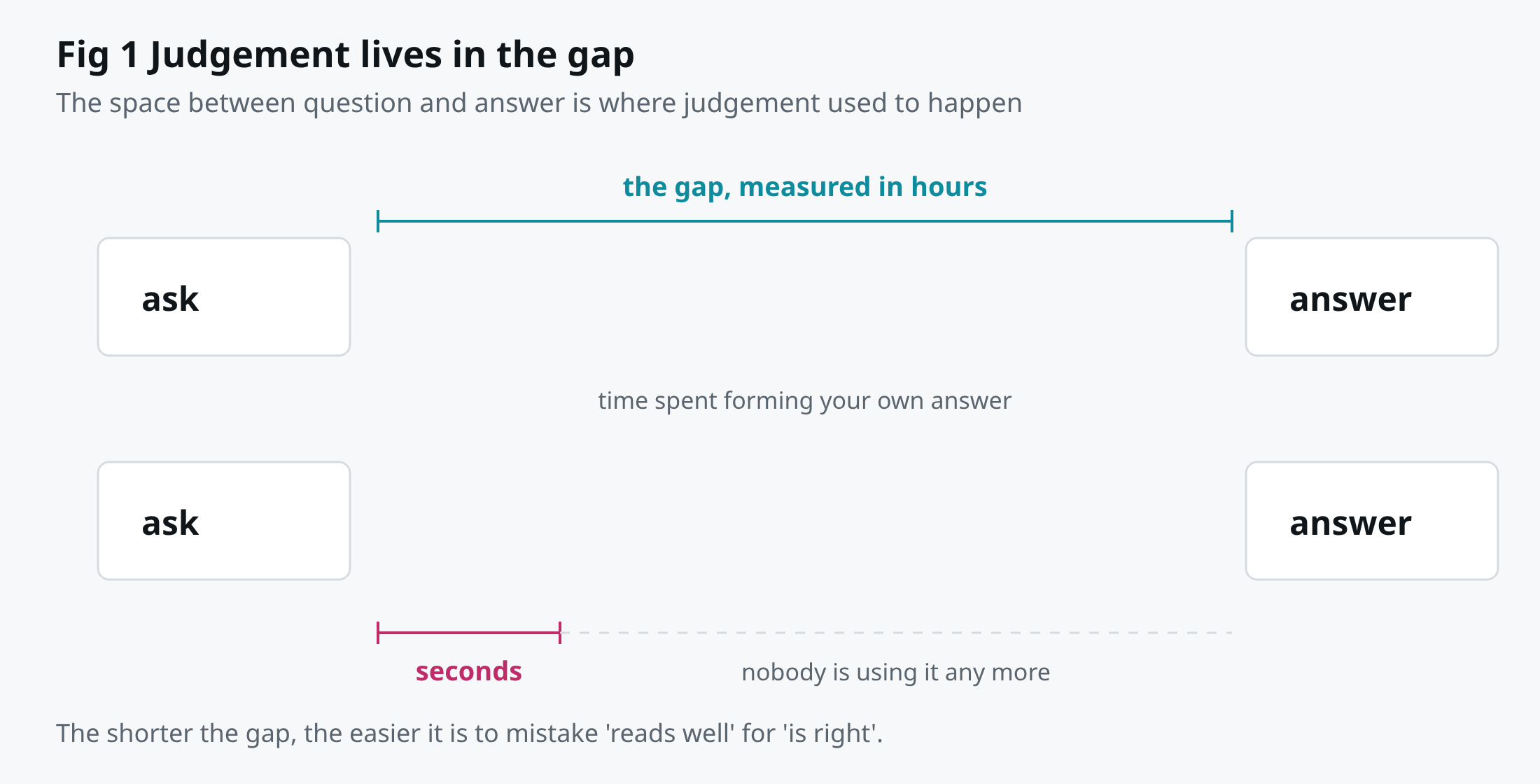
Osmani puts it in one line. Most output will be well written and mostly correct, and it will not demand a second look.
2. Three steps down
He describes a spectrum. It is easier to draw as a slope.
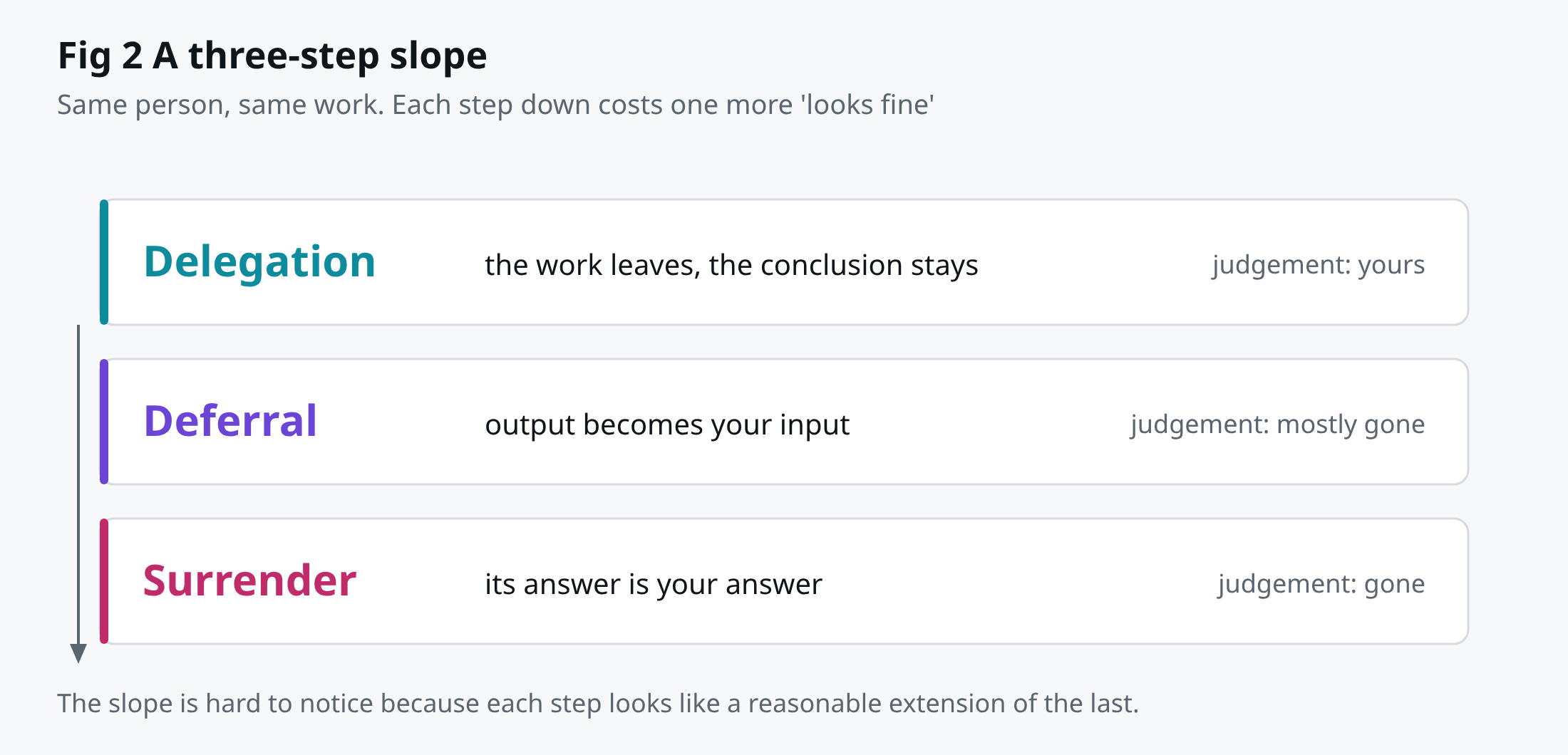
At the top sits delegation. The work leaves, the conclusion stays yours, and you check it once. In the middle sits deferral. Its output becomes your input and you stop doubting it. At the bottom sits surrender. Its answer is your answer, and you can no longer say what you would check.
The term cognitive surrender comes from Steven Shaw and Gideon Nave at Wharton, in a paper posted in January 2026. They extend dual process theory with a third system, System 3, meaning the thinking that happens outside your head.
Nobody catches the slide as it happens. You read the last answer carefully, so you skim the next one, then you scan the outline of the one after that. By the time someone in a meeting asks about a specific line, you cannot explain it.
The bill has a name. Tests stay green and the repository looks tidy while the team’s shared model of the system quietly thins out.
3. Two experiments, pointing opposite ways
Osmani’s piece works from experience. Two measurements are worth adding.
The first comes from Wharton. Three preregistered experiments, 1,372 people, 9,593 trials, using an adapted cognitive reflection test. Participants could consult an AI at any point, and the researchers flipped its accuracy behind the scenes with hidden seed prompts.
The result is a symmetric swing. Accuracy rose 25 points above baseline when the model was right and fell 15 points when it was wrong.
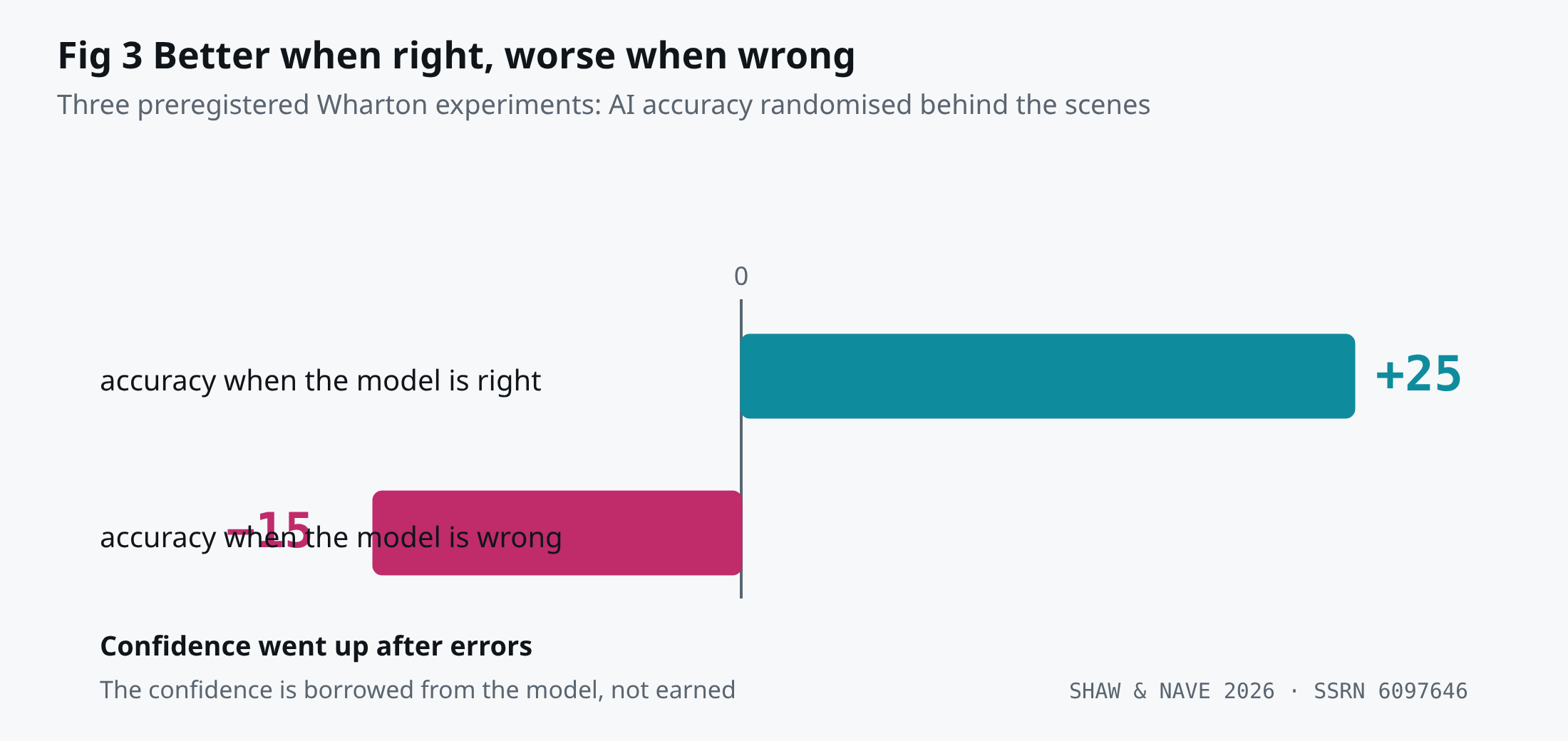
The part that stings is confidence. It went up after errors as well. That is the counter-intuitive one. People were borrowing the model’s certainty, and the model is certain about everything.
The second comes from Anthropic’s own randomised trial on skill formation. Engineers learned an unfamiliar Python library with AI help, then took a comprehension quiz.
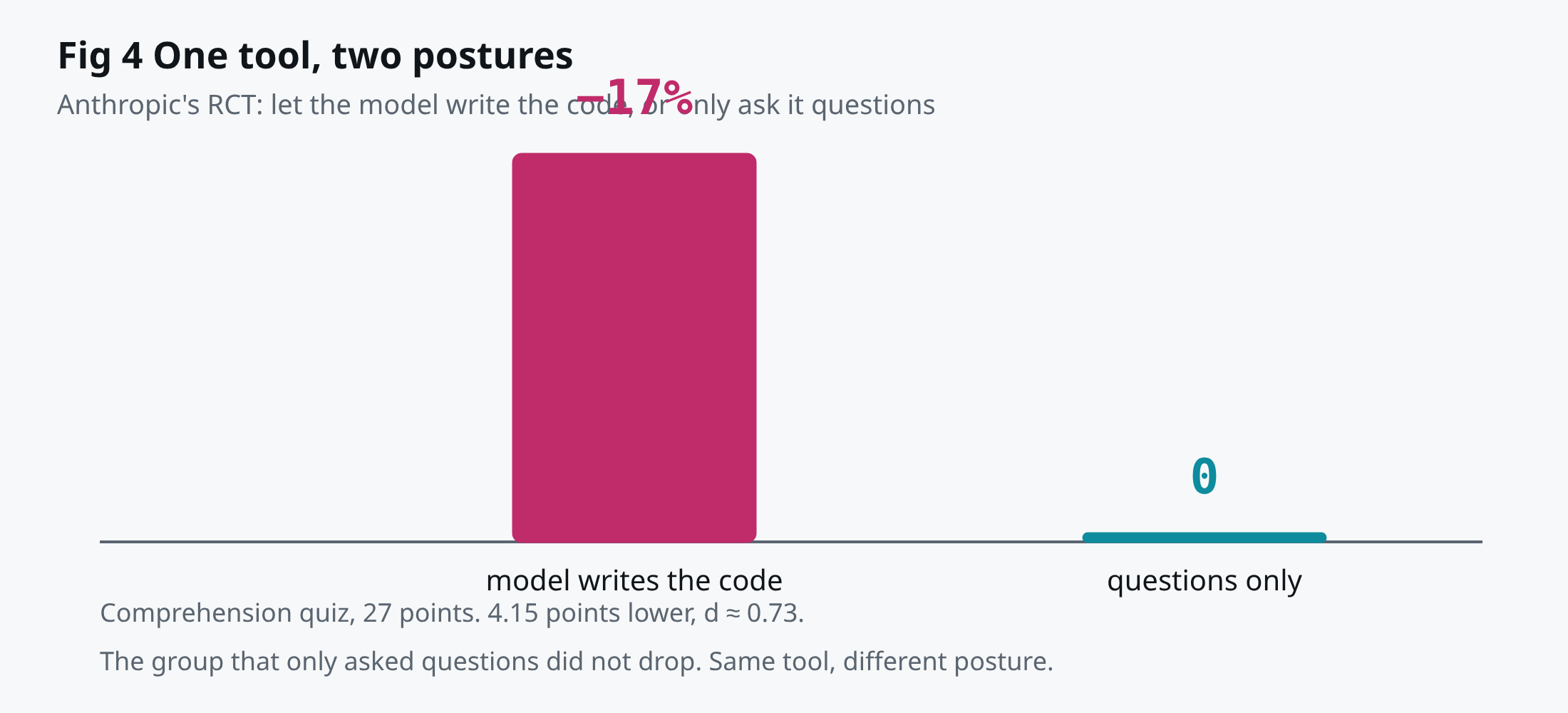
The group that used AI to generate code scored 17 percent lower than the group that wrote it by hand, 4.15 points on a 27 point scale. The group that used AI as something to interrogate, asking why the code looked the way it did, did not drop at all.
Read together, the two results hold up. The tool does not produce surrender. The posture does.
The numbers and where they come from
| Metric | Value | Source |
|---|---|---|
| Wharton experiment size | 1,372 people / 9,593 trials / three preregistered studies | measured, PsyArXiv yk25n_v1 abstract |
| Accuracy when the model is right | +25 points over baseline | measured, Study 1 |
| Accuracy when the model is wrong | −15 points below baseline | measured, Study 1 |
| Confidence after errors | rises | measured, same abstract |
| Effect size | Cohen’s h = 0.81 | measured, same paper |
| AI-generated code group, comprehension | 17% lower (4.15 of 27 points, d ≈ 0.73) | measured, Anthropic RCT |
| Question-only group | no drop | measured, same trial |
4. Five questions before you delegate
Osmani lists the questions he actually asks himself. I have compressed them into five.
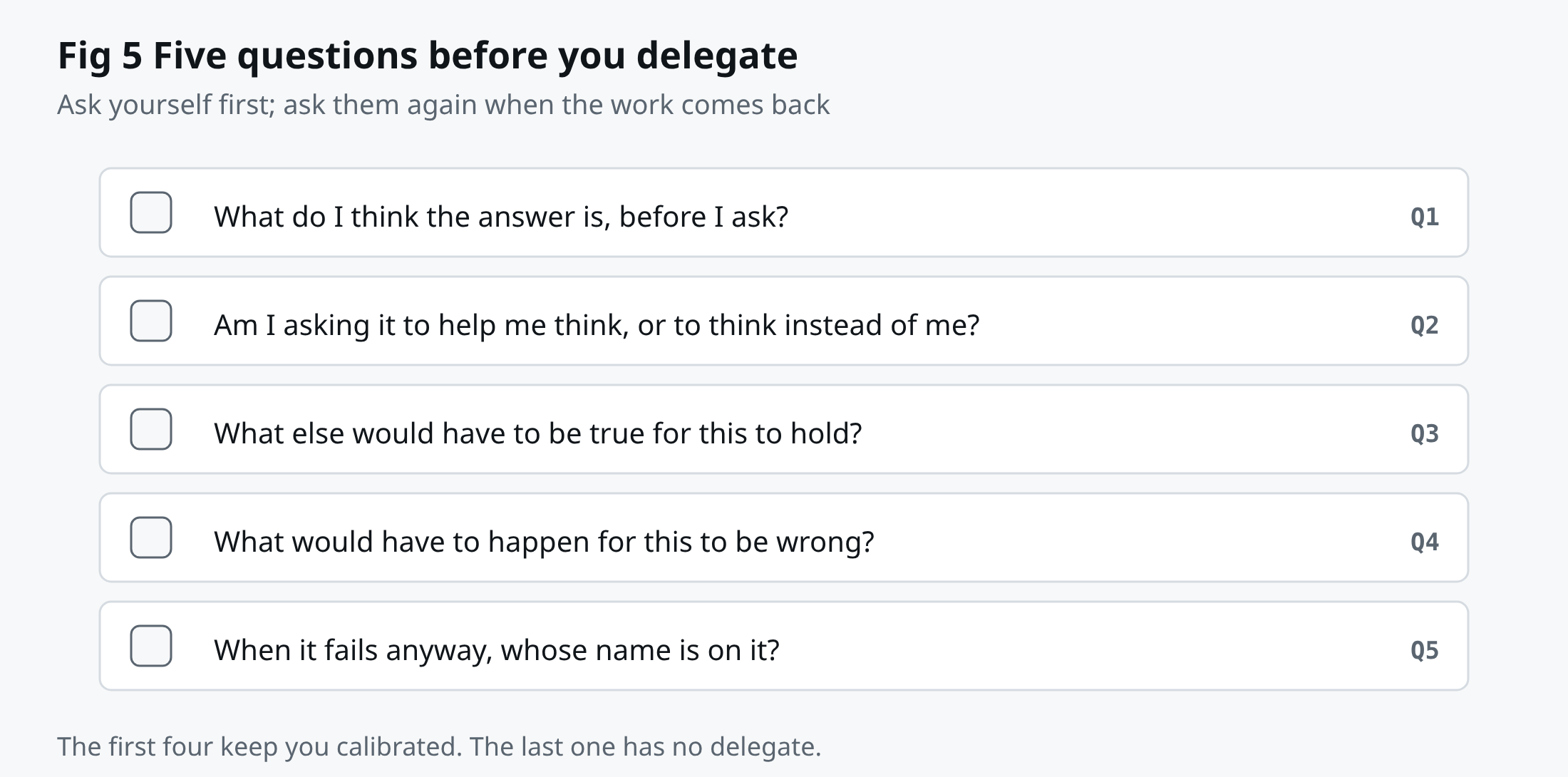
The first is to form an answer before you ask, even a wrong one. A well written reply makes every other possibility hard to imagine afterwards.
The second is to notice whether this is thinking with the model or thinking done for you. Both are legitimate. Knowing which one you are doing is the point.
The third asks what else would have to be true. The fourth inverts it and asks what would make the conclusion wrong, then goes and tests that.
The fifth is the one I would put first, not last. When this fails, whose name goes on it.
The first four keep you calibrated. The fifth decides whether calibration matters.
5. A green check proves one thing
On verification his piece is sharper than most writing on review. Surrender the checking too, and the question shifts from whether evidence supports the conclusion to whether the check went green.
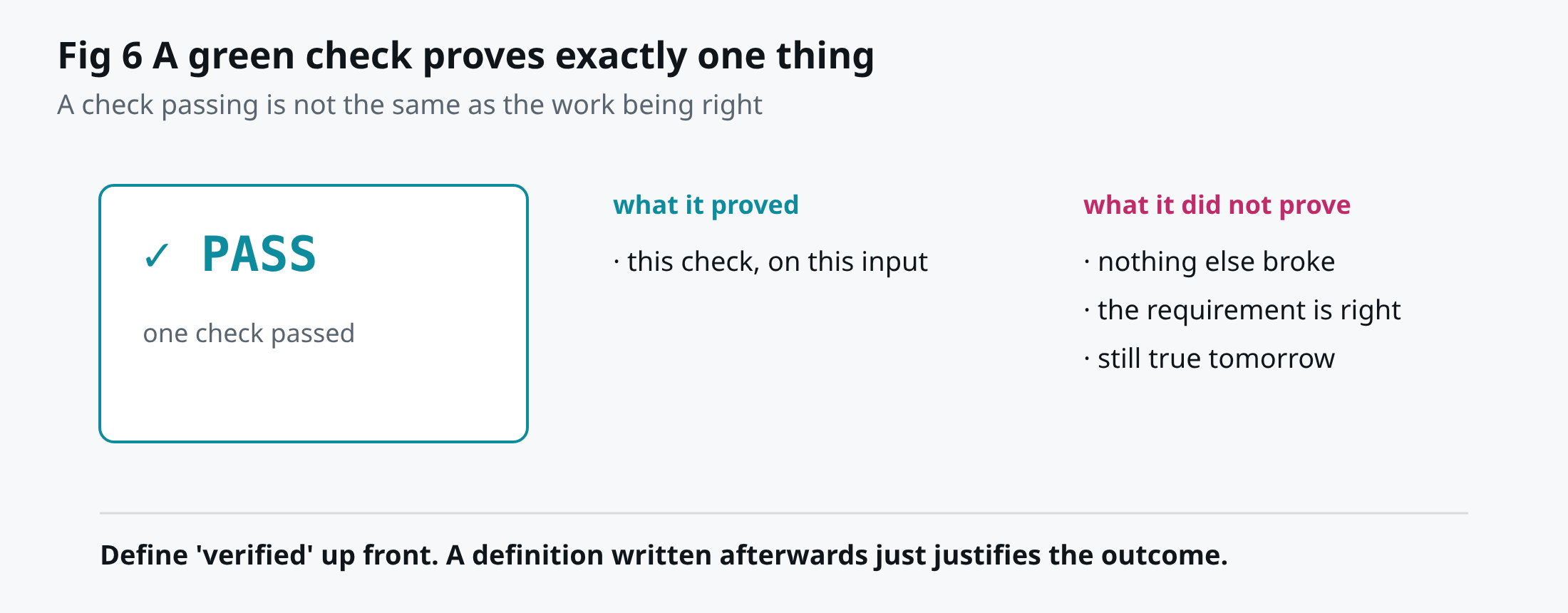
A passing check says one check passed, on this input. It does not say that nothing else broke, or that the requirement was right all along. If the test carries the same misunderstanding as the code, both go green together.
His remedy is to make finished mean something visible, a test that ran, a screenshot, a log line. Define verified before the work starts, because a definition written afterwards only justifies whatever happened.
There is an operational detail worth stealing. When an agent reports that it finished, read the command it ran and the output it produced before you read the summary. The summary is written in the voice of everything went well. The command and its output are not.
6. Where the argument is thin
Three places I would push back, and one number I would not repeat.
Delegation is not the problem. Osmani picks a hotel for a recording session from three similarly rated options, has no time to read the reviews, and hands the whole decision to a model. That was correct. His own line is the useful one. Hand off where being wrong is cheap, keep the reasoning where someone else pays for it.
You do not need the whole system in your head. The Claude Code team has said publicly that they rebuild understanding on demand, asking for an explanation of the slice in front of them. So the bar for cognitive debt can sit lower than total recall. Knowing which part you do not understand is enough.
The Wharton numbers do not transfer to code review. They used short questions with one right answer. A 600 line pull request is a different object. The 25 point swing tells you the direction, not the size of the effect in your repository.
The 73 percent figure from Osmani’s earlier post is not used here. The preprint abstract reports percentage point differences, and I could not reproduce 73 percent from the public material. Writing both numbers within a year is a reminder that second hand statistics need a trip to the source.
7. Three habits for this week
The argument only matters once it lands on a calendar.
| Cadence | Action | Why this one |
|---|---|---|
| Weekly | Write some real code without an agent | The point is calibration. If the feel is gone you cannot tell what is left |
| Monthly | Write down what you stopped doing by hand, then decide what stays outsourced | Skill loss is gradual. Written down, it becomes a choice |
| Every delivery | Put the acceptance check into config, a hook or a test | Taste compounds there. Next time the same class of problem gets stopped early |
The last line of his post is the one to keep. You may offload the work and much of the auditing, but not the accountability.
References
- Addy Osmani, Critical thinking in the age of agents (long form post on X, 2026-11)
- Addy Osmani, Cognitive Surrender
- Steven D. Shaw and Gideon Nave,
Thinking—Fast, Slow, and Artificial(PsyArXiv, SSRN 6097646, 2026-01), https://osf.io/preprints/psyarxiv/yk25n_v1 - Anthropic, How AI assistance impacts the formation of coding skills
- Anthropic, How AI Is Transforming Work at Anthropic