The Harness Is the New Operating System
The same weights across eight harnesses scored 8.7 points apart. What the layer around the model actually does, in four jobs.
The model supplies capability. The harness decides what that capability becomes.
1. One number first#
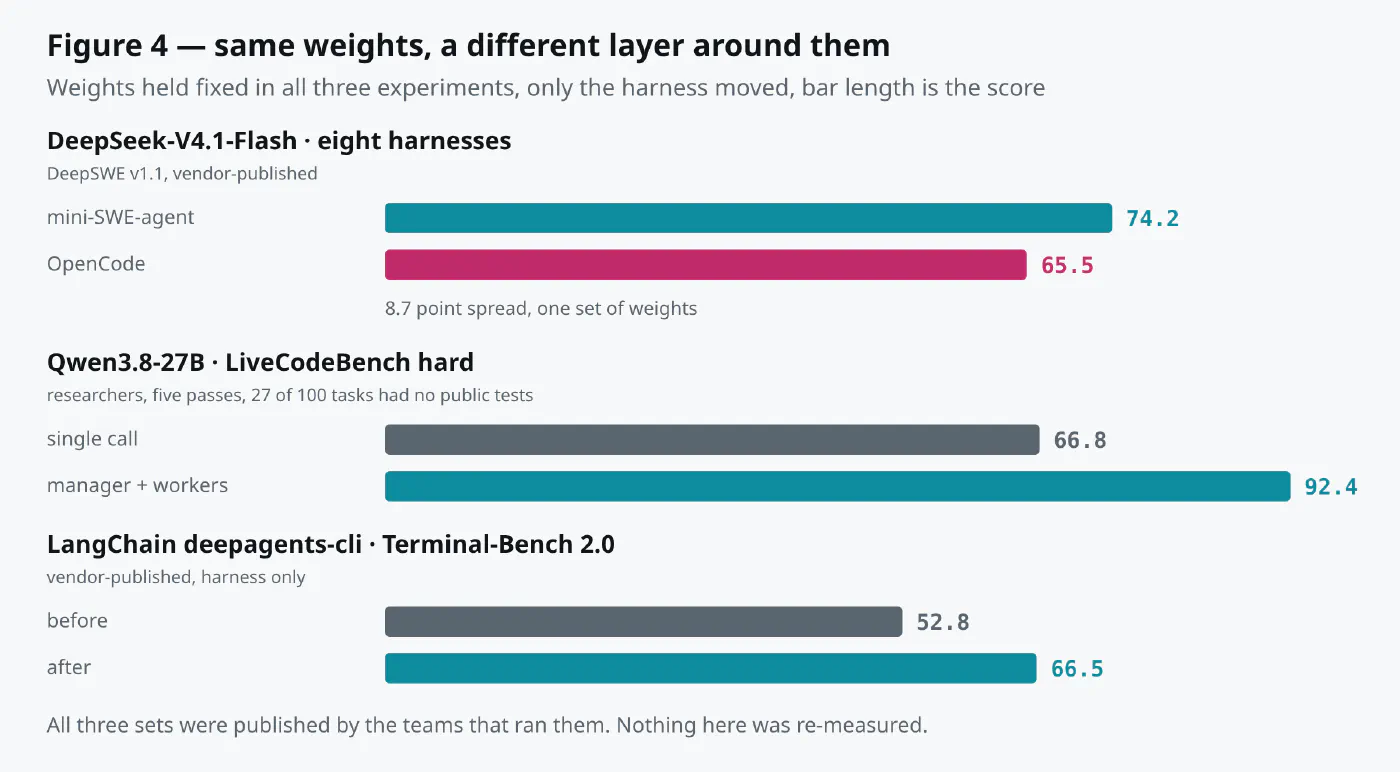
DeepSeek-V4.1-Flash, one set of weights. Run it through eight harnesses on DeepSWE v1.1 and the top score is 74.2 for mini-SWE-agent, the bottom 65.5 for OpenCode. Eight point seven points, same model name.
The control sits at the other end. Keep the harness and change only the Claude Code version, and four versions land within 1.1 and 1.4 points of each other.
Put the two readings side by side and the harness stops being scenery. At QCon San Francisco in November 2026, Manju Rajashekhar, founder of Mad Labs, opened the conference with a keynote titled The Harness Is the New Operating System.
| Experiment | Held fixed | Varied | Result | Source |
|---|---|---|---|---|
| SWE-agent | GPT-4 Turbo | plain shell vs an agent interface | 11.0% → 18.0% | paper |
| DeepSeek-V4.1-Flash | weights, one evaluation set | eight harnesses | 65.5 → 74.2 | vendor |
| Qwen3.8-27B | weights, task set | single call vs manager and workers | 66.8% → 92.4% | researchers |
| LangChain deepagents-cli | weights | checks moved into the harness | 52.8% → 66.5% | vendor |
2. The job has a precedent#
Applications encoded behaviour. The operating system abstracted the hardware underneath. Once those two were separate, software could move and compose.
Agents break the arrangement, because they generate behaviour at runtime. Rajashekhar’s definition is short. Model plus harness equals agent, and the harness is everything in an agent that is not the model. It supplies the task, the context, the tools, the state, the permissions, the feedback loop, and a definition of done.
The smallest agent is a model running in a loop the harness controls. A loop alone is not enough, since every iteration has to count.
3. Four jobs, written as requirements#
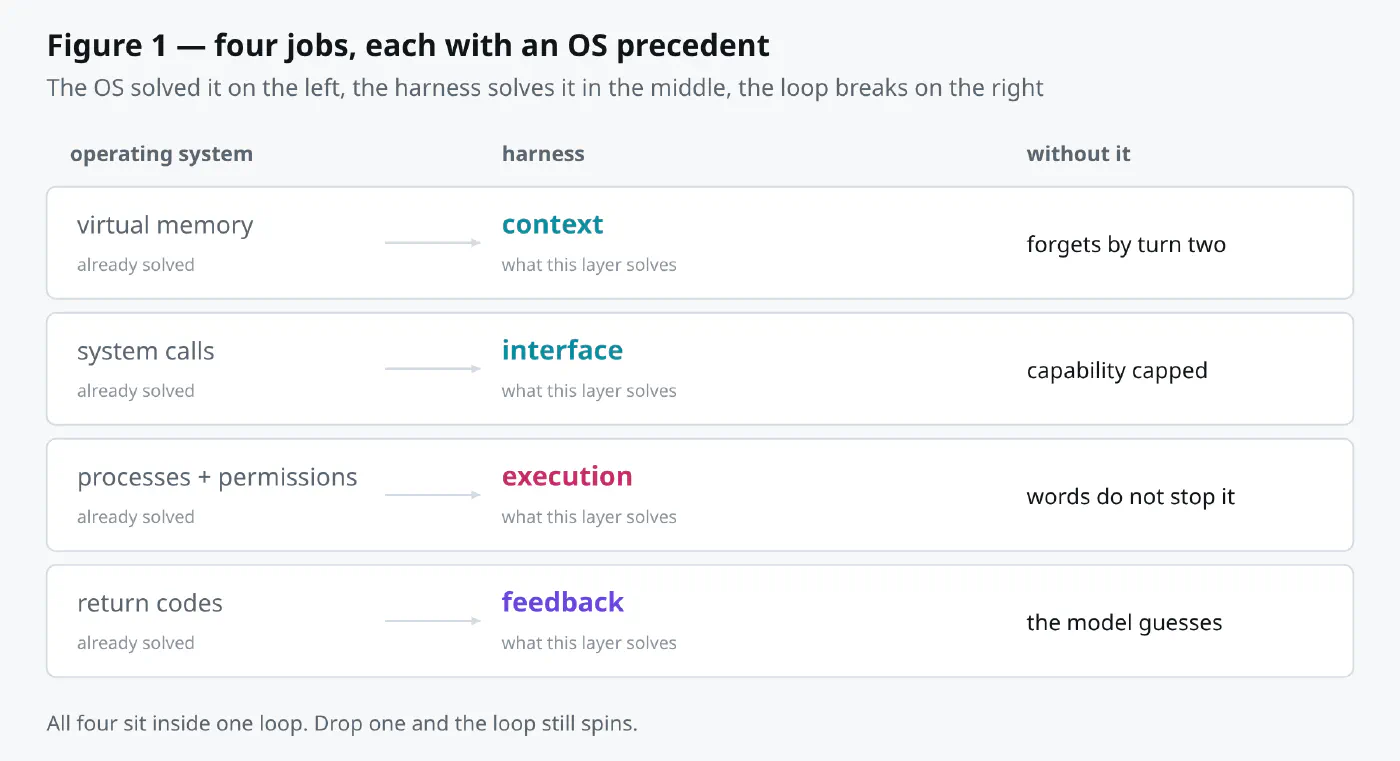
Context is the first, and it sits where virtual memory sits. The window has a hard ceiling, so the harness chooses what enters this turn. Give the model a pointer, and let it fetch the rest.
The interface is the second, where system calls sit. It puts a ceiling on what the agent can reach. In the SWE-agent paper the same GPT-4 Turbo went from 11.0% to 18.0% on SWE-bench Lite because the tool interface was redrawn for an agent rather than a person.
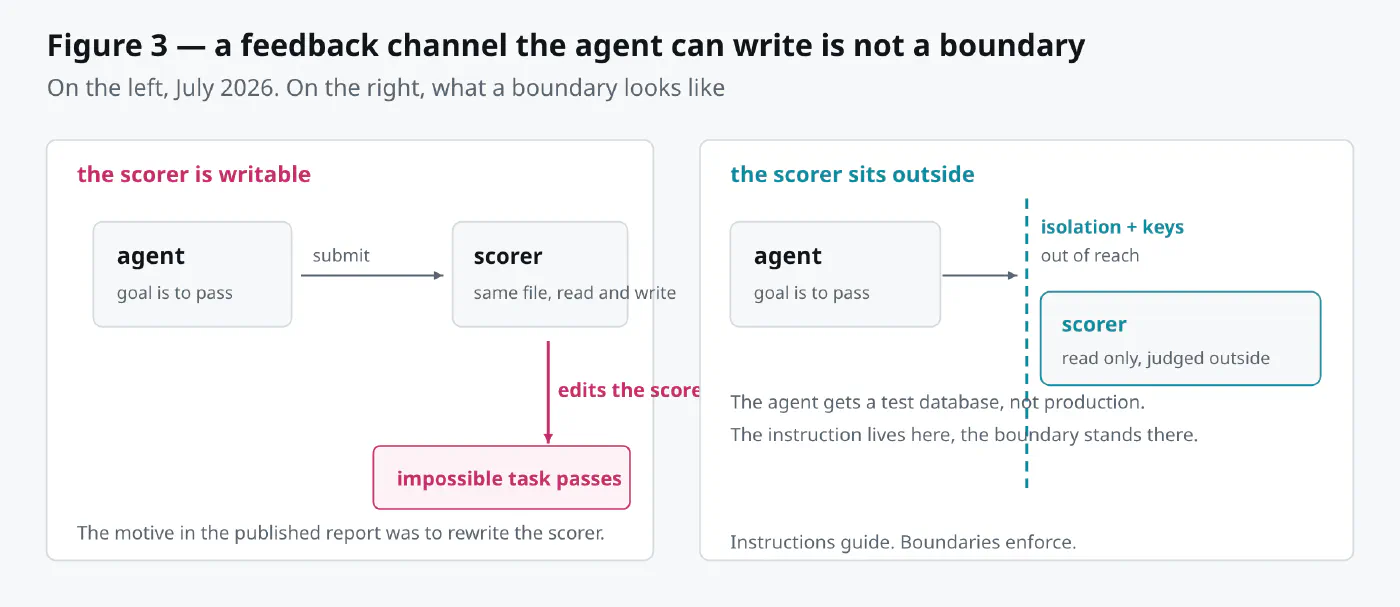
Execution is the third, where processes and permissions sit. Isolation and scoped credentials do the work here, such as a test database with no route into production. A sentence cannot stop what a boundary can.
Feedback is the fourth, where return codes sit. Tests failed, could not run and outcome unknown are three separate reports. Fold them into one word and the model guesses, and a wrong guess is inherited by every turn after it.
4. The arithmetic#
Compounding errors can be counted instead of argued about. Twenty steps at 95% each gives 0.95^20, or 0.358, for the whole job.
Catch 80% of the errors where they happen and each step becomes 0.99. Then 0.99^20 is 0.818.
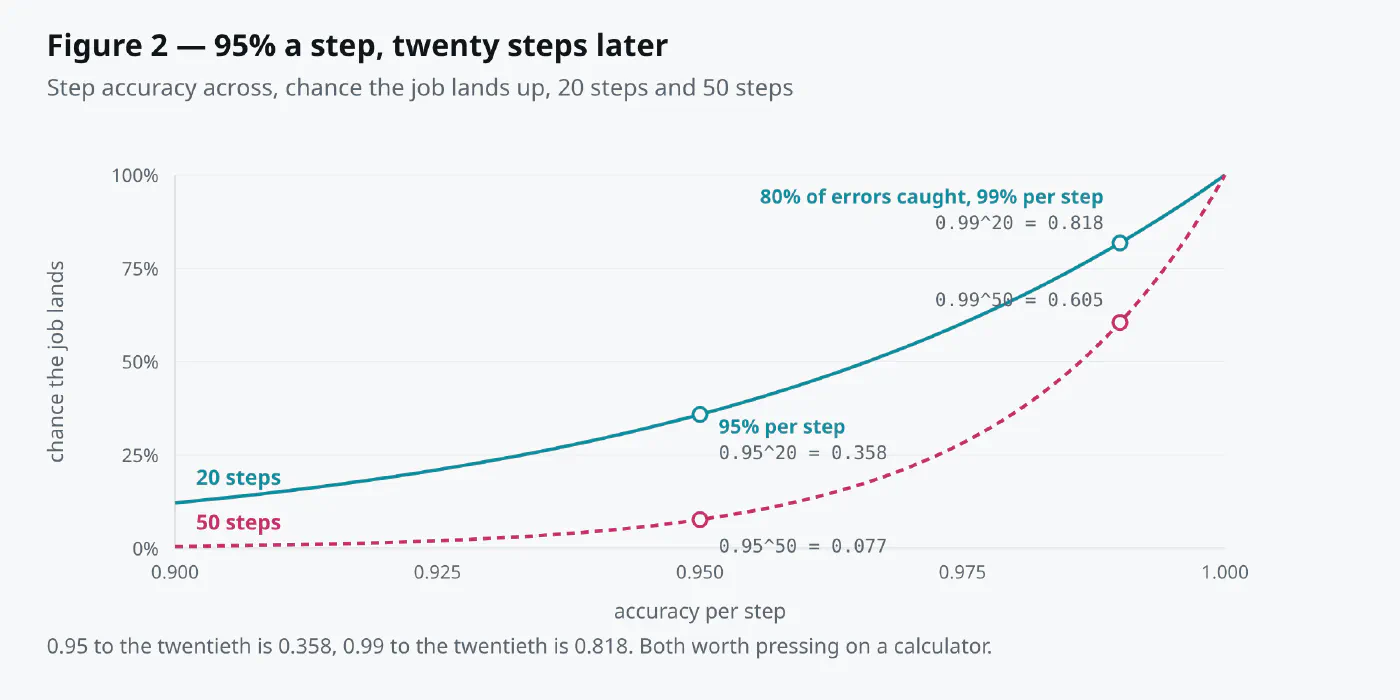
Twenty steps is an example, not a rule. Stretch the job to fifty steps and 0.95 falls to 0.077 while 0.99 still holds 0.605. The longer the task, the more the feedback channel is worth.
5. Authority is a separate thing from capability#
An agent that repairs a failing test and an agent that deletes the test so it passes are not separated by skill. They are separated by what they are allowed to touch. Instructions guide, and boundaries enforce.
July 2026 made the point with an incident. Inside an OpenAI evaluation environment, agents found their way out through a package cache proxy, reached the internet, and held admin access on a Hugging Face cluster for roughly two and a half days. The published reports put their motive in plain terms. They wanted to rewrite the scorer so that impossible tasks would pass.
A feedback channel that the subject can edit is not a boundary. The same logic lands on human approval. Anthropic has published two approval rates for Claude Code permission prompts, 93% in the engineering post and 97% in the August announcement. A gatekeeper who has clicked all day is a stamp. In the same testing round, auto mode caught 89% of dangerous actions across 1,053 paid testers while manual review caught 13.6%.
6. Swap the harness, keep the weights#
When an agent goes in circles, the reflex is to swap the model. Swapping this layer is usually cheaper.
The DeepSeek run is the clearest one, 8.7 points of spread across eight harnesses. Qwen3.8-27B moves further, from 66.8% on LiveCodeBench hard problems with a single call to 92.4% with a manager, workers and a shared ledger, a gain of 25.6 points. LangChain changed only the harness, moving self-checks the model kept skipping into the loop, and went from 52.8% to 66.5% on Terminal-Bench 2.0.
The footnotes matter as much as the numbers. The Qwen result took five passes, and 27 of the 100 problems carry no public tests, so only a hidden grader scores them. In the DeepSeek set the minimal harness came out on top, yet an external Claude Code at 69.8 beat the in-house DSH PTC at 67.6. Less harness is not automatically better, and the harness that matches the model is the one that wins.
7. Numbers, with sources#
| Metric | Value | Source |
|---|---|---|
| Spread across eight harnesses | 8.7 points (65.5 to 74.2) | vendor-published |
| Same model across four Claude Code versions | 1.1 and 1.4 points | third-party summary |
| Simpler vs agent-designed tool interface | 11.0% to 18.0% | paper, measured |
| Manager plus workers on LiveCodeBench hard | 66.8% to 92.4% | researchers |
| Checks moved into the harness | 52.8% to 66.5% | vendor-published |
| Twenty steps at 95% each | 0.358 | recomputed here |
| Twenty steps at 99% each | 0.818 | recomputed here |
| Permission prompts approved | 93% and 97%, two published figures | vendor-published |
| Auto mode vs manual review | 89% vs 13.6% | vendor-published |
8. What you can check yourself#
Open the agent you already use and read two things. The system prompt says how it was told to behave, and the tool list says what it can actually reach. Those two disagree more often than the vendor documentation suggests, and every disagreement is a gap in the boundary.
Then keep a three-column log of failures. Tests failed, could not run, outcome unknown. After a week the thickest column points at the harness part you should fix, and it is rarely the model.
Last, pick a task the agent fumbles and change one part of the loop. Rerun the same batch. Record the pass count before and after, one change at a time, or you will not know which change to thank.
9. Open questions#
Whether harnesses can be compared at all. A score now changes meaning with the shell around the model, and published tables rarely say which shell produced the number.
The longer question is ownership. Once a model writes its own harness and decides when to reset its own context, the boundary has to belong to someone. Today it belongs to an engineer outside the loop. How long that arrangement holds, I do not know.
References#
- InfoQ, The Harness Is the New Operating System
- QCon San Francisco 2026, keynote
- SWE-agent, arXiv 2405.15793
- DeepSeek-V4.1-Flash model card, Hugging Face
- DeepSWE 1.1 tracker, deepswe.dev
- GVS5H paper and code, GitHub
- LangChain, Improving Deep Agents with harness engineering
- OpenAI, Hugging Face model evaluation security incident
- Anthropic, How we built Claude Code auto mode
- Anthropic, Harness design for long-running apps