One person as a creative team: what transfers from Dan Koe's letter
Dan Koe splits the creative director job into brand strategy, content strategy, and writing plus ops, then wires the three together with a nine block interview. This piece checks the three numbers that carry the urgency and marks the three things a technical reader should not copy.
In one line: the part worth carrying away is the job split. It cuts the creative director role into brand strategy, content strategy, and writing plus ops. The price tags, the product plugs and the growth numbers belong to the sales side of the letter.
Dan Koe published a long letter in November arguing that the most lucrative skill has always been capturing attention. Three numbers carry the urgency, three job descriptions carry the method, and one concrete move closes it, write ten posts for a dream client for free and put the finished work in front of them.
The letter is a sales letter. The author founded Eden and promotes it here alongside a 49 dollar writing workshop. Naming that up front does not take anything away from the job split in the middle.
1. Three numbers, none of them a census#
Three numbers carry the acceleration in the letter, and all three are real, each on a different basis.
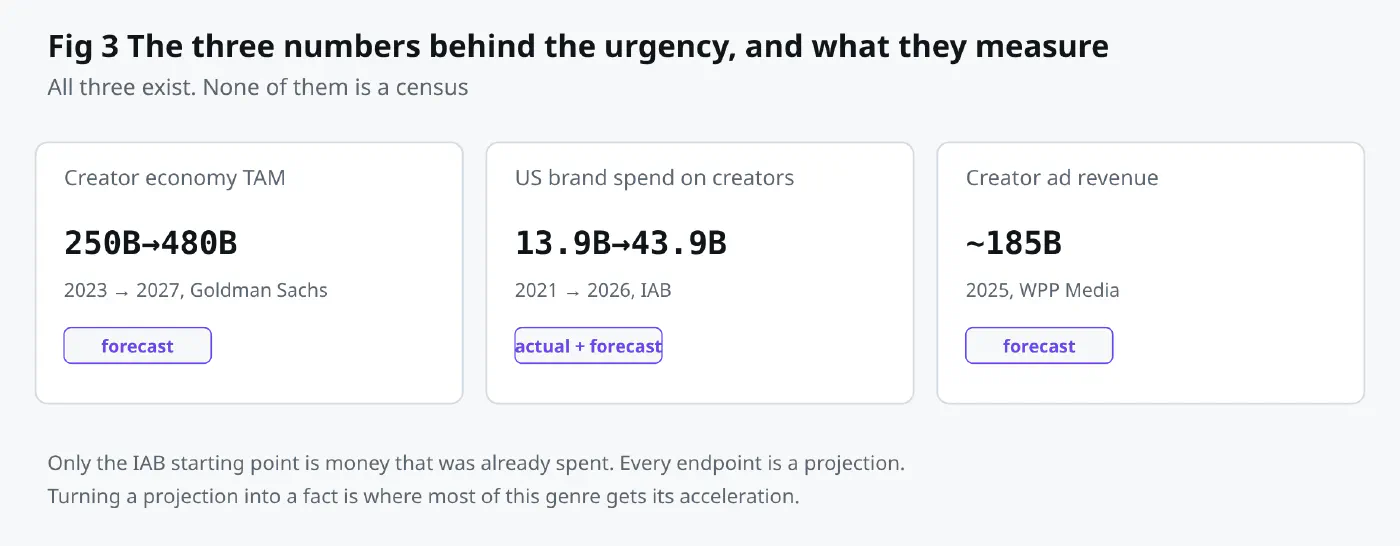
Goldman Sachs Research published a note in April 2023 putting the creator economy’s total addressable market at 250 billion dollars, heading for roughly 480 billion by 2027. That is the firm’s own model, not a market census.
The IAB’s creator ad spend report tracks what US brands actually spend, 13.9 billion dollars in 2021, 29.5 billion in 2024, 37.1 billion in 2025, with 43.9 billion as the 2026 forecast. The letter calls that tripling in five years. Both endpoints are right, and the second one has not happened yet.
The third comes from WPP Media’s mid 2025 forecast, which put creator platform ad revenue above traditional media for the first time, with creators taking about 185 billion dollars. Forecast again.
| Metric | Value | Source | Kind |
|---|---|---|---|
| Creator economy TAM | 250B → 480B dollars | Goldman Sachs Research, 2023-04 | forecast |
| US brand spend on creators | 13.9B (2021) → 43.9B (2026) | IAB | measured + forecast |
| Creator ad revenue | about 185B dollars (2025) | WPP Media | forecast |
Together these say only that attention is moving onto social platforms and the pool is large. They do not support the claim that making content pays off for the person making it, because not one of the three describes how outcomes are distributed across individuals.
2. What is actually on offer#
Take the sales side away and a job table is what remains.
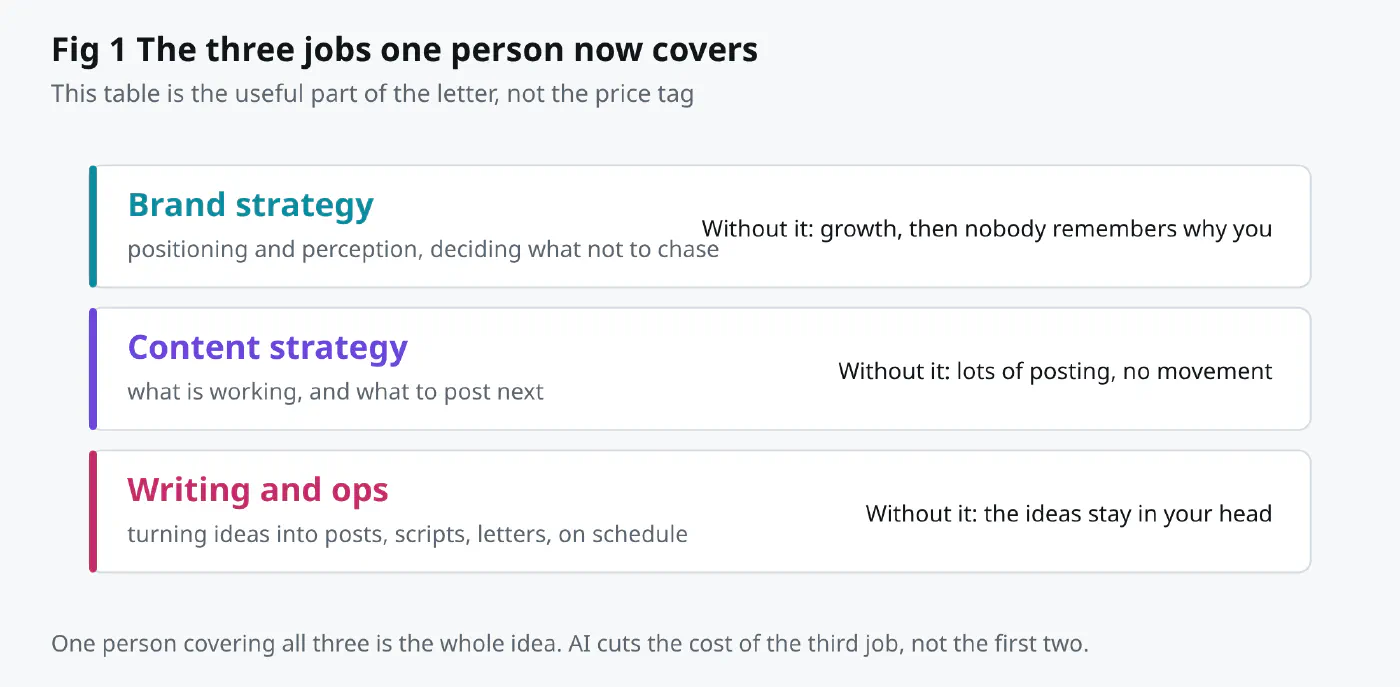
Brand strategy owns positioning and perception, and its first duty is deciding what not to chase. Content strategy owns what is working right now and picks the next topic. Writing and ops turn ideas into posts, scripts and letters, and get them out on schedule.
In a traditional company those are three hires. One person covering all three is where the phrase comes from. Koe’s read is that AI cuts the cost of the third job while the first two stay human. He quotes a client saying revision time fell from twelve hours a day to four, with the remaining time going into judgement and rewriting.
That quote arrives without any underlying data, so it reads as advertising copy.
3. Nine question blocks, and they are a context protocol#
The most usable part is the interview.
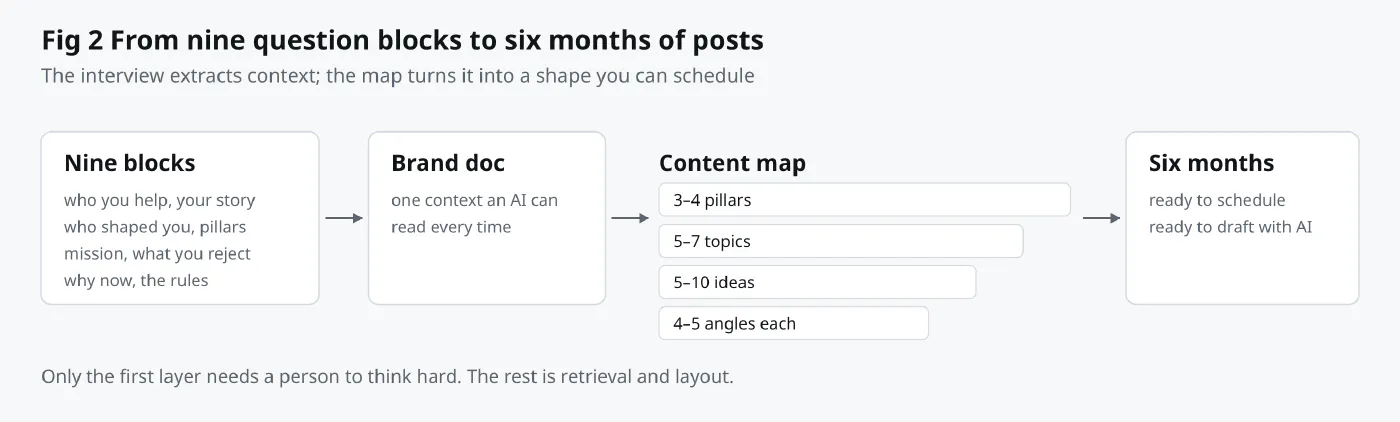
The nine blocks ask who you help, what your story is, who shaped your thinking, which content pillars you own, what your mission and beliefs are, what you are against, why this matters now, where you take people, and finally your rules and your own vocabulary. That last block is the one people skip, and it is the one that forces you to name your method.
Two documents come out. A brand document holds the answers, and a content document holds the person’s best past work. Feed both to a model and ask for a content map, which is four layers deep, three or four pillars, five to seven topics under each, five to ten ideas under those, and four or five angles per idea. Multiplied out, that is roughly six months of scheduled posts.
Nothing here is new to anyone who has built retrieval contexts. The move is applying context engineering to a person.
4. The cold start#
The closing story belongs to JK Molina. Pick a target client, write ten posts for free, send them over with a note saying you do not need a reply, use them if they are useful, and a line of feedback is enough.
Koe calls it the best way he has seen to land a client. To an engineer it looks familiar. It is the same move as opening a pull request that already runs before asking for a design discussion, and it shifts the cost of being convinced from the buyer to the seller.
He also shows the public version. Someone posted a short video titled Grant Cardone needs a new creative director, and this is my application. Cardone replied. Both versions rest on the same condition. The target is specific and the work is usable on arrival. Aimed anywhere else it is spam with extra steps.
5. Three things a technical reader should not copy#
Most readers here work on infrastructure, and lifting this playbook wholesale runs into three walls.
Attention is not the only variable in B2B infrastructure. The buyer needs numbers, integration cost, and a clear answer to who owns the failure. One well run benchmark post does more than thirty daily posts, because the benchmark can be forwarded to a colleague who has to approve the spend.
A daily cadence costs an engineering team more than it returns. Koe’s product is a personal brand, so posting is part of the product. An engineering team’s product is a system, and a daily content habit eats the maintenance and review time that keeps it alive.
The price is not an average. Ten to seventy five thousand dollars a month across one to three clients is what an established personal brand charges. Treating it as an entry ticket turns content back into a lottery.
6. If you keep one thing#
Use the three jobs as a checklist.
Before publishing anything outward, answer three questions. What perception is this supposed to build, which is brand strategy. Which reader’s problem does it solve today, which is content strategy. When and where does it go out and in what shape, which is writing and ops.