Personal agents in 2026: where the isolation boundary sits, and who owns the memory
Seven personal agents landed on one list in 2026. Written out as a table, the ranking stops mattering and three things stay checkable, where the isolation boundary sits, who owns the memory file, and who pays for the tokens while nobody is watching.
In one line: the split in this category runs along where the isolation boundary sits and who owns the memory file. Both are written down in vendor docs, just never side by side.
1. Twelve months, a weekend project, a product line#
Clawdbot started in November 2025 as a weekend project by Peter Steinberger and went viral in January 2026. By 2.0 (v2026.8.1, 31 August 2026) the code carried 933 contributors, and v2026.6 already spoke to 26 messaging channels.
Four more vendors shipped their own take inside the same year. Google announced Gemini Spark at I/O on 19 May, Meta announced Muse on 8 September, OpenAI announced dots at DevDay on 29 September, and Perplexity folded its Mac-side Personal Computer into a subscription. Twelve months took a weekend project to a standing product line at five companies.
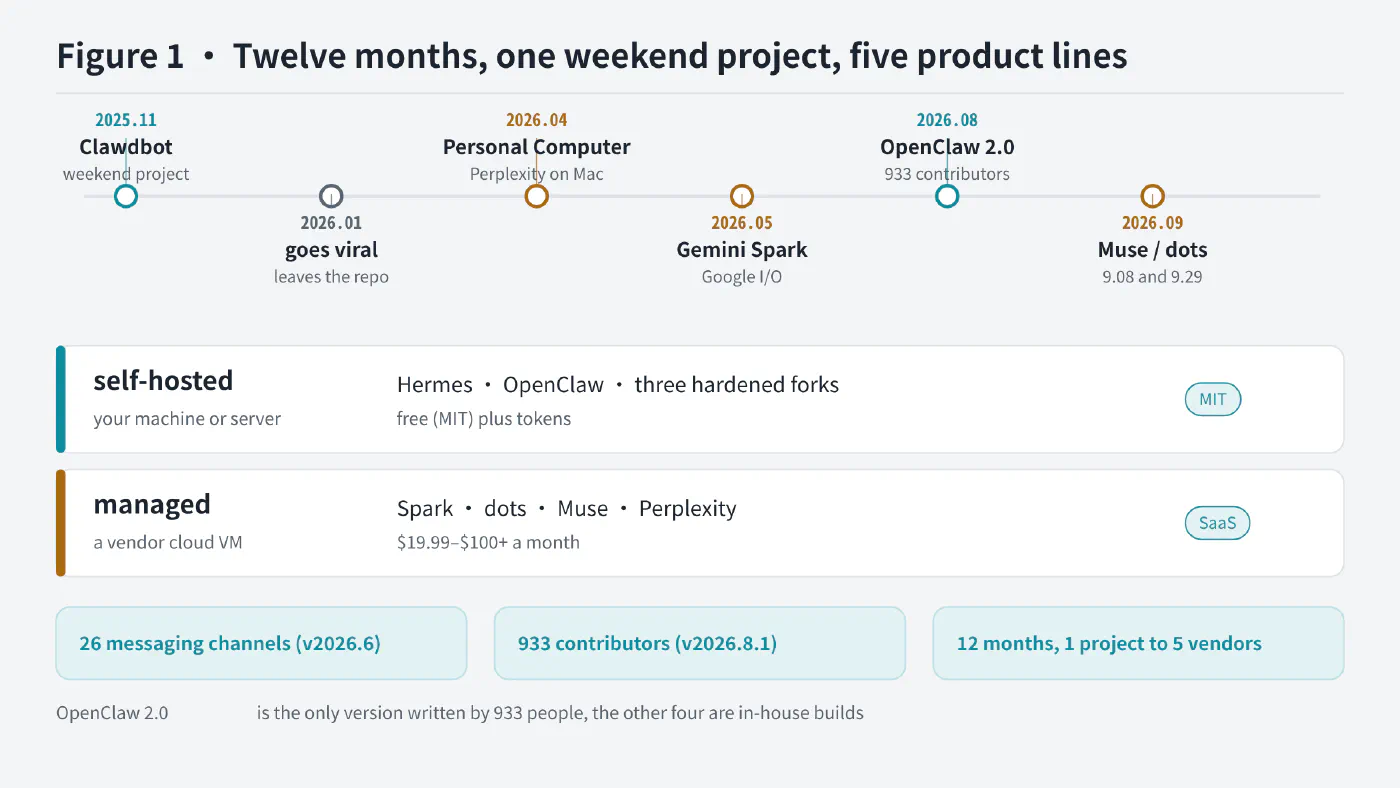
Cut by where the code runs, the seven products fall into two camps. Self-hosted runs on your machine or your server with a model you pick, and holds Hermes Agent plus OpenClaw and three hardened forks. Managed runs on a vendor’s cloud VM with compute inside the subscription, and holds Spark, dots, Muse and Perplexity. Every section below leans on that cut, because it decides where memory lives, where the boundary sits, and whose card gets charged.
2. The table, with the parameters#
| Product | Runs on | Entry price |
|---|---|---|
| 1 Hermes Agent | Your machine or server | Free (MIT) plus tokens |
| 2 OpenClaw | Your machine or server | Free (MIT) plus tokens |
| 3 Gemini Spark | Google Cloud VM | $19.99/mo |
| 4 OpenAI dots | OpenAI cloud computer | Included in Pro |
| 5 Meta Muse | Meta cloud VM | Free, $20 / $100 |
| 6 Perplexity | Your Mac plus cloud | Pro or Max |
| 7 NanoClaw and two others | Container, WASM, Rust binary | Free plus tokens |
Memory and the security default get their own table, because those two cells hold the longest text.
| Product | Memory | Security default |
|---|---|---|
| 1 Hermes | MEMORY.md, USER.md, SQLite | Denied on timeout, denylist |
| 2 OpenClaw | Editable Markdown, SQLite | Full host access unless sandboxed |
| 3 Spark | Google account, connected apps | Asks before money or email |
| 4 dots | Chats, ChatGPT memory, notes | Research read-only, no passwords |
| 5 Muse | Learns preferences, forgets | Sentinel gates the network |
| 6 Perplexity | Not detailed publicly | On-device auth, 2FA, audit |
| 7 NanoClaw etc. | Varies by project | Isolation on by default |
The ranking is the source’s fit score for one person, not a capability ordering. Across both tables, the two least consistent columns are memory and the security default, which happen to be the two things you cannot carry to the next product.
3. Memory: three owners, and what survives a new machine#
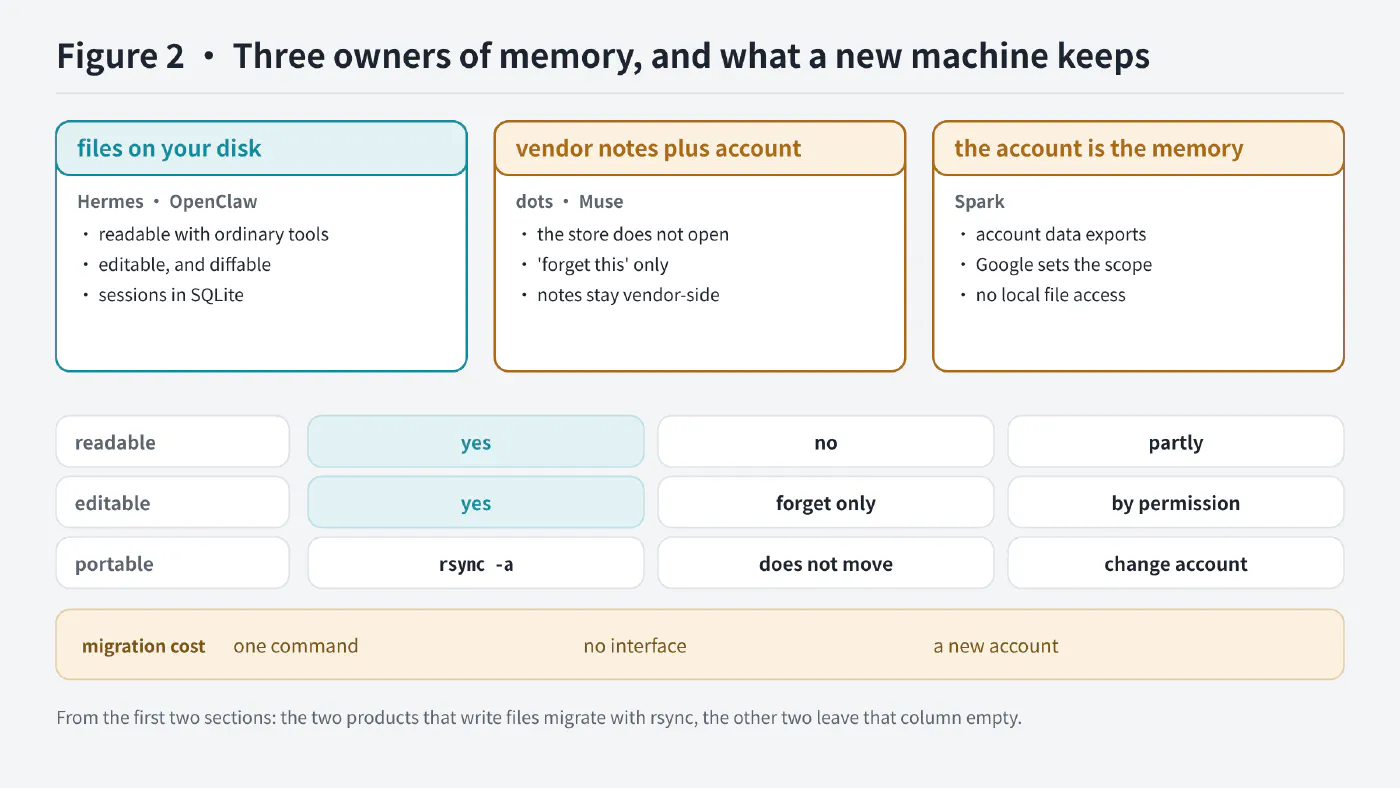
Hermes writes memory as files. MEMORY.md holds durable conclusions, USER.md holds who you are, session history goes into SQLite with FTS5 full-text search, and finished complex tasks turn into skills in the agentskills.io format. The /learn command turns a workflow into a slash command without hand-writing a SKILL.md.
OpenClaw spreads behaviour over a few Markdown files. SOUL.md is the persona, TOOLS.md holds the tool rules, USER.md holds what it knows about you, and 2.0 moved sessions and transcripts into SQLite. All of it opens with git diff and copies with the directory.
dots and Muse each keep their own notes on top of the account context. You can ask them to forget something, and you cannot open the store. Spark goes further, since its memory is your Google account, read through Personal Intelligence from the apps you connect. Google has not published an editable memory file in the Hermes shape.
| Owner | Examples | A new machine |
|---|---|---|
| Files on your disk | Hermes, OpenClaw | rsync -a moves it |
| Vendor notes plus account context | dots, Muse | does not move |
| The account is the memory | Spark | you change accounts |
The first row migrates with rsync -a ~/.hermes ./, which you can check without installing anything. The last two rows leave that column empty.
4. Security: the same word, five different layers#
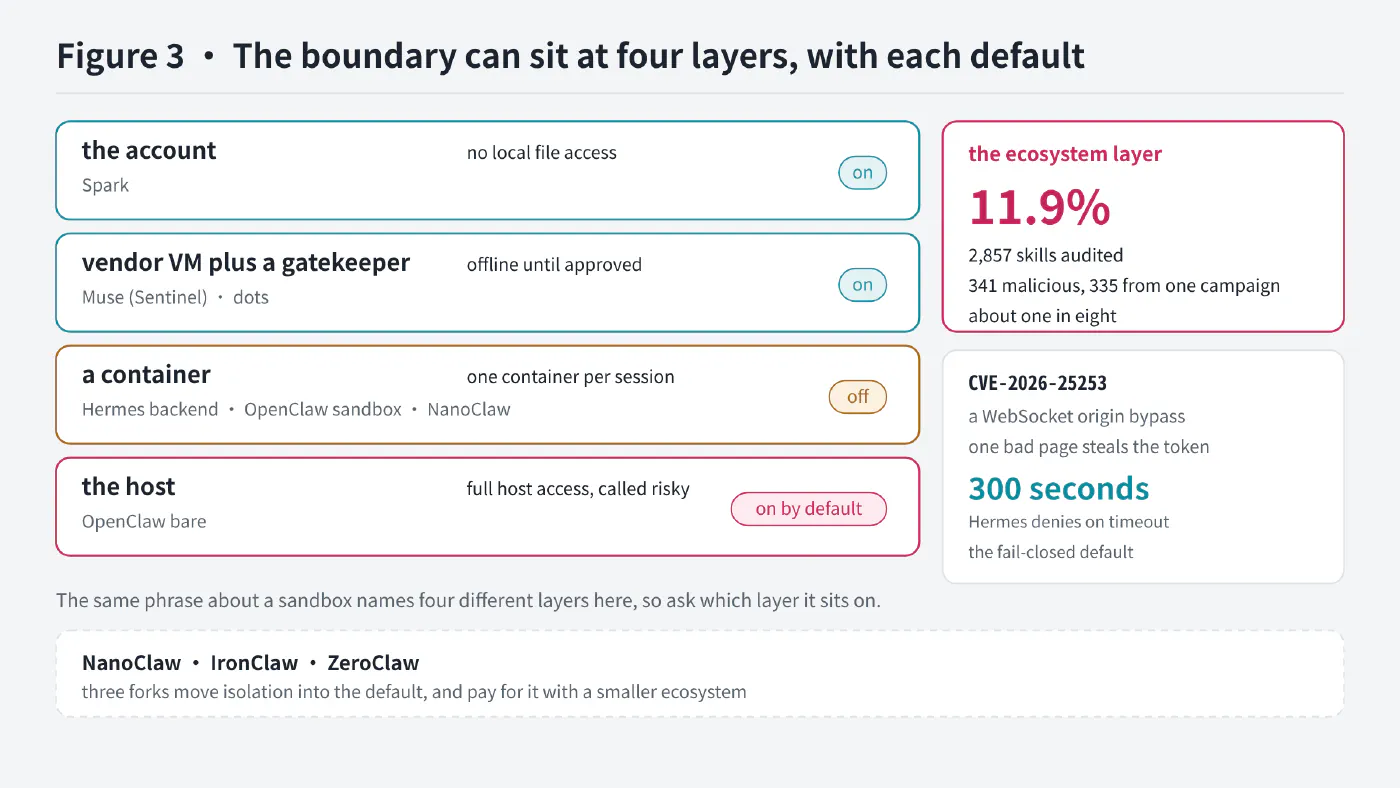
On the managed side, Muse publishes the most detailed design. Muse Secure VM is a dedicated machine holding the agent and your data together, with a separate Sentinel agent on the same VM isolated at the system level. Muse has no internet access until Sentinel approves it, and Sentinel asks you when it needs to. Credentials sit in storage Muse can use but not read, and checkout runs through Stripe’s Link with one-time cards.
Hermes defaults to failing closed. An approval prompt nobody answers is denied after 300 seconds, and your own deny rules survive YOLO mode. The SECURITY.md says the load-bearing sentence itself, that a denylist does not sandbox a hostile or compromised agent, so the real boundary is the container backend, meaning Docker, Modal, Daytona or Vercel Sandbox.
OpenClaw defaults to full host access, which WIRED called incredibly risky. The sandbox is opt-in and strong once enabled, one Docker container per session with no network egress, a read-only root and every capability dropped. The design is solid; the default is off.
The ecosystem numbers deserve copying into your notes. Koi Security audited 2,857 ClawHub skills and found 341 malicious, 335 of them from one campaign tracked as ClawHavoc. Antiy CERT later counted 1,184, without publishing the denominator, so that number describes scale and not a rate.
341 / 2857 = 11.9%, roughly one malicious skill in eight. OpenClaw’s answer was to scan every upload with VirusTotal and re-scan daily, and 2.0 added protected credential requests plus a team-scoped Secret Store.
The entry hole was CVE-2026-25253, a WebSocket origin bypass where a visit to a malicious page was enough to steal auth tokens, patched quickly. The three forks move isolation into the default. NanoClaw runs each agent group in its own Linux container that sees only mounted paths, IronClaw is a Rust rewrite with untrusted tools in a WebAssembly sandbox, and ZeroClaw is a minimal Rust binary that reportedly runs on $10 hardware under 5MB of RAM.
5. Cost: the subscription is a down payment#
Self-hosted software is free under MIT, and the bill lands on tokens and hosting, with managed hosts quoting $12 to $49 a month. A managed subscription wraps compute and model into one number, with usage limits on top.
The idle part is what a price page hides. The source survey puts it plainly, that heartbeat checks, scheduled jobs and proactive research all call the model. At one heartbeat every five minutes, that is 288 wake-ups a day and 8,640 a month, and at 2,000 prompt tokens per call it is 17.28 million input tokens a month.
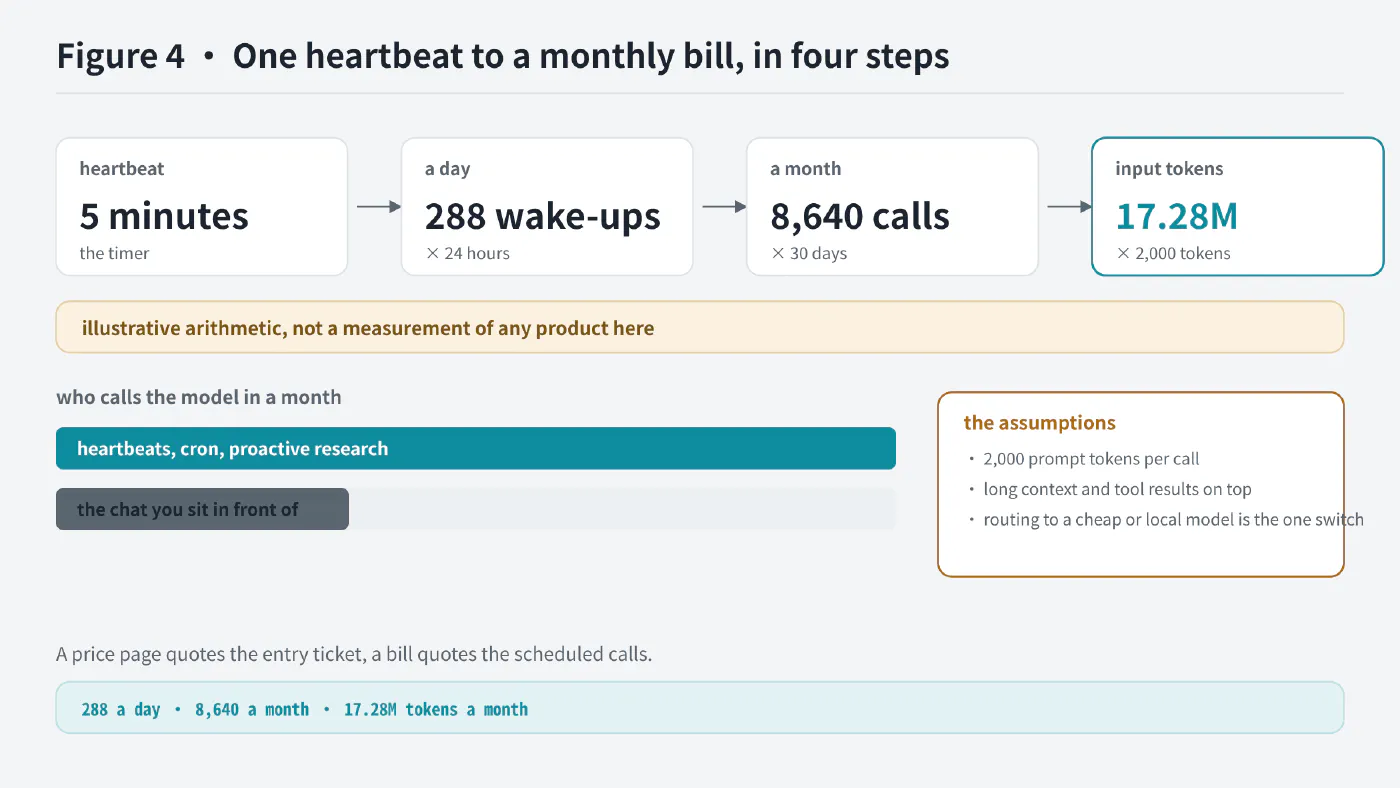
That number is an order of magnitude, not a measurement of any product in the table. Long context, tool results and retries push it up. Part of a resident agent’s bill is spent while you are not looking at it.
Entry prices moved fast this year as well.
- Spark launched on the $99.99 AI Ultra plan and joined the $19.99 AI Pro plan in July 2026, an 80% cut to get in
- The first dot is included, chatting with it does not count against ChatGPT limits, and Codex and Work tasks do; BGR reports the entry plan as Pro 200 or Business Premium rather than the $100 tier, the reports disagree here, so check the plan page before buying
- Muse has a free tier alongside $20 and $100 plans
- Perplexity needs Pro or Max, which Rework lists at $17 and $167 on annual billing, with cloud work consuming credits
A price page quotes the entry ticket and a bill quotes the number of scheduled calls. The two are separate on the self-hosted side and packed into one figure on the managed side, so comparing the headline numbers across camps measures nothing.
6. Picking by situation#
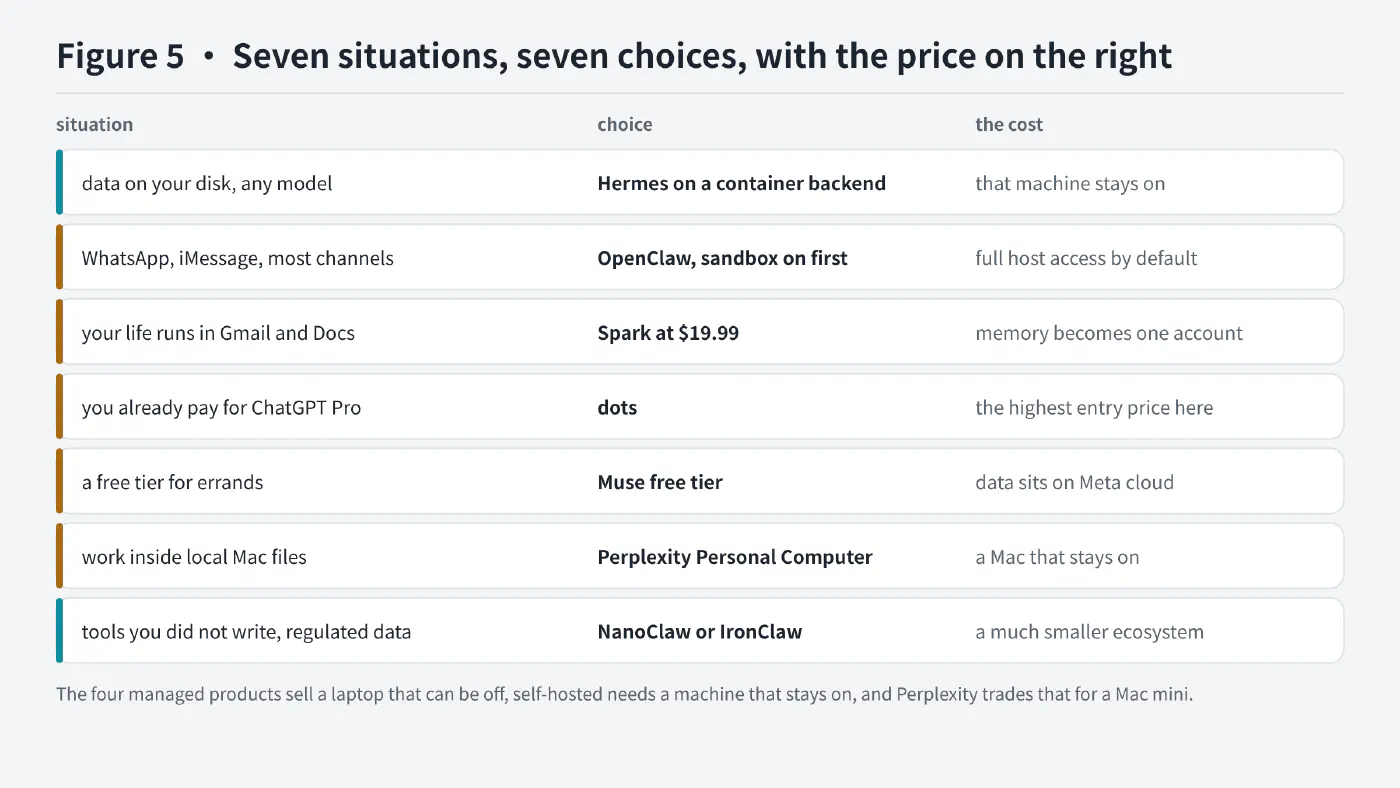
- Your data stays on your disk and any model will do, take Hermes on a container backend, and accept that the machine has to stay on
- You need WhatsApp, iMessage and the widest channel list, take OpenClaw with the sandbox enabled first
- Your life runs in Gmail and Docs, take Spark at $19.99, and accept that memory is now one Google account
- You already pay for ChatGPT Pro, take dots, whose cross-channel memory is the cleanest here, at the highest entry price in the table
- You want a free tier for errands, take Muse
- The work is in local files and native Mac apps, take Perplexity Personal Computer, which the vendor suggests pairing with a Mac mini that stays on
- You run tools you did not write, or hold regulated data, take NanoClaw or IronClaw
The four managed products sell the fact that your laptop can be off. The self-hosted ones need a machine that stays on, and the Perplexity route trades that duty for a Mac mini that stays on. All three solve the same problem, and the bill and the risk land on different people.
7. Five rules for the first week#
- Put a self-hosted agent in a container, a VM or a dedicated machine, never bare on the laptop you use
- Grant read-only scope first and add send or purchase rights later
- Install only skills you have read, with the 341 in section 4 as the reason
- Keep approval gates on email, payments and deletions, and keep the 300-second timeout that denies
- Read the audit trail weekly for the first month, from Muse or Perplexity directly and from the backend logs when self-hosted
8. Numbers and sources#
| Number | Value | Source |
|---|---|---|
| Clawdbot start | November 2025 | vendor |
| OpenClaw 2.0 | 2026-08-31 | vendor |
| Contributors | 933 | vendor |
| Channels | 26 at v2026.6 | Parallel |
| Skills audited | 2,857 | Koi Security |
| Malicious | 341, 335 from one campaign | Koi Security |
| Malicious share | 11.9% | this post |
| Antiy CERT count | 1,184 | third party, no denominator |
| Approval timeout | 300 seconds | Hermes docs |
| Heartbeat to monthly bill | 288 a day, 17.28M tokens | this post |
| Spark entry price | $99.99 to $19.99 | vendor and reported |
| OpenClaw hosted | $12 to $49/mo | Parallel |
| Perplexity | $17 and $167 annual | Rework |
| dot entry plan | Pro 200 or Business Premium | BGR, unconfirmed |
9. Two questions without answers#
The first is whether anyone outside a vendor can verify a memory deletion. dots and Muse both accept a request to forget, and Meta says it plans a Muse Confidential VM encrypted with a key only you hold. Until that ships, whether the data is gone is something you take on trust, and once memory moves into account-level context it stops being only yours.
The second is approval fatigue. Denying after 300 seconds is the right default, and a person asked thirty times in a day starts clicking through somewhere around the sixth prompt. There is no published measurement of prompt frequency against wrong approvals, and whoever has one should write it down.
References#
- Marktechpost, Best Personal AI Agents in 2026
- Hermes Agent security docs and SECURITY.md
- Parallel, OpenClaw vs Nous Research Hermes
- eSecurity Planet, malicious ClawHub skills
- Immersive Labs, OpenClaw CVEs
- Meta, Introducing Muse
- OpenAI, dots documentation
- Digital Trends, Gemini Spark on AI Pro
- TechCrunch, Perplexity Personal Computer on Mac
- NeuralTrust, OpenClaw alternatives