Quantum computing lands on the grid first: three projects, one shared loop
On grids, hydrogen catalysts and solar materials, the quantum processor hands a classical solver a batch of candidates. Whether they count is decided by the feasibility check. The JIJ and ORCA benchmark has the numbers you can audit.
Across the grid, hydrogen and solar projects, the quantum processor does one thing. It hands the classical solver a batch of candidates, and the feasibility check decides whether they survive.
1. One question, every evening#
The National Energy System Operator in Britain balances supply and demand across England, Scotland and Wales. Every evening it owes the next day a plan. Which units run, from what hour, at what output.
The problem is unit commitment. The variables are the on-off state and the output of every unit in every period. The constraints are ramp rates, minimum up and down times, spinning reserve, and the forecast output of wind and solar. In the project JIJ ran with ORCA, the UK National Quantum Computing Centre and bp, the largest instance carried 25,755 variables and 48,939 constraints, on benchmark data whose industrial relevance bp’s digital R&D team reviewed.
This work used to be a senior planner’s judgement. Now it is a solver. The solver’s constraint is time. The plan is due in tens of minutes, and a change in grid conditions means running it again. Quantum computing enters the energy industry at exactly that window.
2. Three lines of work, three depths of evidence#
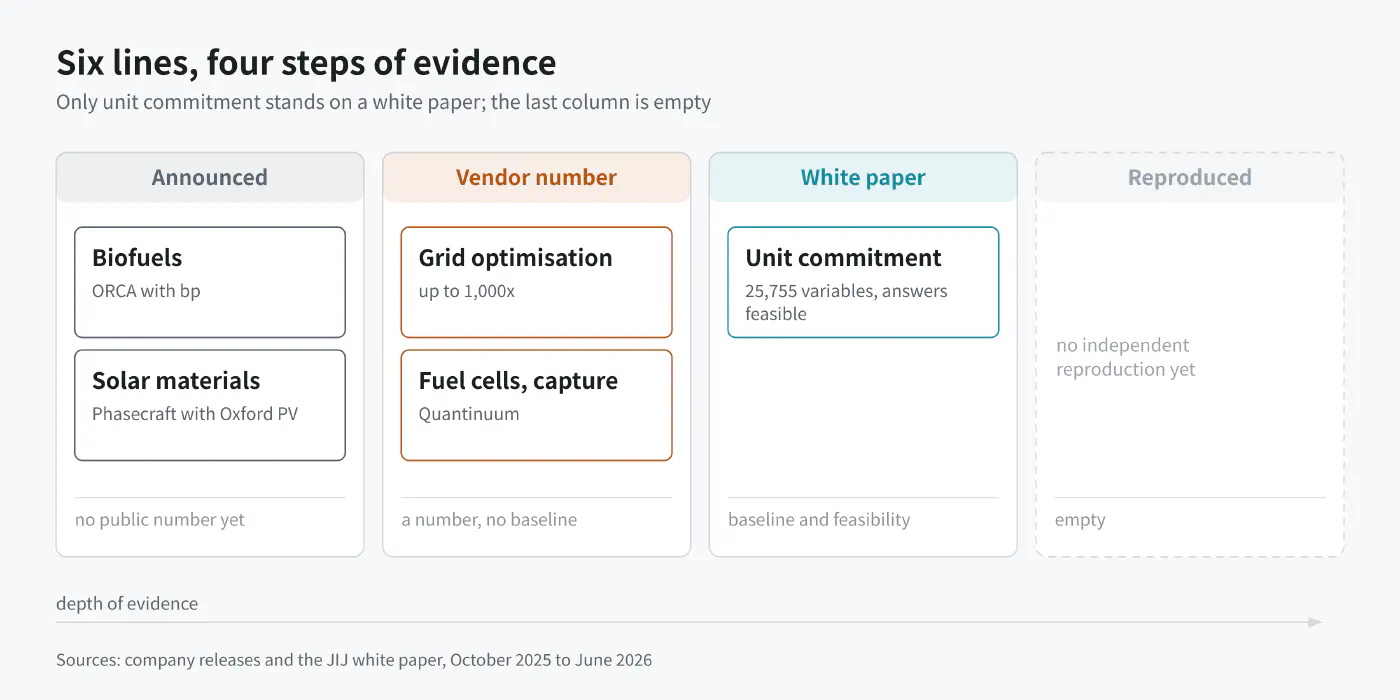
| Line | Who | What the quantum stage does | Where the evidence stops |
|---|---|---|---|
| Grid optimisation | Phasecraft with NESO | One quantum computation accelerates an existing classical optimiser, on power exchange calculations, intentional islanding, renewable siting | Vendor says up to 1,000x, published October 2025 |
| Unit commitment | JIJ leads, ORCA supplies photonic hardware, NQCC hosts the testbed, bp observes | On-off variables go out as a QUBO, output levels stay classical | White paper, 25,755-variable instance, answers verified feasible |
| Hydrogen catalysts | Phasecraft with Johnson Matthey, Harvard and QuEra, funded by ARPA-E | Simulate the anode catalysis of water electrolysis, look for recipes that use less iridium | $4,519,658 contract, algorithms in progress |
| Fuel cells and carbon capture | Quantinuum | Materials modelling | Company announcement, no baseline |
| Biofuels | ORCA with bp | Molecular properties and combustion | Partnership announced |
| Solar materials | Phasecraft with Oxford PV | Search for higher-efficiency cell materials | Partnership announced |
Only the first two rows carry a number you can audit. That is where the field is.
3. Two methods, one loop#
Phasecraft calls its method quantum-enhanced optimisation. The output of a quantum algorithm becomes a prior that accelerates an existing classical algorithm, which does the converging. It runs on today’s noisy hardware. Whether the quantum stage adds anything depends on how the classical stage consumes it.
JIJ decomposes instead. The mixed-integer program is split by dual decomposition. The on-off decisions become a QUBO and go to ORCA’s photonic processor. Output levels stay with the classical solver. The partial answers are reassembled against the original problem.
The engineering differs a lot. The shape is the same. The quantum processor is not outside the loop. It is inside it, handing back a batch of candidates each round, and the classical stage decides whether that batch is usable.
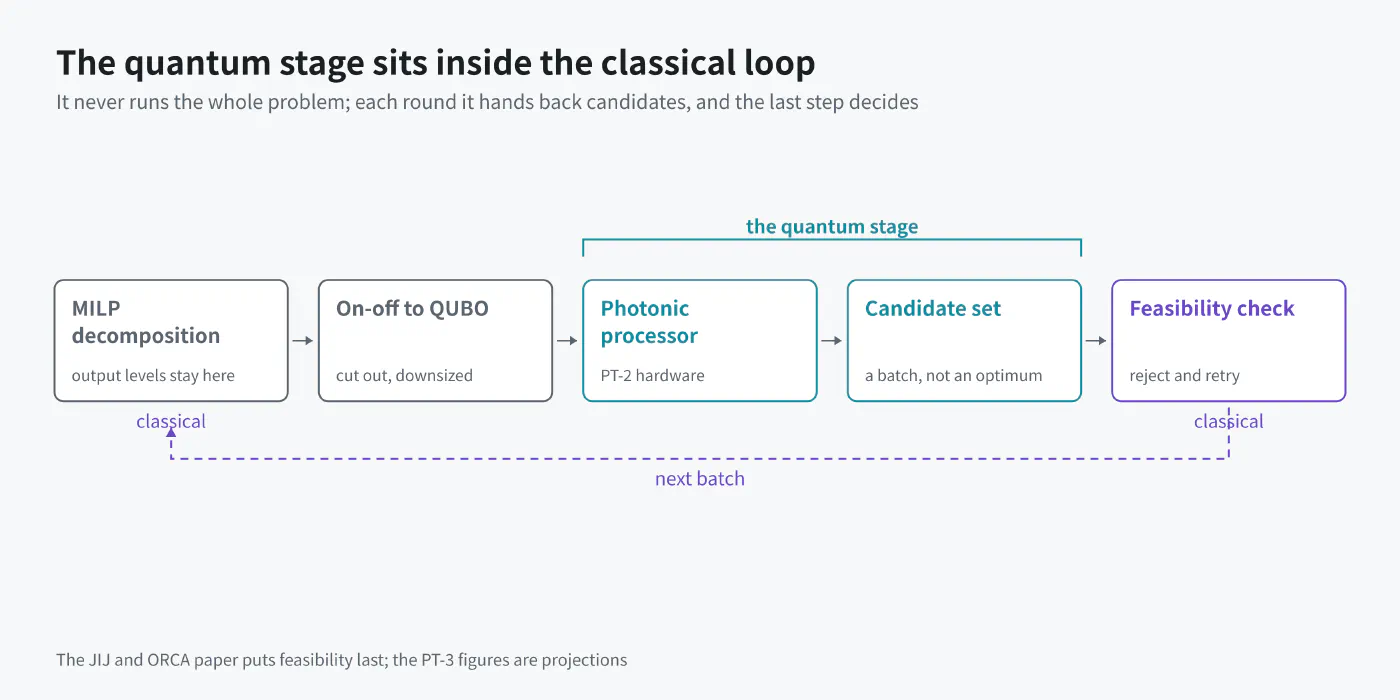
That shape sets how the claim should be judged. The useful question is how many candidates survive the check, and how much classical time the check costs. Speed comes after those two.
4. A benchmark you can read line by line#
The white paper JIJ and ORCA published in June 2026 says several things that rarely make it into a press release.
- On short runtimes, Gurobi performed better.
- The hybrid kept improving as runtime increased, and reached comparable solution quality under the conditions tested.
- Its answers were verified feasible on the original problem, and were produced on a real quantum processor.
- The PT-3 results are projections from current measurements.
- The findings do not establish commercial quantum advantage, or readiness for operational deployment.
The last two are what make the rest usable. It separates measured from projected, and keeps the conclusion inside the evidence.
Compare that with Phasecraft’s 1,000x. The release names the problem types that map onto NESO’s work, power exchange, intentional islanding, renewable siting. It does not name the baseline solver, the instance size or the parameters. That number is a direction, not a result.
5. The iridium bill#
Water electrolysis needs iridium oxide at the anode. In Johnson Matthey’s platinum group metals report of May 2026, iridium was the only PGM whose total demand was still rising, at 7.5 tonnes against mine supply of 7.1 tonnes, with the gap covered by recycling and stock.
The number that matters for scale is the loading. PEM electrolysers today carry 1 to 2 mg/cm². The US Department of Energy target is 0.5, with an ultimate goal of 0.125.
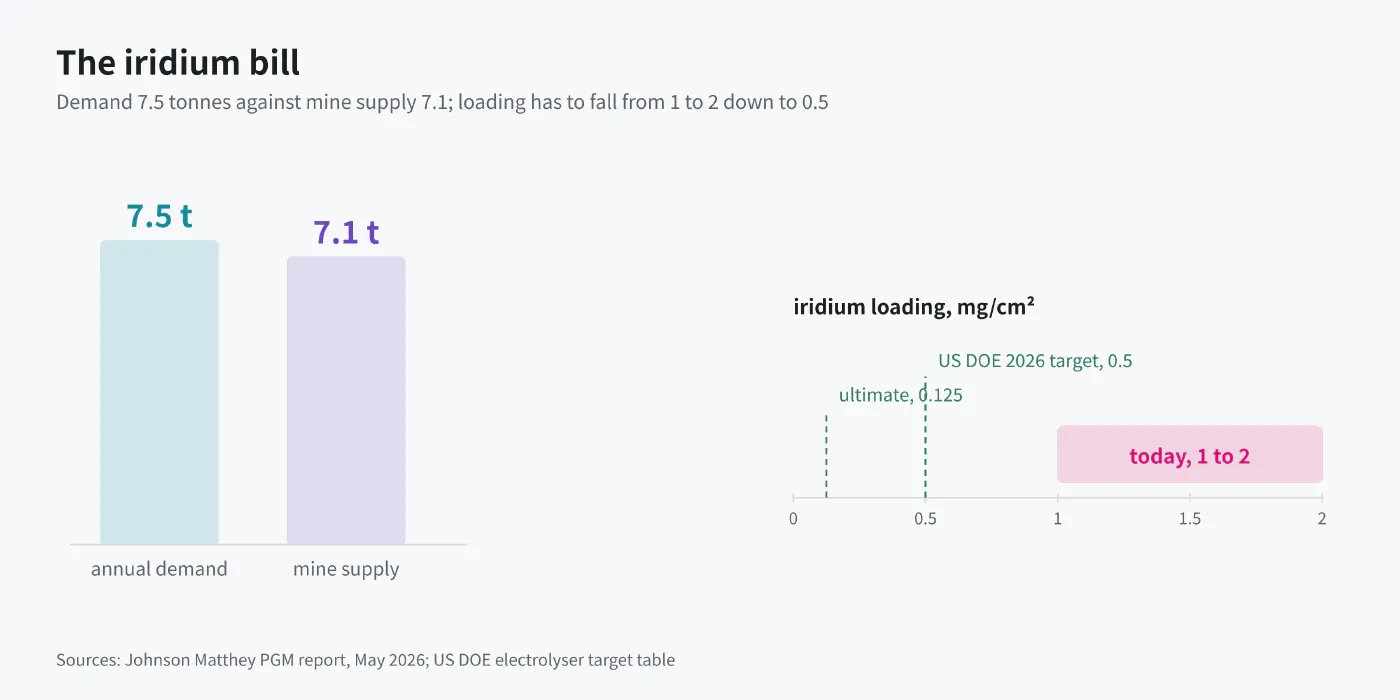
Put the two together and the metric for the materials line is loading. Electrolyser capacity may multiply. Iridium output will not. Loading is the only variable left to move. The $4,519,658 ARPA-E contract under the QC3 programme states its goal as reducing reliance on platinum group metals, not as running faster.
This is also the slowest line. Catalysts are strongly correlated electron systems. The qubit count and error correction that quantum chemistry would need are orders of magnitude away from available hardware. The contract funds research, not a delivery.
6. The money arrived, the evidence is in transit#
| When | What | How much |
|---|---|---|
| 2025 | Phasecraft Series B | $34 million |
| October 2025 | UK Quantum Catalyst Fund for Mondrian | £1.2 million |
| June 2026 | Quantinuum lists on Nasdaq | 28 million shares at $60, $1.68 billion raised, $17.63 billion at debut |
| June 2026 | ARPA-E QC3 contract to Phasecraft | $4,519,658 |
| September 2026 | Phasecraft opens a US headquarters in Arlington, Virginia | undisclosed |
Each line is checkable. None of them moves the sentence in section 4. Commercial quantum advantage is still not established.
7. The numbers, with sources#
| Number | Value | Source |
|---|---|---|
| Unit commitment instance | 25,755 variables, 48,939 constraints | white paper |
| Short-runtime comparison | Gurobi better | white paper |
| Answer validity | verified feasible on the original problem | white paper |
| PT-3 results | projections from current measurements | white paper |
| Grid optimisation speed-up | up to 1,000x | vendor published, baseline not disclosed |
| Iridium demand per year | 7.5 tonnes | Johnson Matthey, May 2026 |
| Iridium mine supply per year | 7.1 tonnes | same |
| Iridium loading today | 1 to 2 mg/cm² | literature review |
| US DOE loading target | 0.5 mg/cm², ultimate 0.125 | DOE target table |
| ARPA-E contract | $4,519,658 | ARPA-E project page |
8. Four questions for the next speed-up claim#
- Which classical solver is the baseline, at what version and what settings.
- How large is the instance, in variables and constraints.
- Were the answers verified feasible on the original problem.
- Is the number measured or projected.
The JIJ paper answers all four, which is why 25,755 is worth quoting. The 1,000x answers none of the first, so it stays a direction. The point is not to catch anyone exaggerating. It is to tell which claim can be used today.
9. Two questions still open#
When does Mondrian’s baseline become public. A thousandfold speed-up in NESO’s setting is a real result, but if the baseline is an open-source solver at default settings, a tuned commercial solver changes the picture. Nobody can say yet.
Which path brings iridium loading down faster, quantum chemistry simulation or experimental iteration. Johnson Matthey is thrifting the catalyst itself, with experimental cycles measured in months and the hardware a quantum simulation needs measured in years. Neither path has arrived.
References#
- CNBC, Quantum computing may find early payoff in energy, 22 November 2026, https://www.cnbc.com/2026/11/22/quantum-computing-energy-applications.html
- JIJ, ORCA, NQCC and bp, Testing Quantum-Classical Hybrid Optimization for Industrial-Scale Power Operations, https://www.j-ij.com/en/cases/sparq-unit-commitment
- NQCC, Unit Commitment Problems in the Energy Industry, https://www.nqcc.ac.uk/unit-commitment-problems-in-the-energy-industry-solving-with-hybrid-decomposition-across-classical-and-photonic-quantum-computing/
- Phasecraft, Mondrian launch, https://www.phasecraft.io/journal/journal/phasecraft-launches-mondrian-quantum-enhanced-optimisation-software-platform-for-real-world-network-challenges
- ARPA-E, Quantum Computing for Hydrogen Fuel Production, https://arpa-e.energy.gov/programs-and-initiatives/search-all-projects/quantum-computing-hydrogen-fuel-production
- Reuters, Honeywell’s Quantinuum valued at $17.63 billion as shares rise in Nasdaq debut, 4 June 2026
- Johnson Matthey, PGM market report, May 2026, as summarised by raw-science