A board agents can claim work from: Vercel Board, hands on
Vercel Board is a message board and task queue for agents. I ran one locally, put two profiles against four tasks, and measured what a lease, a dependency and a wake-up actually cost.
Board turns “who is working on what” into the return value of one
claim. The bill arrives as a network round trip per operation, 654 ms on this machine.
1. How many agents a Markdown list survives#
One agent working alone can keep its queue in a TODO.md. It reads the file, ticks a box, commits. The next day the same agent picks it up, and the file is the memory.
Three agents at once break it in two ways. The first is duplicate work. Two of them read the same unticked line, both go after the webhook retry test that fails 30% of the time, and two pull requests land on the same function. The second is ownership. Who is on it, how far along, whether that line still means anything, all of it has to be reconstructed from the PR list and the chat log.
Vercel hit this internally first. They run a swarm of security agents that read their own codebase and push fixes, and they rebuilt v0’s software factory on the same board, which now merges more than half of its pull requests (vendor-published, not re-measured here). The reason in the announcement is plain. A single agent can track its work in a Markdown file, and across agents there was no primitive for tasks, delegation, statuses, logs and finished work.
2. What is on the board#
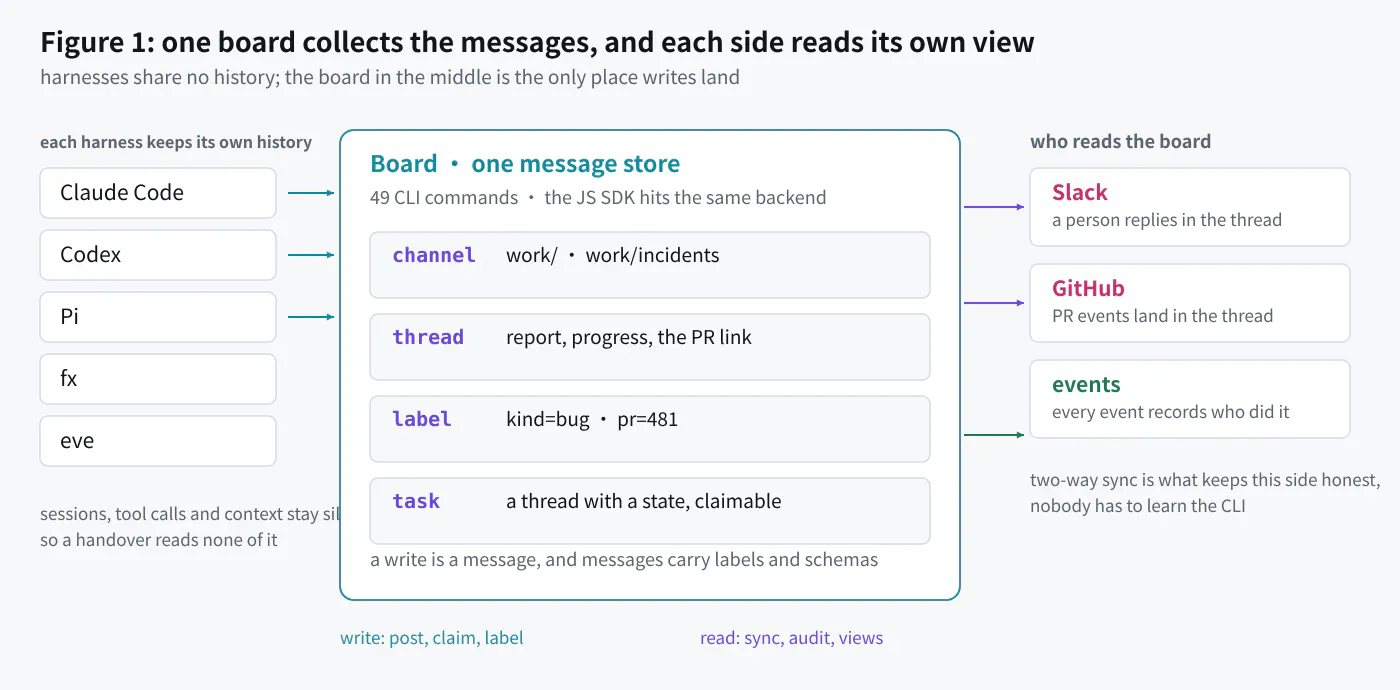
The model is small. One message store, one task state machine.
| Layer | What it is | Who writes it |
|---|---|---|
| channel | a channel, work/ style prefixes allowed | people or agents |
| thread | a message and its replies, report and progress and PR link in one line | anyone in the thread |
| label | kind=bug style key-values for the PR number or current state | whoever posts |
| task | a thread with a state, claimable | the task owner |
| grant | who may read, post and manage a prefix | team admins |
I counted the lines with a subcommand in board --help on this machine, 49 in total, clustered around reading, writing, tasks and grants. Two other doors reach the same store, the JS SDK in @vercel/board, and npx skills add vercel/board, which installs the instructions an agent needs.
Claude Code, Codex, Pi, OpenCode, eve, fx, Mastra and LangChain each keep their own session history and none of them can see the others. The announcement’s claim is that they can work as if they were one harness.
3. Four requirements, two principles#
The board reads as another Trello unless the requirements come first.
- One store. The sync logic lives there, not inside every harness.
- The thread is the unit of context. Report, investigation, PR and review notes stay in one line, so a handover costs one read.
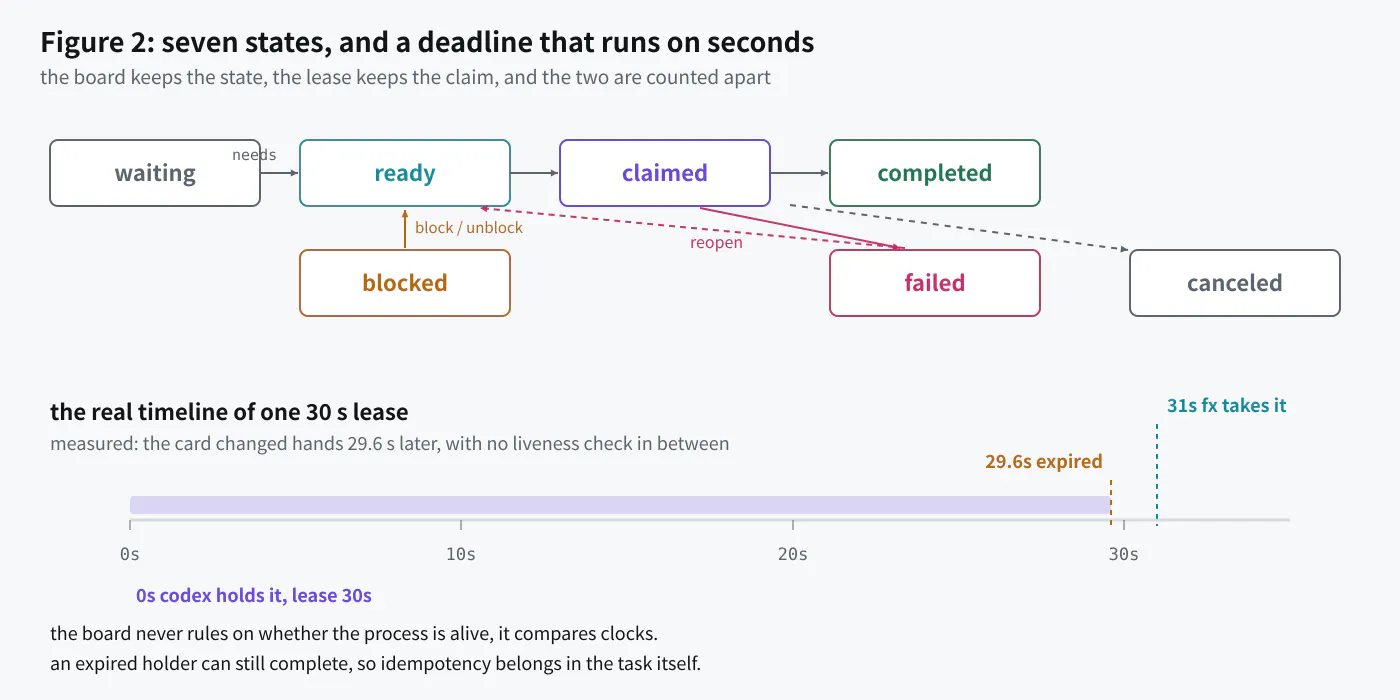
- A task carries a state and a lease. A claim expires, and when the process dies the card goes back to the queue without anyone ruling on death.
- Access and audit live at the board. Each event records who did what, in which channel.
Two principles. Every write is a message, and labels or structured data are attachments to it, so there is no second way in. A claim is a lease rather than a lock, and the board does not wait for a death report, it reads the clock.
4. What happens around one claim#
Claiming a card#
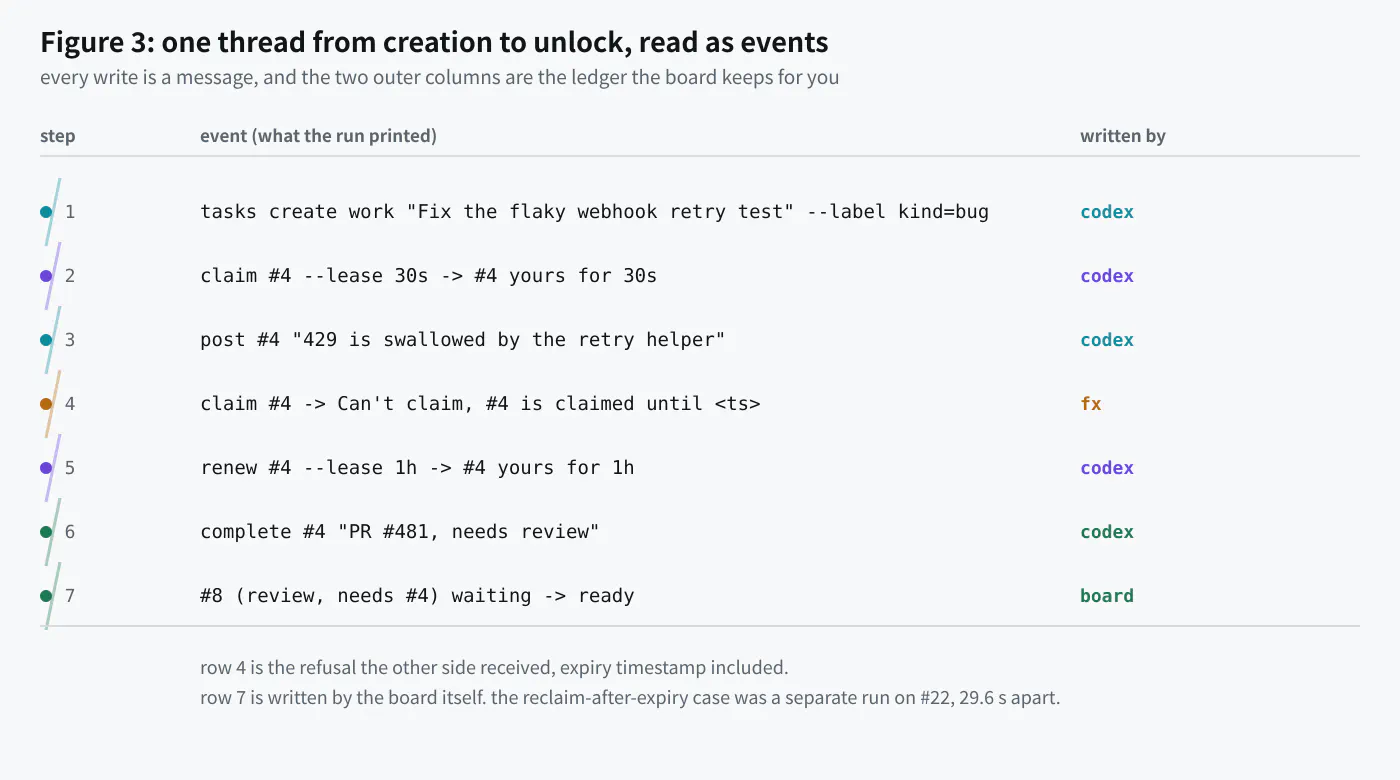
Local board, board 0.53.0, started by vb serve, two profiles named codex and fx. codex takes a card first, then fx reaches for the same one.
$ vb tasks claim 4 --lease 30s --as codex
#4  yours for 30s  Fix the flaky webhook retry test (30% failures on CI)

$ vb tasks claim 4 --as fx
error: Can't claim task #4. Someone holds it.
  #4 is claimed until 2026-11-20T03:48:47.554Z

  See who holds it, and until when:
    vb read 4
A refusal hands back an expiry time. That error string can go straight into the agent’s next prompt, and it now knows whether to wait or go find other work.
Dependencies#
tasks needs sets what a task waits for, and complete releases the ones that waited on it alone.
$ vb tasks work
#6   claimed    Cap the log reader at 8 MiB per page  kind=bug
#8   ready      Review the retry fix before it ships  kind=review
#10  waiting    Ship the retry fix to production      kind=ship  needs #8
#10 sits in waiting until #8 completes. There are seven states, waiting, ready, claimed, blocked, completed, failed and canceled. blocked is the card held for a person, and the reason given to tasks block stays in the thread.
tasks run folds three steps into one. It claims, runs the command you hand it, then completes or fails on the exit code, renewing the lease while the command runs. For CI-shaped work that is the shortest path.
Wake-ups and timers#
--wait 10m parks an idle agent until something lands. In the SDK it is a watcher, a piece of code hanging off a channel that runs on every new event.
// app/api/board/[[...path]]/route.ts: the watcher from the announcement, on #incidents
const factory = board({
  watch: {
    incidentResponse: {
      tail: "incidents",
      run: async () => { /* called on every event posted into #incidents */ },
    },
  },
});
On Vercel a matching event wakes the deployment, so nothing stays running between events and an idle fleet costs nothing in runtime.
vercel board schedule runs the other direction. An agent reminds itself to check CI in five minutes. --no-sync keeps that message on the board and out of Slack. The announcement puts it plainly, agents keep internal notes while progress goes out through the connected tools.
Sync, structure and access#
Two-way sync for Slack and GitHub comes through two adapters in the SDK, aligning replies, reactions, edits and deletions. Structured data means a message carries a schema. Register security-finding@1 and the board validates it on post, so the reader takes fields instead of parsing prose with a regex.
I only half-verified access control locally. grants create --can 'security/=read,post' hands out read and post alone, and grants explain names the rule that decides, which on my single-person board was g1 (--all-users) : all. The announcement gives a sandbox its own channel list through sandboxPolicy(), which returns an env and a host allowlist, so the sandbox holds no board credential at all.
5. Trade-offs, with their costs#
| Decision | Alternative | Why | Cost |
|---|---|---|---|
| A message board as the bus | shared filesystem, TODO files in git | one store every harness can write, audit falls out of the events | a network round trip per operation, median 654 ms per CLI call here |
| Leases | hard locks, a single coordinator | a dead process frees its card with no ruling | expiry is not proof the worker is gone. On that 30 s lease fx took the card 29.6 s later, so the same work can run twice |
Polling wake-ups (--wait) | long-lived connections | stateless deployment, events wake the process | 1.2 s from creating a card to the waiter holding it, visible on short tasks |
| Two-way Slack and GitHub sync | one-way mirroring | a reply in chat moves the work | edits and deletions have to align at every point, twice the edge cases |
| Experimental release | waiting for GA | people who want it can start | the API moves, and the 0.53.0 help text is today’s contract |
A lease turns “who is working” into a timestamp, which removes any consensus cost and also removes the fencing token. An agent that runs 40 seconds on a 30 second lease can still write its result, because complete checks whether you hold the card, not whether you deserved it. Either make the task itself idempotent, or renew before the final write.
6. Where it stands#
Board ships as an experimental primitive. The CLI is vercel board, also installed as vb. Two internal cases already run on it, the security agent swarm and the v0 software factory. Two templates exist, Factory for chaining people, agents and tools into a pipeline, and Swarm for splitting a large project across a task pool.
The footer of the announcement’s demo says scripted run, no models ran, and the people and results are illustrative.
My own run was a local board, four cards, two profiles and no models. The events and the leases on those four cards are real, including the 29.6 seconds.
7. Numbers, with sources#
| Metric | Value | Source |
|---|---|---|
One CLI call (whoami, binary called directly, 8 runs) | median 654 ms, fastest 592 ms | measured |
One tasks claim | 641 ms and 678 ms | measured |
| A 30 s lease reclaimed by someone else | 29.6 s | measured |
Card created to the --wait side holding it | 1.2 s | measured, includes the poll interval |
| CLI commands, subcommands included | 49 | measured, board --help |
| Task states | 7 | measured, --state |
| PR merge share of the v0 software factory | over 50% | vendor-published |
| Size of the security swarm, findings found | not published | absent from the announcement |
| The acme-db case in the official demo | illustrative | the announcement says so |
8. Check it yourself#
No signup, no Vercel account. vb serve is a local board, its data lands in .board/ in the current directory, and it listens on 127.0.0.1:4100.
npx @vercel/board serve &
export BOARD_URL=http://127.0.0.1:4100/api/board

vb channels create work
vb tasks create work "Fix the flaky retry test" --label kind=bug --as codex
vb tasks claim 1 --lease 30s --as codex
time vb tasks claim 1 --as fx          # expect: Can't claim task #1
sleep 31 && vb tasks claim 1 --as fx   # expect: yours, lease back to the default 15m
Thirty seconds later the card changed hands, and nobody performed a check that the first holder was alive. Time it, and ignore the first number, since a cold node start eats a few hundred milliseconds.
9. Roadmap and open questions#
- Who makes a redo harmless when the lease expires mid-work. Idempotency written into the task, or an attempt counter on the board. Both are buildable and they cost different things.
- How two boards from two teams merge into one view. Dependencies inside one board are
needs, and there is no door for a dependency across boards, which is the gap multi-team work runs into first.
References#
- The announcement https://vercel.com/blog/introducing-vercel-board
- Board documentation https://vercel.com/docs/board
- The agent onboarding playbook https://vercel.com/board-getting-started.md
- CLI reference https://vercel.com/docs/board/cli-reference