The lamp in the stairwell
Attention is the one thing nobody can print more of, so watching turned into a trade. I read a long letter about capturing it, and kept thinking about the lamp in my stairwell, which hears a footstep and never learns a face.
In one line: attention is the one thing nobody can print more of, so watching became a trade, and both the watcher and the watched end up wondering how much of themselves is still theirs.
The stairwell in my building has a lamp that answers to noise. On the way up, at the third landing, you stamp a foot or clap once and it comes on. It does not know faces. Walk quietly and it stays dark. Make a sound and it gives you fifteen seconds of light, then goes out on schedule, wherever you happen to be standing.
I have thought for years that this lamp could serve as a model, without ever working out what it models.
1. Attention is hard#
A while ago I read a long letter. The man who wrote it runs a company, and the letter explains how to capture attention on social platforms. It was well made and I finished it. What I was thinking about while reading was something else.
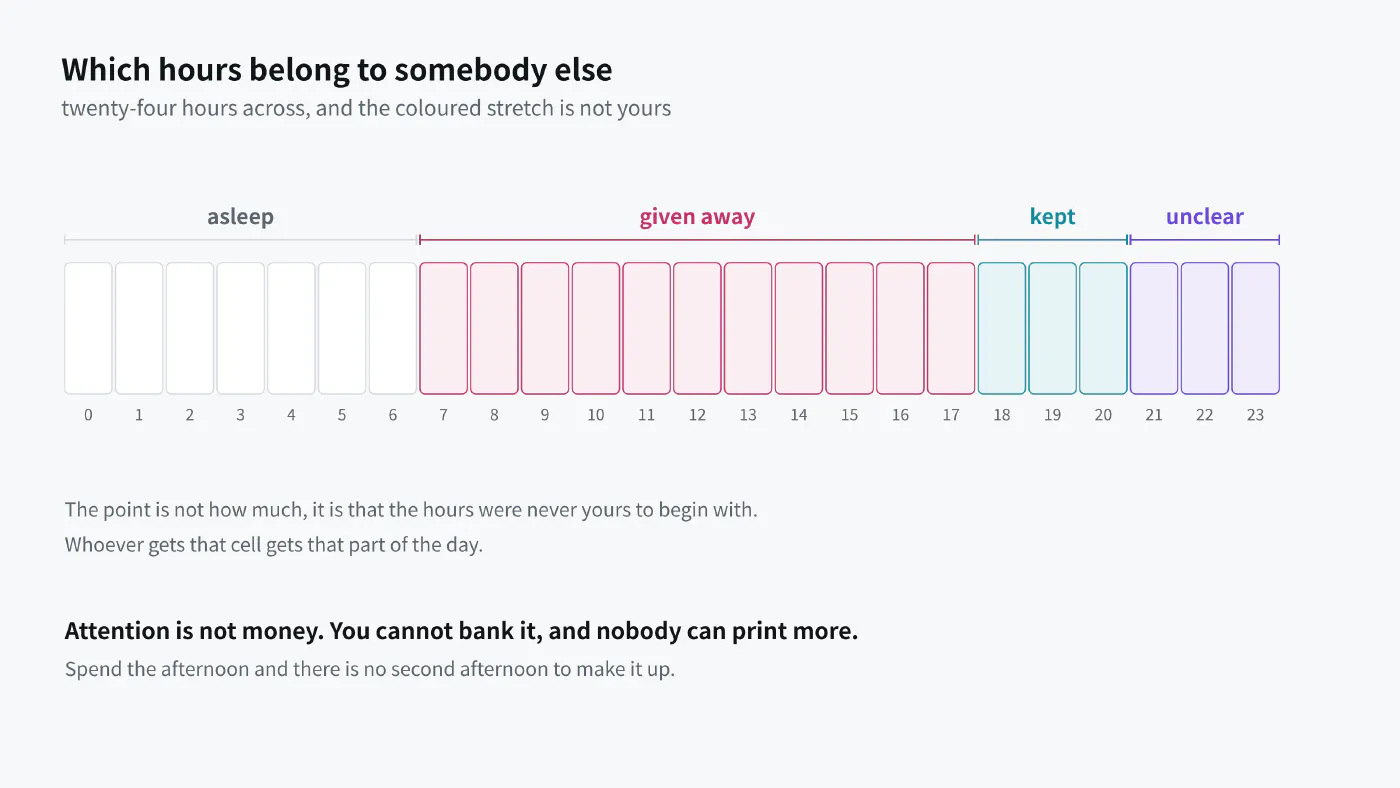
Money can be printed. Print enough of it and a pound of beans costs eight yuan. Attention cannot be printed. An afternoon has one length, and if you hand it to one thing it is not available for another. The two behave in opposite ways. Money multiplies as you print it, and attention runs down as you spend it. I have a habit of doing sums and then putting the paper away.
People have taken to calling this the attention economy. The name is polite, the way a well is given a botanical name. The water is limited, more people arrive with buckets, and soon somebody is selling water, somebody is selling buckets, and somebody stands by the well teaching others how to draw. Whether the well is tired is not part of the conversation.
The letter is about how to take. I was thinking about what happens after the taking. I folded the letter and left it on the corner of the desk, and did not open it the next day.
2. Watching is an old trade#
There is nothing new about a crowd. At the execution ground they turned up in numbers too, and brought lunch. A row of necks over the railing, two bowls of rice at home afterwards, and no one in the crowd thinking he was setting a price.
What is new is the price of a seat. It has fallen to zero, so everything gets watched now, including things that do not deserve it.
The trick of watching is that it feels free. You pay nothing, you spend a little time, and you come away feeling that you have judged the world. Accounts rarely work that way. Every extra glance makes somebody more expensive. Every withheld glance makes somebody cheaper. The pricing is done by the audience, and nobody sends the audience a payslip.
I watch too. When something flares up my hand moves before my head does. I open it, and then I regret it. The people who scold the trending list and the people who open it are often the same people, and on a phone those two acts use the same finger.
3. Being watched bends the posture#
Put a person under a gaze and the body changes. You do not need a theory for this. Try eating a bowl of noodles while your neighbour watches, and the noodles become hard to lift.
Stay under the gaze long enough and the face becomes hard to locate. First he pretends to be like that. Then he becomes like that. Then there is nothing left except that.
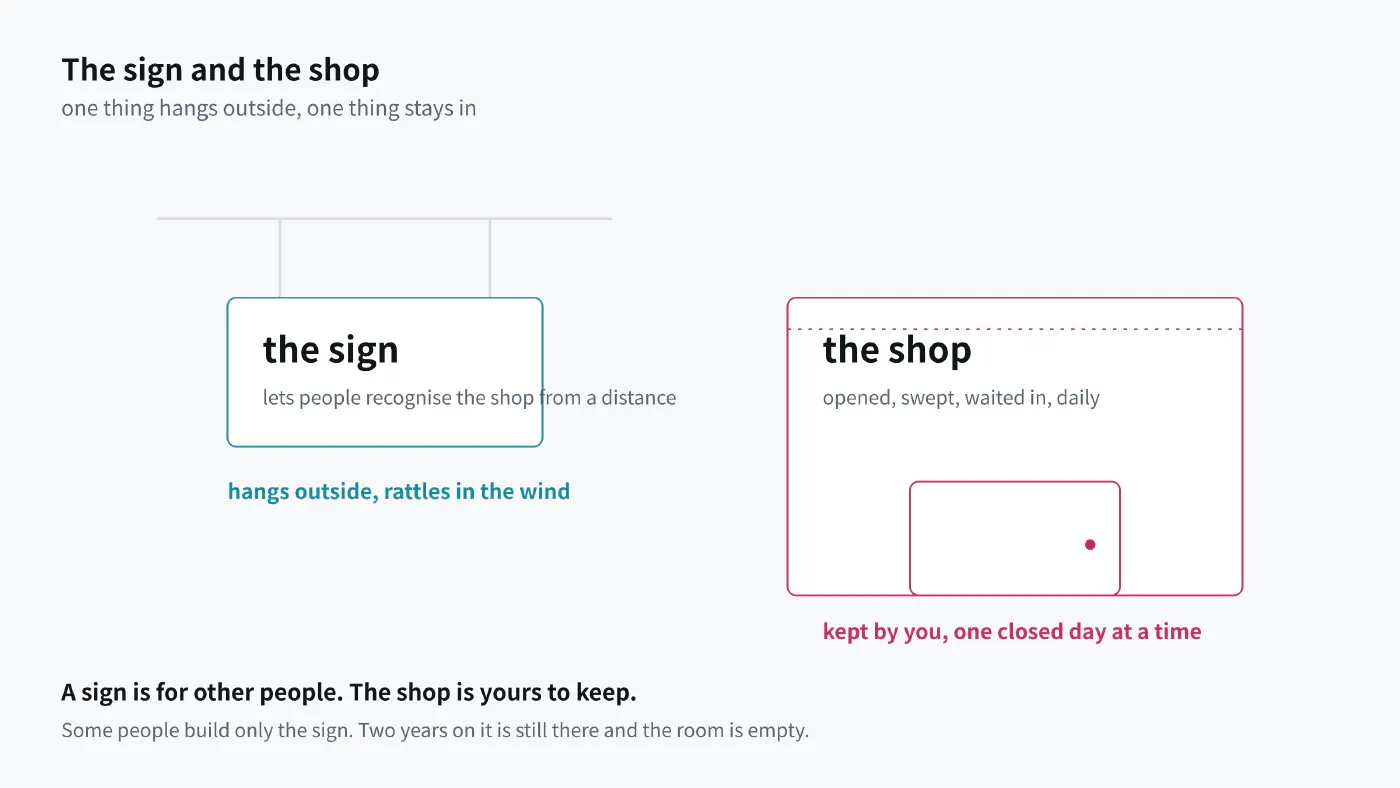
There is a phrase for it now, a personal brand, which means turning yourself into a sign. A sign is a decent thing. A sign lets people recognise the shop from a distance. The trouble starts when the sign is mistaken for the shop. Hang it long enough and the man moves in behind it, and whether there is anything on the shelves stops being a question he asks himself.
4. A thousand people know of you, one knows you#
Knowing of someone and knowing someone are two different things.
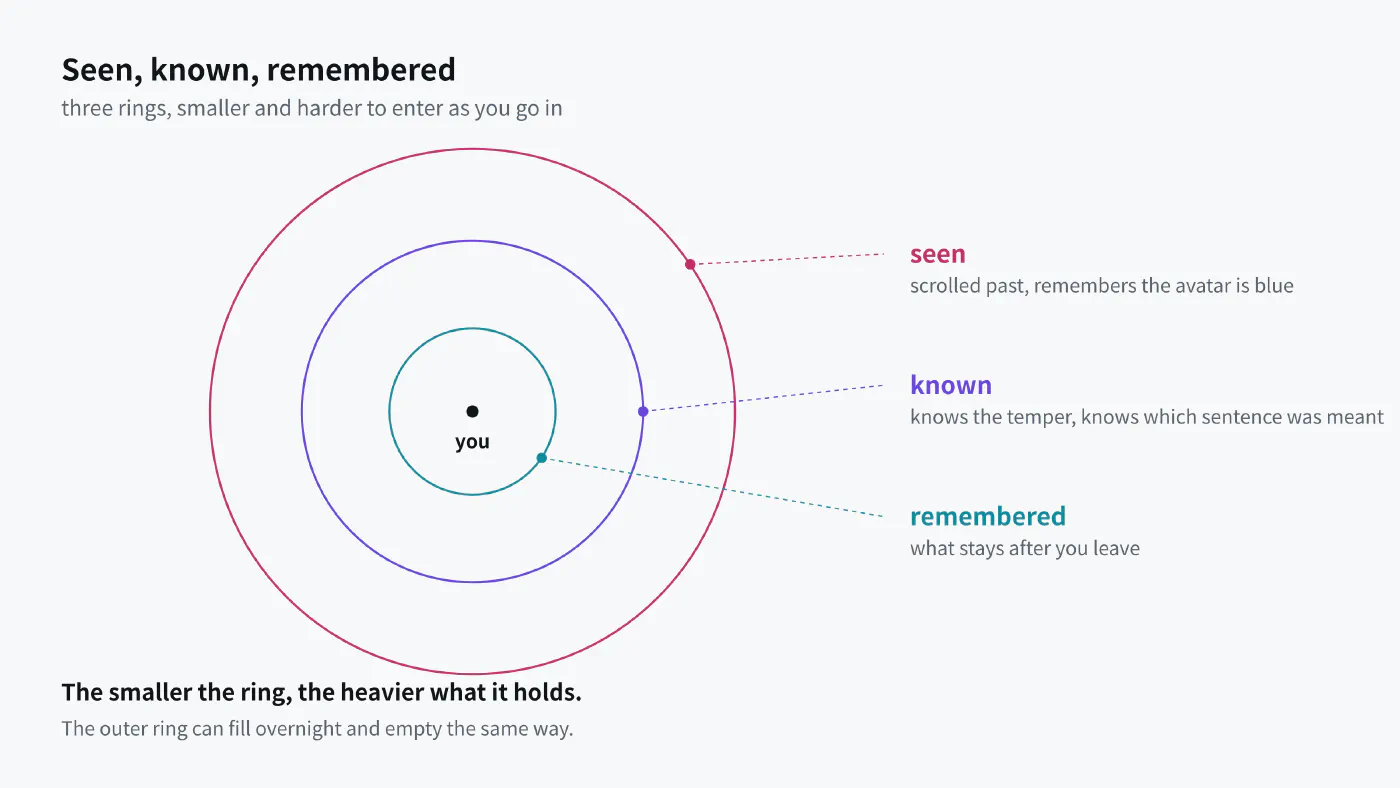
To know of a person usually means having scrolled past three times and remembering that the avatar is blue. To know a person means knowing what frightens him, knowing that when he says he does not mind he minds, knowing which sentence of his was meant. The first can make you famous. The second can make you live like a person.
A reputation is something other people keep for you. The keeper is in a good mood today and leaves it hanging there. Tomorrow the wind changes and it is taken down, without a receipt. What people who know you keep cannot be taken away, because the two of you built it together.
So I am not convinced that being seen by more people is much of a good in itself. More people seeing you does not mean more people know you.
5. Giving all of it away and keeping all of it are both faults#
Still, you cannot hold attention too tightly either.
A person who gives nobody any of it lives like a locked room, clean and unvisited, until a knock sounds unfamiliar and gets blamed on the wind. Everybody needs to be seen a little. When someone who does careful work is seen, the next person doing careful work walks a shorter road, and that is a good thing.
The difficulty is proportion. My own method is to hand some of it to chosen people and keep the rest. The method may be wrong. It suits my hands. I once went a month without opening any feed and did not become wiser, only better tempered, and the temper wore off. How badly it wore off I will not say.
6. The lamp#
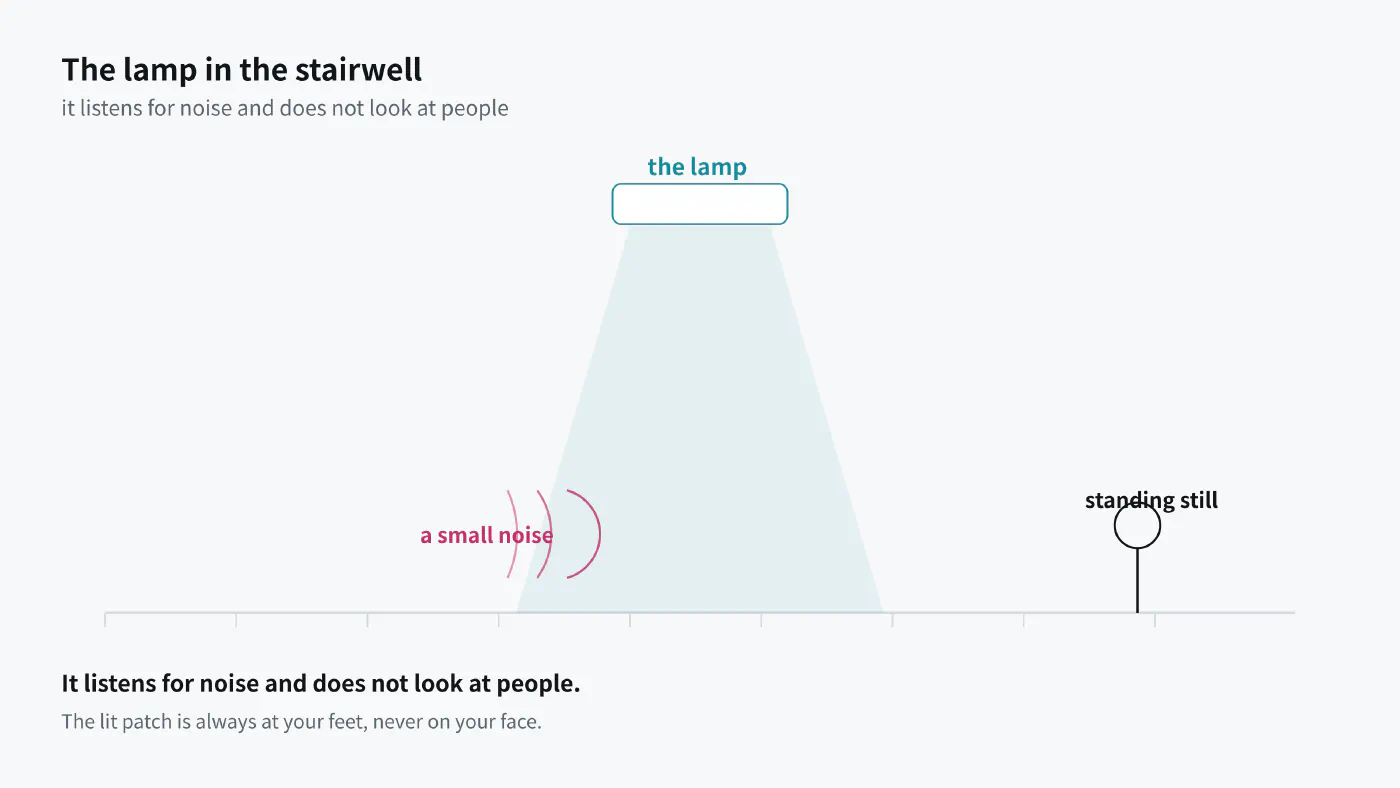
It listens for noise and does not look at people. Stamp your foot and it lights. Stand still and it goes out. There is something fair about that. It remembers nobody and owes nobody. I have walked through plenty of brightly lit places in recent years, and those lights have the same temperament. A sound, a flash, and nobody asks who you are.
These days I take the stairs quietly. When the lamp stays dark I go up by the handrail. It is darker that way, and those few steps are mine.