One hour a day, 365 hours a year: which half of Dan Koe's deep focus actually lands
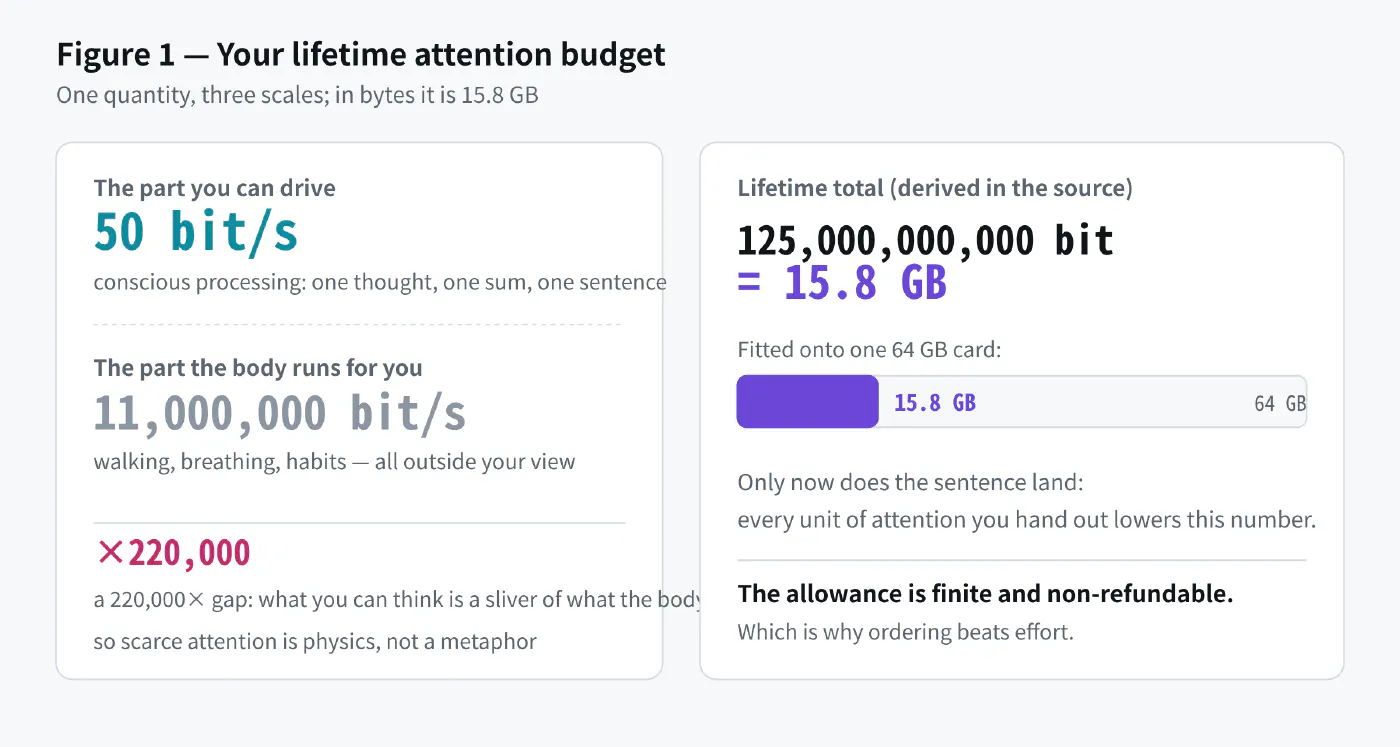
An hour a day sounds like a slogan until you multiply it: 365 hours is 45 full working days, and a lifetime of conscious bandwidth is about 15.8 GB. What survives from Dan Koe's focus essay is a five-layer frame; what does not is his sample.
In one line: the useful thing in the essay is not “use your phone less” — it is a budget you can compute: one hour a day, 365 hours a year, 45 full working days, all of them spent on your own project.
Scope first. The source is Dan Koe’s long post How to unlock extreme focus on command, published on X on 19 January 2026; I read the full body. Every number below carries its origin: computed means I derived it from the numbers he gives, source means it is his citation or his own experience. The two never share a cell.
1. Do the arithmetic: what one hour actually is#
One hour a day is 365 hours a year (computed). Divide by 8: 45.6 — 45 full working days, spent on your own work (computed). That conversion is the hinge of the whole essay: the first thing to know is how much there is to spend.
Then the stranger numbers: conscious processing runs at roughly 50 bits per second, unconscious processing at roughly 11 million (source, not re-measured). Working from those, a lifetime of conscious information comes to about 125 billion bits (source). Divide by 8 and you get 15.8 GB (computed) — your entire waking bandwidth fits on a memory card with room to spare.
From there he draws a counter-intuitive claim: the successful creatives and CEOs he watched — the ones who did not mortgage their lives — physically worked very little while their minds kept running, thinking and plotting; once the idea was clear, they executed at a speed nobody else could match. Busyness was not the variable he was measuring.
2. Three kinds of work, one of which deserves your hour#
| Kind | What it looks like | Rhythm | Who does it |
|---|---|---|---|
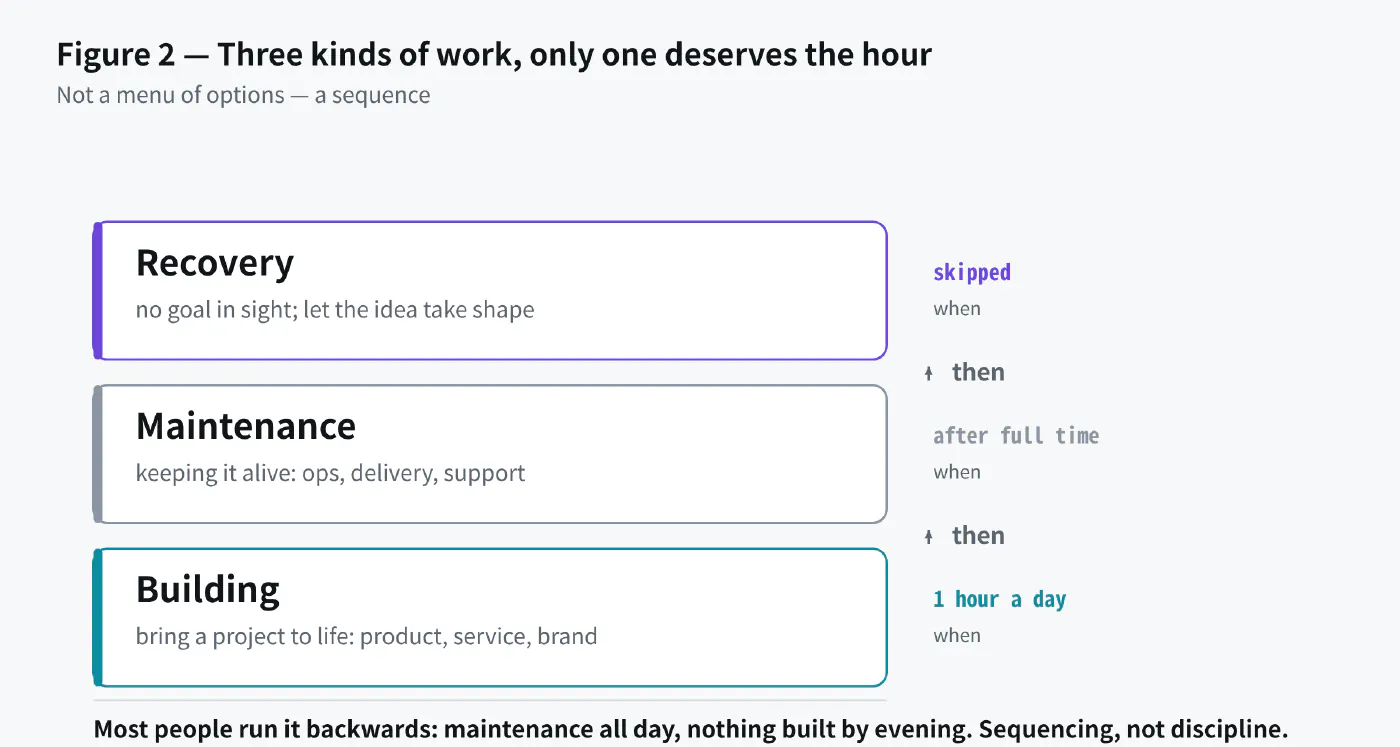
| Building | Bringing a project to life: product, service, brand | Intense, in blocks | You, in that one hour |
| Maintenance | Keeping the thing alive: marketing, support, delivery | Steady, repetitive, systemisable | Later you, or time you buy |
| Recovery | Chasing no goal, letting breakthrough ideas form | Subconscious, skipped by nearly everyone | You, scheduled |
The order is the point: build until you can do it full time, then start thinking about maintenance. Most people run it backwards — a dozen alignment calls and two hundred messages a day, all maintenance, and nothing built by evening.
3. Focus is not willpower, it is three preconditions#
He names them clarity, importance, urgency, and each one decomposes into an action (source):
- Clarity: pick a task novel enough to be hard. If it overwhelms you, break it into sub-goals you do have clarity on, execute those, and acquire the skill that lets you return to the main task.
- Importance: see both ends at once — where life ends up without the goal, and what your potential is with it. One end alone lasts about three days.
- Urgency: not a deadline, the thing that gets you to sit down now.
Add the flow formula: the challenge sits just barely above your skill. Too high is anxiety, too low is boredom, and the narrow band between them is the only place attention stays.
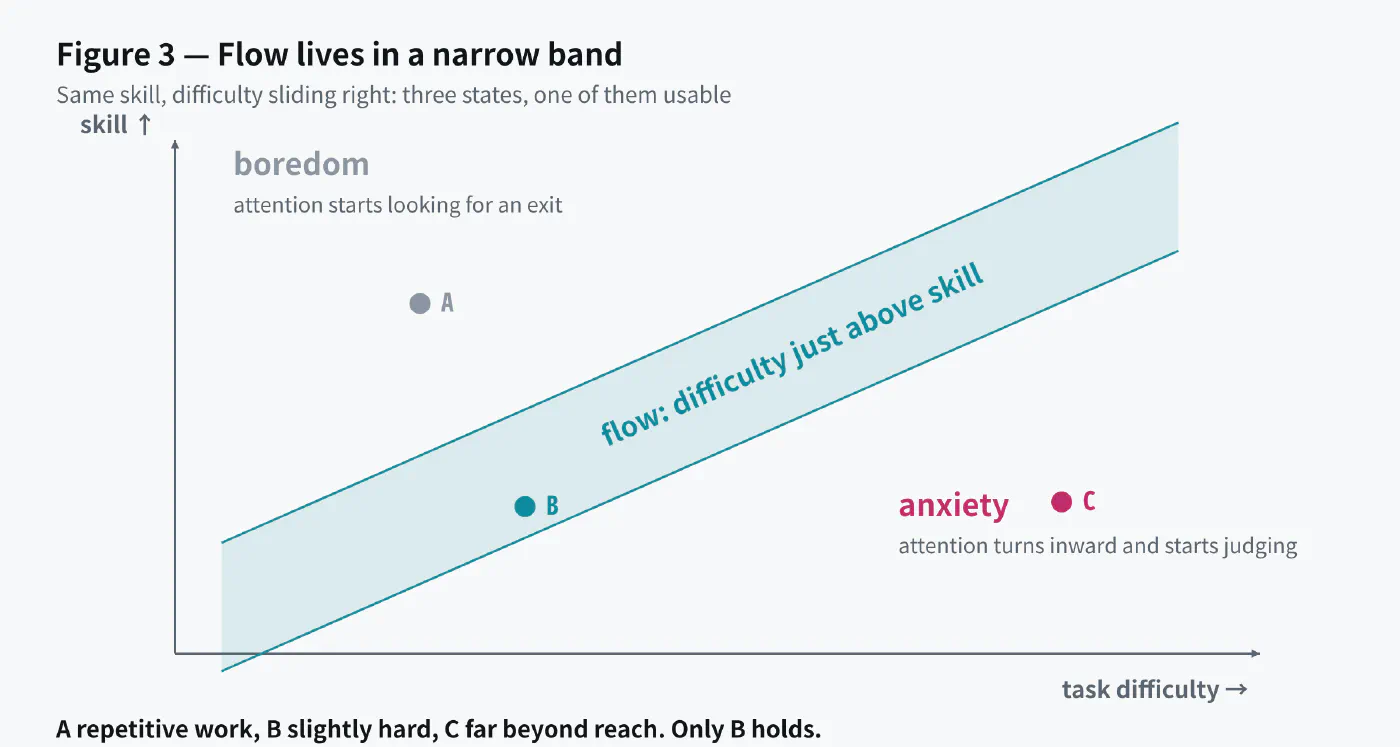
One disagreement. He calls boredom a gateway to novelty and anxiety the chaos creativity needs. On a task you chose, fine. On a job whose schedule someone else wrote, boredom is just wear. Collapsing those two cases is the most common slip in this genre.
4. Rest is part of the work, not a reward for it#
He gives a mechanism: when you stop attending to external tasks, the brain shifts into the default mode network, linking the regions behind visual thinking and creativity — and it does not use much less energy there. You think you are resting; it is working overtime.
So the walk, the swim, the lap around the campus are a stage of the process. His examples of “the idea arrived” almost never happen at the desk.
That makes the day four phases: use the brain in the morning (highest-leverage output), fill it in the afternoon (books, learning, people), empty it on a walk (default mode), clear it before bed (write it down, close the open loops).
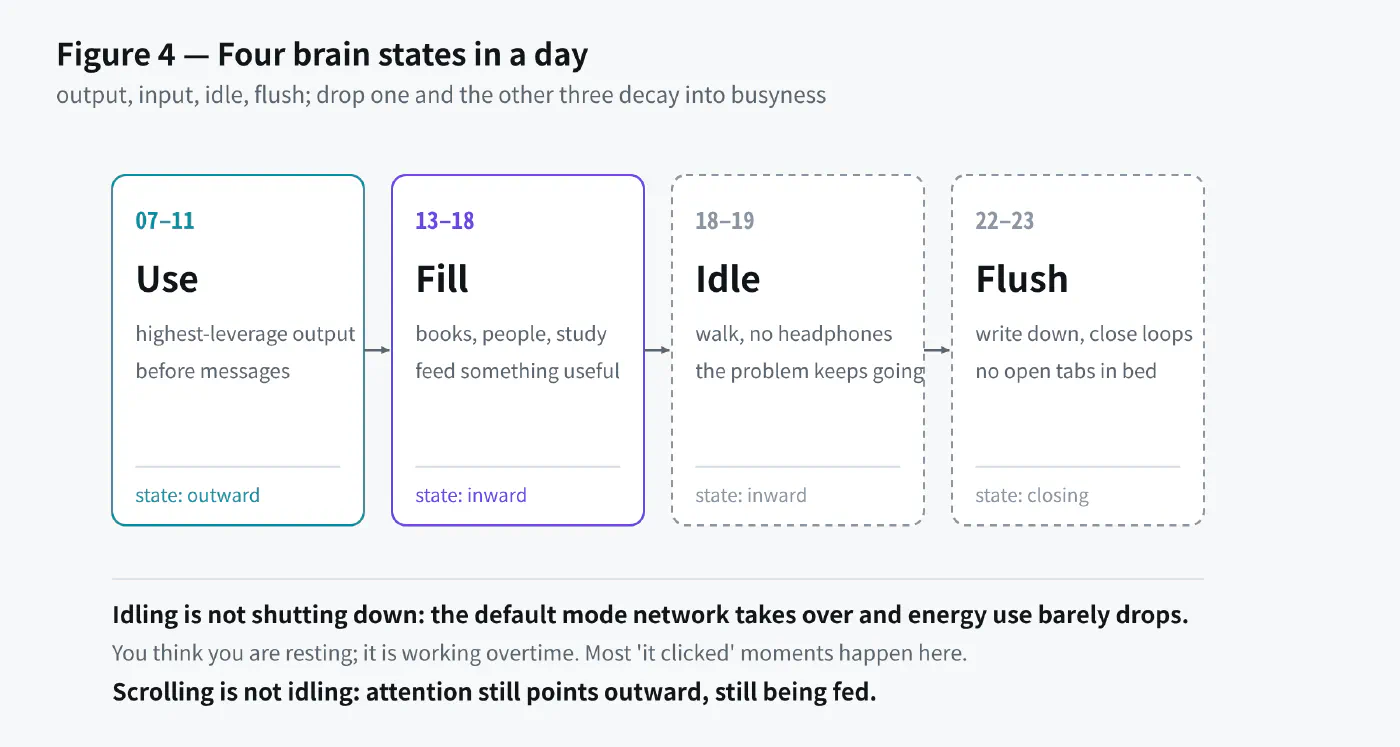
Keep “rest” separate from cheap pleasure: scrolling is not rest, because attention is still pointed outward and still being fed. His line — most people escape a life they hate with cheap pleasure and call it rest — is unkind and accurate.
5. Build the frame: five layers, from vision to tonight’s task#
The protocol is one nested structure, largest to smallest (source):
- Vision and anti-vision. Write what you do not want, until it becomes uncomfortable; then write the life you would build from scratch. The anti-vision is easier because it comes from experience, not imagination.
- A hierarchy of goals. Ten years for direction; one year, one month, one week for clarity. Large goals are not meant to be achieved, they are meant to point.
- Project-based learning. Do not start with tutorials. Start the project and let it expose the gaps; search at the moment you need the answer. His example is Photoshop: nobody learns it from courses, they want one image, fail at it, and learn exactly that step.
- Lever-moving tasks. One to three per day that actually advance the project. Two weeks with no visible progress means you are pulling the wrong lever, not that you are lazy.
- Disappear. Remove what binds you to the old routine in one go — people, games, apps. He advises not announcing the plan, to skip the bucket-of-crabs commentary.
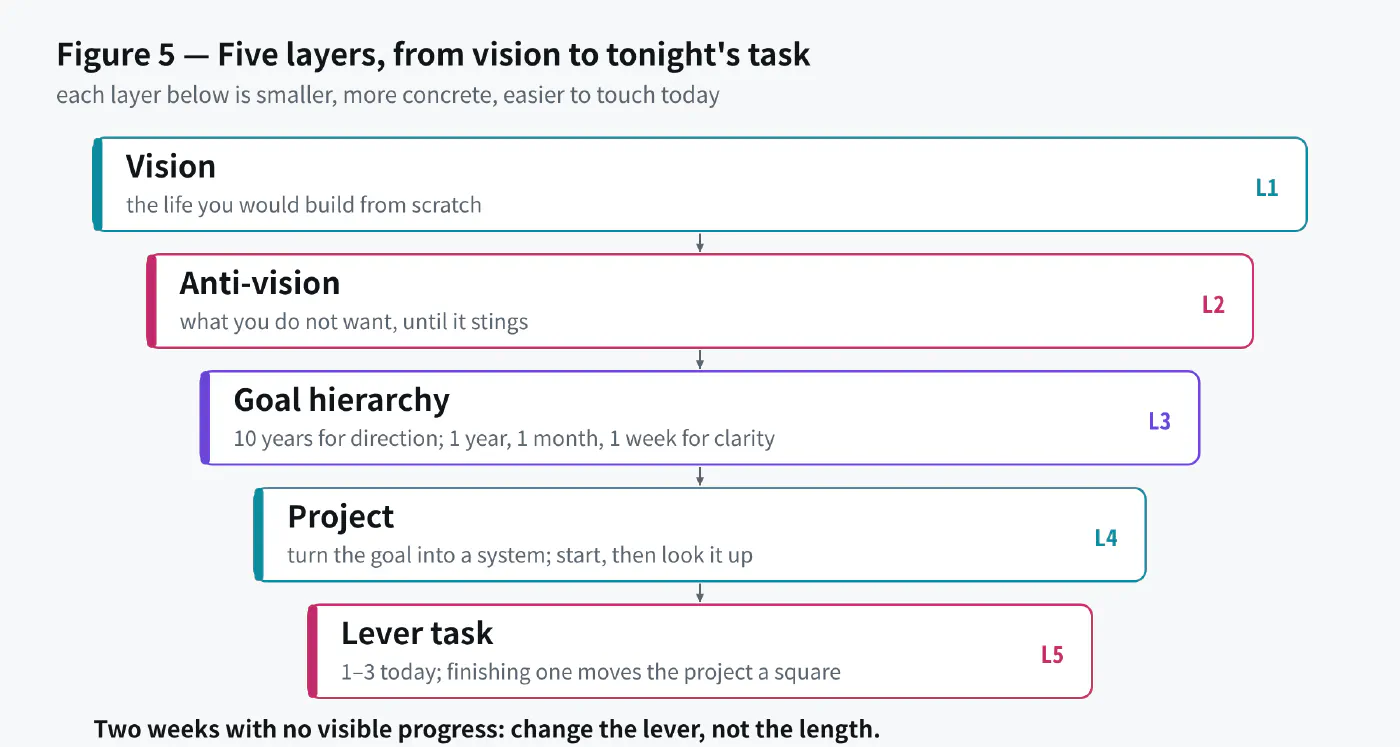
Item 4 is the most operational and the least executed part: finish the one thing that moves the project one square.
6. Uncertainty is signal, not noise#
His position is blunt: of course you feel lost, overwhelmed, and out of your depth — you chose to learn. The difference is that the people we remember do not read uncertainty as danger, so the fight-or-flight response never fires and they can walk into the unknown with a clear head.
He also prices certainty. A job is the most certain thing you can buy, and the salary is the price. Freelancing, a local business, a small product come next — uncertain but simple, with a ceiling somewhere around $1–5 million a year before you need a team or a different model (source, experience-based). Above that: software, physical products, assets — the highest returns and the least resemblance to a plan.
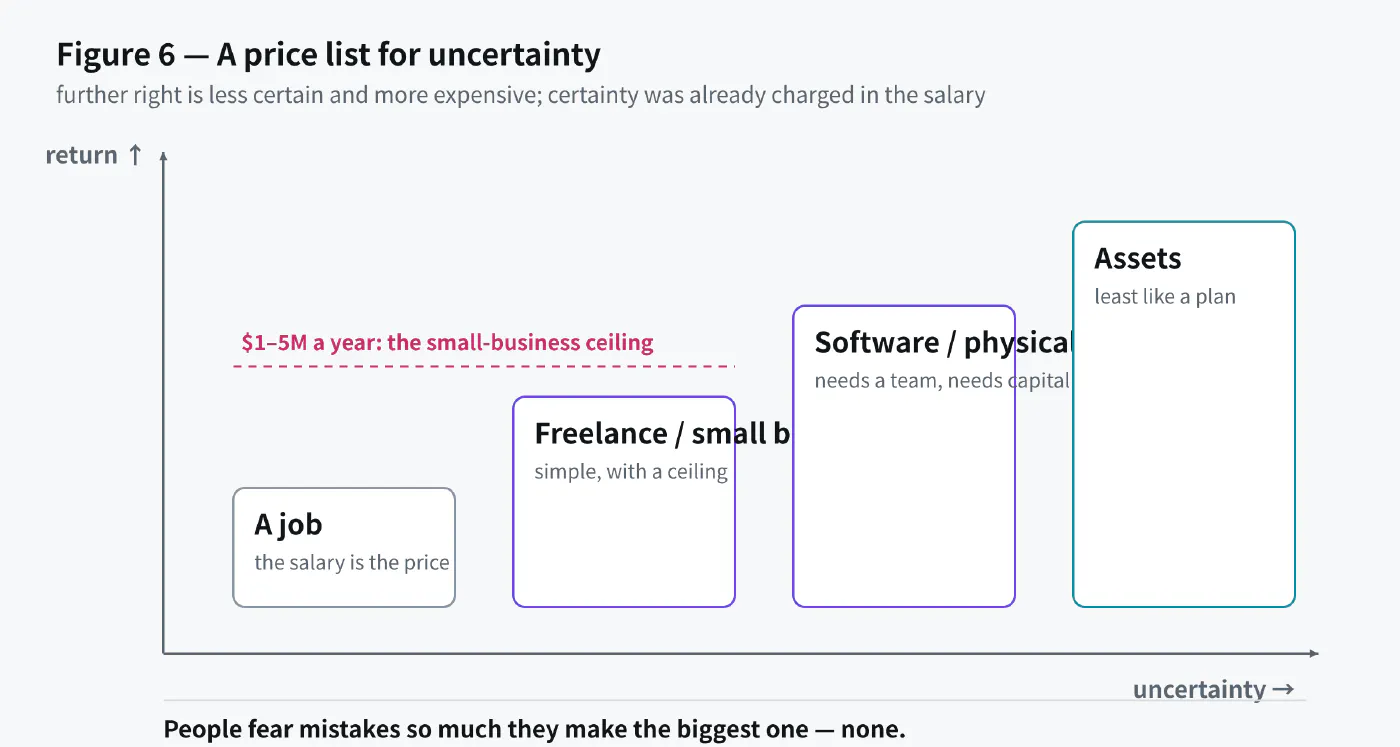
One line worth copying: people are so afraid of making mistakes that they make the biggest one — making none. The self-driving car analogy earns its place too: the system had already crashed millions of times in simulation before it drove anywhere.
7. Numbers, with sources#
| Number | Value | Source |
|---|---|---|
| Time available daily | 1 hour | source, assumption |
| Per year | 365 hours | computed (1 × 365) |
| In working days | 45.6 eight-hour days | computed (365 ÷ 8) |
| Conscious bandwidth | ~50 bits/second | source, not re-measured |
| Unconscious bandwidth | ~11 million bits/second | source, not re-measured |
| Lifetime conscious information | ~125 billion bits | source, derived |
| In bytes | ~15.8 GB | computed (÷ 8) |
| Lever tasks per day | 1–3 | source |
| Test for the right lever | 2 weeks without visible progress means wrong | source |
| Ceiling, small business | $1–5 million a year | source, experience-based |
| Runtime of the film | 1:22 | this episode |
8. Where it does not hold#
The sample is survivors. “Successful creatives walk a lot” does not run backwards: the people who walked daily and did not succeed are not in the sample. Treat it as a hypothesis, not evidence.
Those bit rates are popular-science estimates. 50 bits per second is a rough cognitive-psychology figure, and 125 billion is that estimate multiplied by a lifespan. The error bar is wider than any decision you would make with it. It is memorable and useful and it is not a measurement.
The one-hour model has a hard edge. Work that needs continuous context — chasing a race condition, writing something long, training, caring for family — cannot advance on an hour a day. An hour only pays for reloading the context. That work needs blocks.
Disappearing has a bill. The people you cut off, the dinners you skip, the months you are absent do not come back because your goal was clear. The essay counts the upside and leaves this out.
Maintenance is written too lightly. Most of the essay is about building, and most people’s income comes from maintenance. Someone already in maintenance who adds more building on top of it does not get a second career, they get burnout.
9. Three things you can do tonight#
- Take one sheet of paper and write twenty things you do not want, until it gets uncomfortable. That step alone filters out half the readers.
- Pick one, work backwards into a project that can move this week, and write down its first lever task.
- Tomorrow morning, put that hour on the task and the phone in another room. Two weeks later, look for visible progress — if there is none, change the lever, not the length.
References#
- Dan Koe, How to unlock extreme focus on command (X, 19 January 2026)
- Mihaly Csikszentmihalyi, Flow: The Psychology of Optimal Experience (1990)
- Marcus E. Raichle et al., A default mode of brain function (PNAS, 2001)
- Maxwell Maltz, Psycho-Cybernetics (1960)
- Donald O. Hebb, The Organization of Behavior (1949)