The machine took the typing, the judging stayed on the desk
The Wired piece folds two endings into one, a man's hobby and an industry's trade. I counted the words in it and only believe the first half.
In one line: the machine took the hands. Deciding what counts as finished is still on the desk, and that was always the expensive part nobody taught.
1. He is writing about languages, not programs#
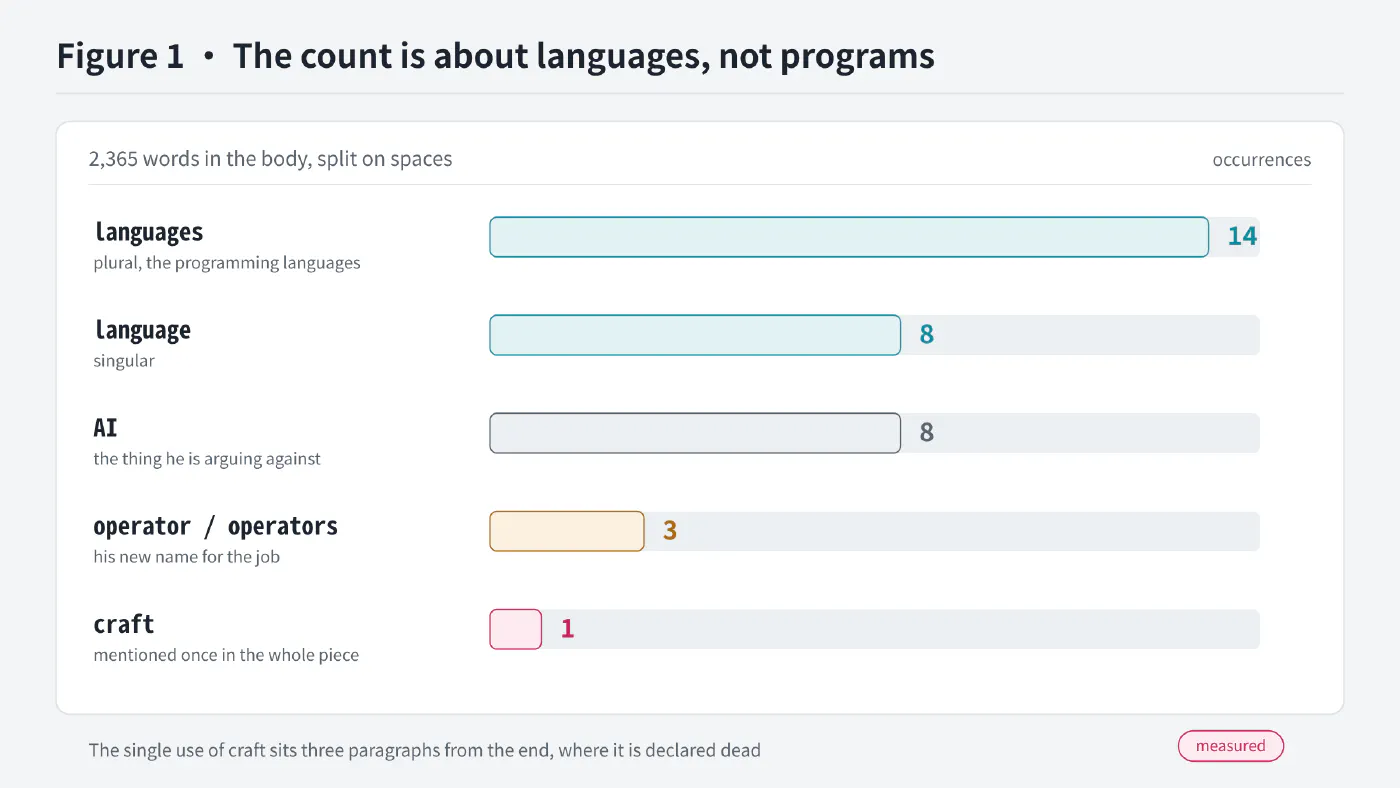
I pulled the body of a Wired article out of the page and saved it as plain text. Split on spaces, it comes to 2,365 words. I did that because of the headline, 《Goodbye, World: The End of Programmers》. A man who writes code, announcing that the people who write code are finished, is worth counting.
The counts. language appears 8 times, languages 14 times, AI 8 times, operator and operators 3 times, craft once.
His own story is a story about languages. A philosophy major who switched to computer science for a visa; Java first, C second, both disliked; Haskell after work to make the job tolerable; a forum of programming-language researchers he compares to a poetry circle; then a compiler, some toy languages, patches to the TypeScript compiler, badges on Stack Overflow. On engineering he is explicit. “I had precisely zero fucks to give about serious engineering.” He wanted a green card and a bit of pleasure between nine and six.
None of that is shameful. Many people come in through that door, and I am one of them. The account is the history of a hobby, and the article draws a conclusion about a trade. There is a gap between the two.
2. The checkable numbers are a short list#
Put the hard numbers in one place and there are only a few. Three come from the author’s own account, one is a report Wired repeats, three are mine.
| Number | Value | Source |
|---|---|---|
| Code written by AI at Anthropic and Coinbase | above 90% | reported by Wired, not re-measured here |
| What the author built with Claude Code | 239 features, 17 extensions, 141 keyboard shortcuts | author’s own count |
| Time spent inside Claude Code on one Sunday | 10 hours, 8 the next day | author’s own account |
| Words in the body, split on spaces | 2,365 | I counted |
| language 8, languages 14 | 22 | I counted |
| AI | 8 | I counted |
| operator and operators / craft | 3 / 1 | I counted |
The hardest number on the list is the 90 percent one, and it is hearsay. Everything else is feel. A column needs feel to carry a reader, so this is not a complaint about the writing. It becomes a problem when the column is read as a verdict on an industry, because most of the numbers in this verdict are the plaintiff’s own bookkeeping.
3. Where the line of a trade sits#
I take a trade to have a threshold. Past it, you cannot know how you will do the thing until you start doing it. A joiner cutting a mortise can draw the shape beforehand. How deep the blade bites and where the wood gives, he finds out at the cut. When it is finished he is a little surprised by his own solution. That surprise is the receipt.
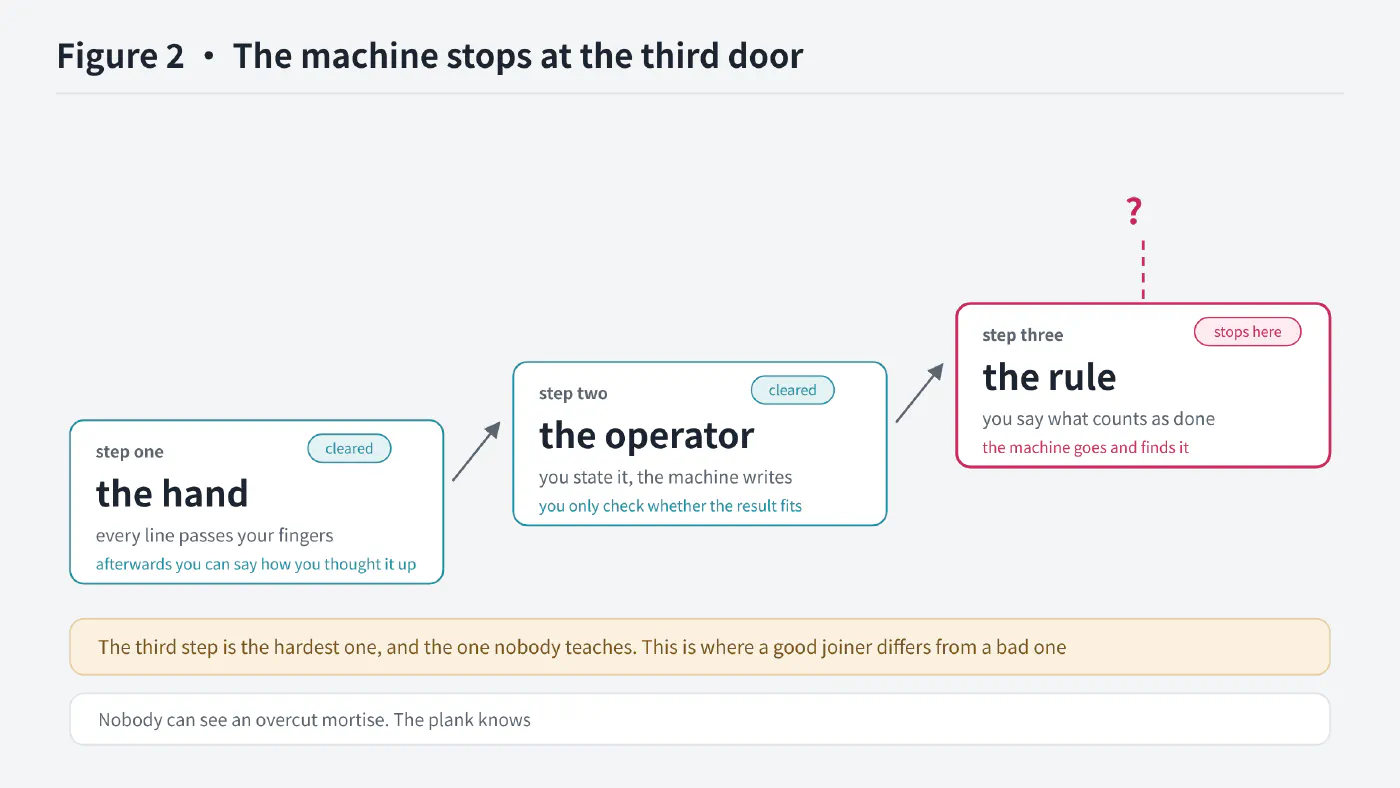
Measure the work of writing code against that line and it sorts into three steps.
- The first is the hand. Every line passes through your fingers, and afterwards you can say how you thought it up.
- The second is the operator. You state what you want, the machine writes it, you look at the result.
- The third is the rule. You state what counts as done, and the machine goes and finds it.
Han says he became an operator. I agree with him. What he skips is the third step, and it is the hardest part of any trade. A good joiner and a bad one are not separated by whether they can plane a board. They are separated by knowing where to stop. Nobody can see an overcut plank, and only the plank knows.
4. A table saw and an agent do not take the same thing#
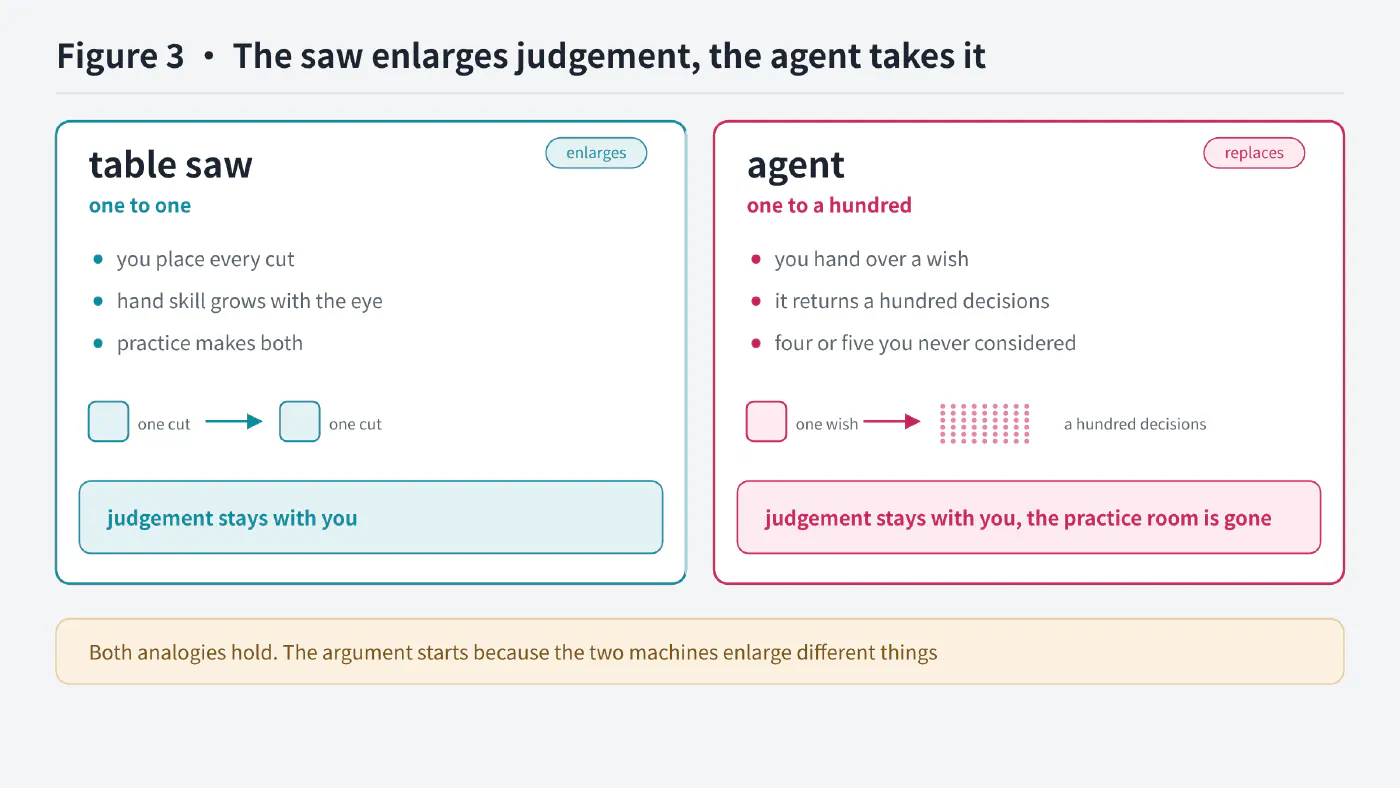
Simon Willison has an analogy. Quitting programming as a career because of LLMs is like quitting carpentry because of the table saw. Han’s reply is clean. A carpenter working with a table saw is still a craftsperson.
Both of them are right, and the argument happens because the two machines enlarge different things. A table saw scales your judgement one to one. You still choose where every cut lands. An agent takes that layer as well. You hand it a wish and it hands back a hundred decisions, four or five of which you never considered.
So two things that grew together come apart. Under the table saw, hand skill and judgement were one exercise, and practice built both. Now the hand skill belongs to the machine, the judgement belongs to you, and the judgement has lost its practice room.
Han worries that there will be no more Brian Kernighan, who co-wrote the book that put “Hello, World” into everyone’s first lesson. I worry about something else. A kind of judgement with nowhere left to train.
5. The last load-bearing wall is review#
If nine tenths of the code is written by machines, then the load-bearing human act left is reading a diff. Review is the one place where a person still decides whether a thing ships.
That wall has always been thin. In teams I have watched, review is a scroll down and an LGTM, thirty seconds when the queue is long. It could afford to be thin while the author had done the work by hand. Now half the authorship never passed through a hand, and the wall is the same thin wall.
Judgement has a constraint here. It grows by meeting mistakes. A thousand other people’s mistakes teach you which line looks wrong. An agent hands over a hundred decisions at once, and you have time to read the results.
6. The handover has happened four times#
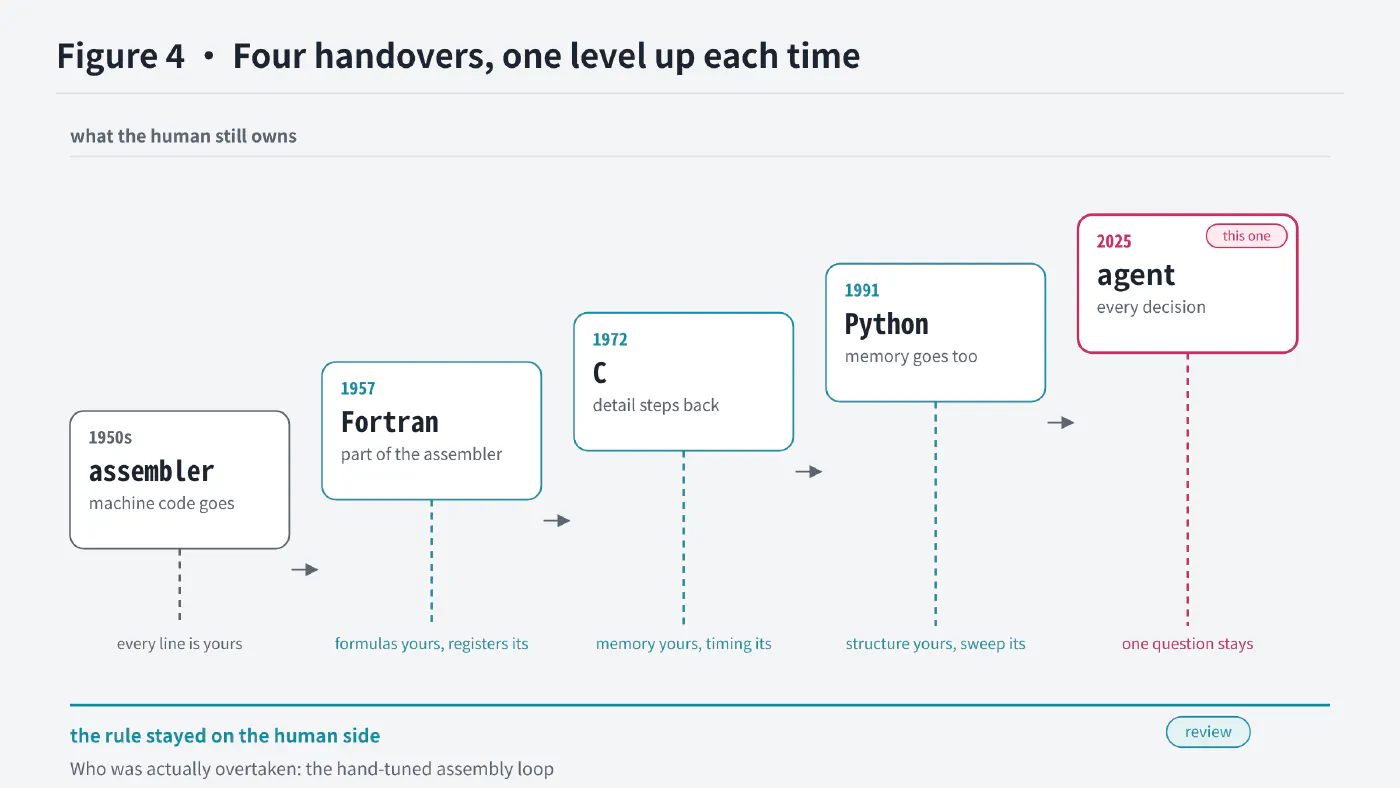
Programming has changed hands before. The assembler took the machine code. Fortran took part of the assembler in 1957. C pushed hardware detail into the background in 1972. Python took memory management in 1991. Each time the human moved up one level and kept the judgement.
One group really was overtaken. The people who hand-tuned loops in assembly were prized in the sixties. Compilers beat them on some of those loops, and the work drained away.
A handover on its own has been survivable. What is different now is the level it reaches. Containers won on large compute as well, and that win had nothing to do with judgement. It was startup time and consistency, an account anyone can settle on paper.
7. Three checks you can run this week#
- Take the last three merged diffs. Without reading the code, write one line on what each change was for. The one you cannot write is the judgement you handed over.
- Pick a function an agent wrote and ask whether you would make a colleague justify it. If the answer is yes, that justification is the rule you still owe.
- For one week, count the times you said “this is not what I asked for” and then gave a reason. That count says more about your standing than the lines you wrote.
8. Two questions I cannot answer#
The first is whether judgement can be trained away from the hand. If it can, I only know one method so far, which is reading reviews the way you read a textbook. If it cannot, then the trade gets collected rung by rung, and I happen to be standing on the rung being collected.
The second is how many lines a day a person can read, once nine tenths of the code is written by a machine and read by a human. Nobody has published that number, and it is not in Han’s piece. It decides when the wall comes down.
His last line says that as humans cede control to the machine, the pleasure of polyglot programming will be a joy lost to us all. I believe that sentence. I still want to know whether what goes is the pleasure or the trade.
When this is done I will read the original once more. No counting this time.
References#
- Sheon Han, 《Goodbye, World: The End of Programmers》, Wired, 23 November 2026.
- Simon Willison’s table saw line, quoted in the article above.
- Natasha Dow Schüll, Addiction by Design, 2012. Han borrows it to separate flow from the machine zone.
- Brian W. Kernighan, Dennis M. Ritchie, The C Programming Language, 1978.