The firm grows a basement
Two twenty-four-year-old managers at OpenAI wrote a long piece about where AI sits once it joins a company. I went down through all three arrangements with a pencil, and the column that stays blank is the one where somebody has to keep the books.
In one line: two people of twenty-four start managing teams whose staff are machines. All three arrangements are already happening, and nobody has filled in the column for the extra floor.
1. Two people of twenty-four#
Every org chart I have seen is printed on A4, landscape, three ranks of boxes squeezed into the height. One box at the top, then a fork, then the third rank, where the paper ends because there is nobody left to manage.
The piece opens with a small fact. The two people who wrote it manage teams at OpenAI, and both are twenty-four. The old rule says a person of that age takes minutes, drafts memos, and spends some years on dull work before a patch of ground belongs to them. They skipped that. They have staff, several of them, and the staff work nights.
Twenty-four is not the interesting part. The interesting part is that the jump cleared two ranks, and nobody has said what goes in the space that opened up.
The piece lays the AI out three ways, and I drew the three of them below. First, underneath us, where everybody gets a basement. Second, beside us, where it sits in a chair like a colleague and reports to the same manager. Third, between us, with people above and people below and the AI in the middle doing the coordinating.
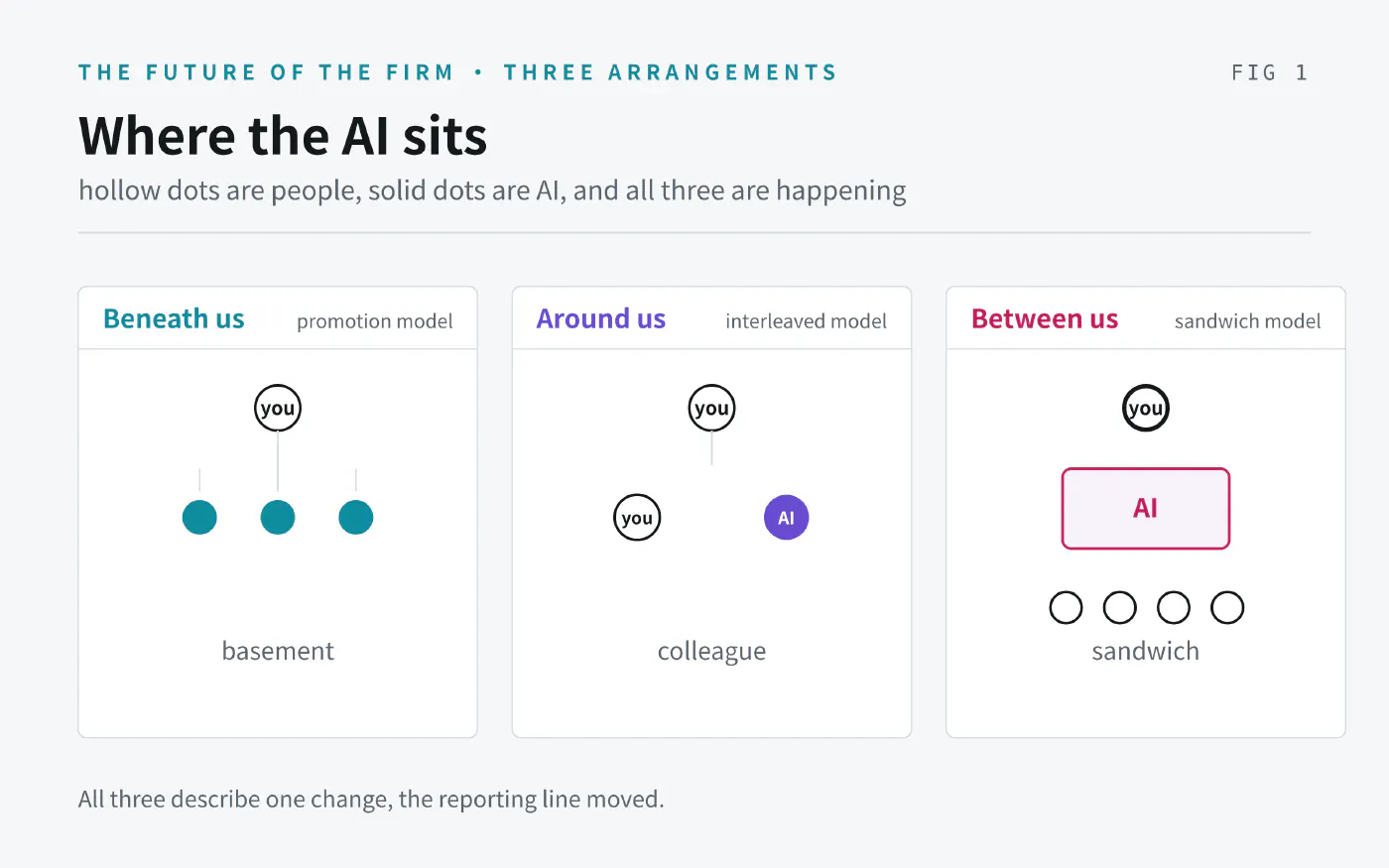
I have heard all three before. What is new is that this time the subject is reporting lines, who sends a weekly note to whom, who signs at whose review. That is not a small change. Move the reporting lines and the chairs have to be moved too.
2. The extra floor#
The first arrangement frightens nobody. Everyone keeps their title, not one line on the chart changes, and each desk simply gains a floor underneath. The piece calls it a basement.
At first the basement holds one or two agents, like a new intern. It writes the email, drafts the memo, answers a message at any hour. An intern needs watching, needs scolding, needs teaching afterwards. Later the basement holds a manager, an accountant, a lawyer, and you stop being the person who supervises an intern. You sit on a board and the basement is a small company.
The example is Jace, an accountant. He no longer walks a spreadsheet cell by cell, because his agents do that. His work now looks like his manager’s work of a few years ago, and his manager has a wider patch than before. The accounting team did not shrink. Other departments produce more, so there is more to account for.
The piece puts a neat sentence next to that sum. AI takes nine tenths of your work, and the tenth that is left gets scaled up tenfold. I copied the sentence into a notebook and then did the multiplication.
Nine tenths times ten is nine full jobs, more than I do now. If either side of the multiplication sign is soft, the answer on the other side is hollow. The piece hedges in the same paragraph, saying the job gets dearer and the target grows with output, provided demand grows too and people still add something to production. It offers a counter-example, that we own far more than we did and work only a little less. I believe the counter-example. The people around me own three times what their parents did and have perhaps half an hour more to themselves.
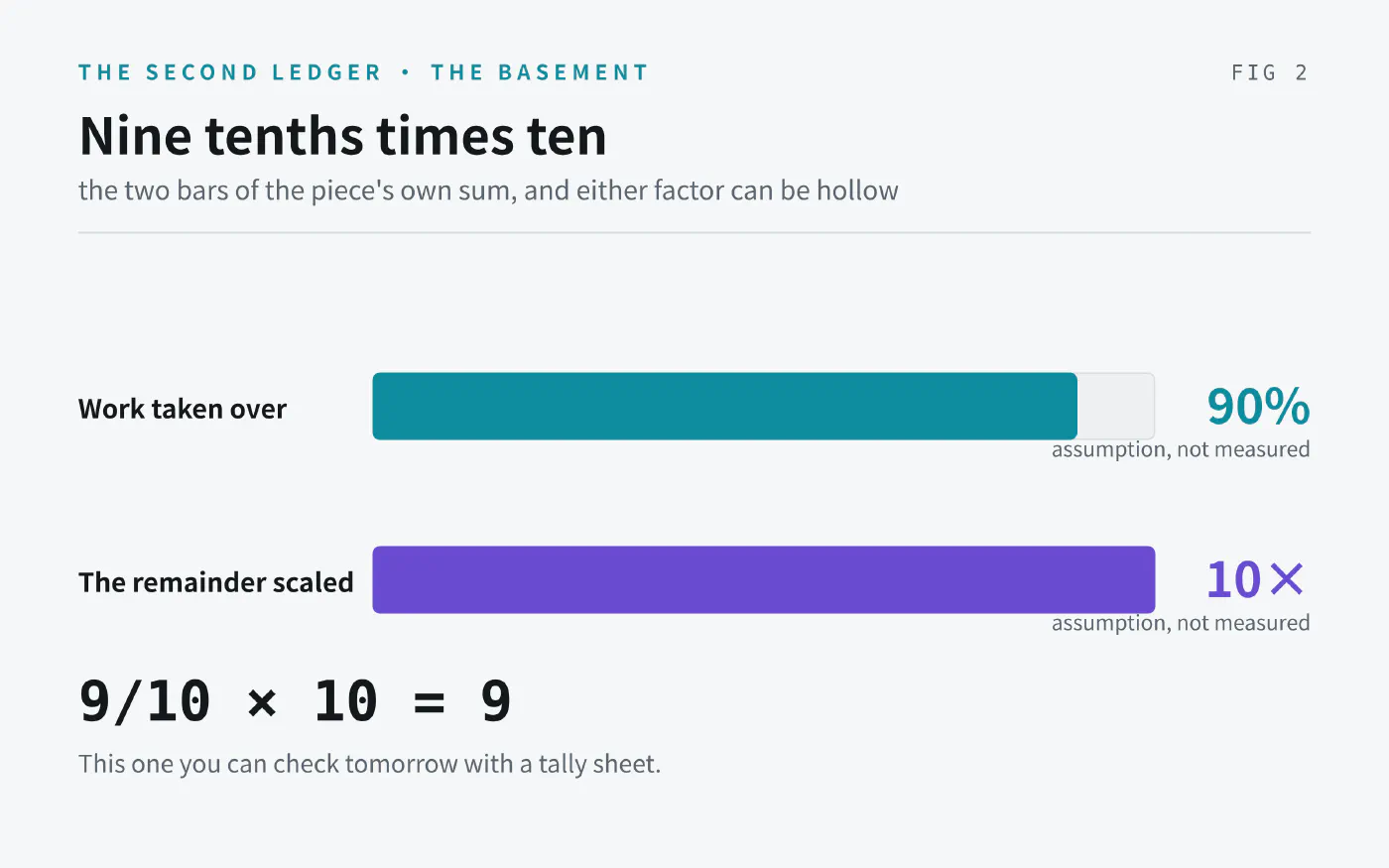
I am not going to bury that sum. I want one more column beside it, and the column is handovers. Once nine tenths of the work is taken away, somebody has to explain to the floor below how those nine tenths were done. I come back to that in section six.
3. Sitting in the middle as a colleague#
The second arrangement is more dignified. The AI does not live in a basement. It sits opposite you, and you both report to the same manager.
The example is Sheila, a vice president at a furniture company. She has run sales and run design. She has never run an ad campaign. She hands a budget to an AI marketing team and asks it to sell a new sofa. The team splits itself up. Some agents interview the salespeople, some check with the factory whether the delivery date is real, the rest produce sample layouts. Drafts move between them without passing her desk. On Monday she receives a plan and one question with it, whether the sofa in the photograph looks too blue. She would not have noticed that detail herself.
What I thought about while reading this was luggage. The piece says a role is a suitcase full of tasks, and a team is a suitcase packed to the lid. The fuller the case, the harder it is to pack on somebody’s behalf, because a single task that needs hands forces the whole team to be given hands.
The wider the scope, the harder it is to build, and the easier it is to adopt. That is the most solid sentence in the piece, and I believe it. Hard to build, easy to buy. A narrow tool needs the whole firm to learn it. A team that can run a whole function needs one nod from the person at the top.
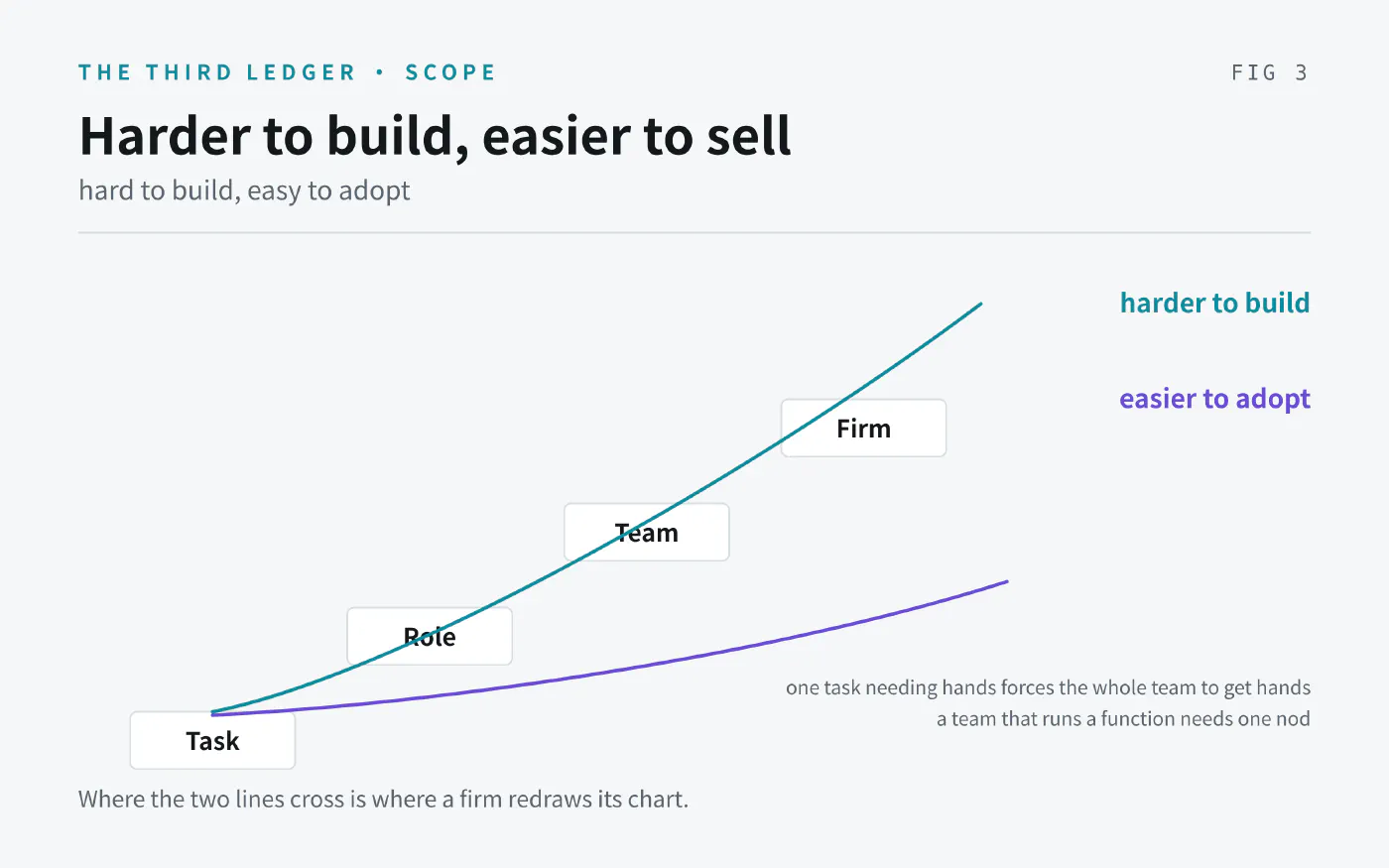
The piece then pours cold water on itself, and I accept this bucket. Almost all economic output comes from organisations, and output from people working alone is tiny. Measuring a machine against one employee flatters us. To be enough, it has to match a group.
That sentence also redraws the picture from the previous section. If every model is one more chair beside one more desk, a firm ends up with thousands of seams, and every seam needs someone watching it. A more likely shape is a few teams arriving whole.
4. The layer in between#
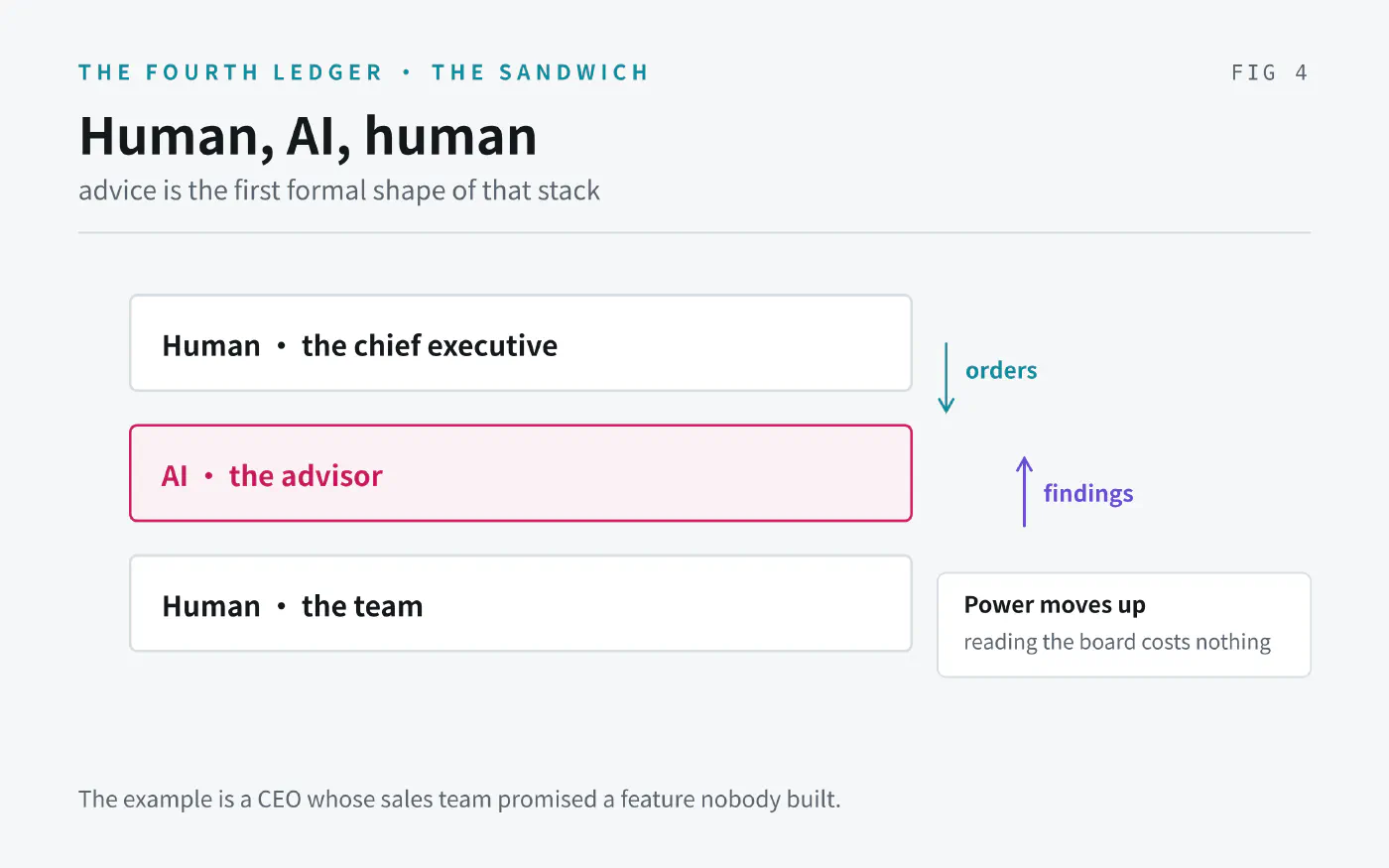
The third is hardest to swallow. Human, AI, human, with the AI in the middle and people reporting to it.
The example is Asha, a chief executive, and an AI advisory that tells her something is wrong with a product about to ship. The trail leads to sales promising a feature that engineering never built. The evidence sits in everyday Slack threads. Nobody wrote a report, and nobody had noticed the two sides meant different things. The advisory also finds an engineer working from home who built the groundwork without being asked, and tells Asha to give her credit for it.
I believe half of that. Reading a few hundred channels and documents to find the one promise that does not match is work a person does in two sleepless nights, and the machine can do it. What I do not believe is how tidy the example is, tidy enough to be a teaching case. Real misunderstandings tend to live outside documents, in two people nodding at each other and neither writing it down.
The price is a livelier question. Consulting firms have stood above the firm for decades, billing by the hour, opening with thirty slides. An AI adviser is cheap enough that nobody asks the price, and it never leaves. The adviser’s cleverness is the same cleverness. What fell was the price, and a price that falls that far turns advice into tap water.
Tap water has a consequence, and the piece states it plainly. Power goes to the top. Information used to be expensive, so the people near the work decided quickly. Reading the whole board now costs almost nothing, so the decision travels upwards.
The piece goes further, saying automation may start at the top. We expect the machine to take the bottom rungs first and leave judgement to the top, yet a manager’s day is mostly on a screen, reading, meeting, weighing, deciding, while the bottom of the firm still needs hands. The intern runs the photocopier. The ladder starts burning at the top, and the piece illustrates it with a skeleton hand on the highest rung. I closed the file for a moment after that.
5. Four ledgers#
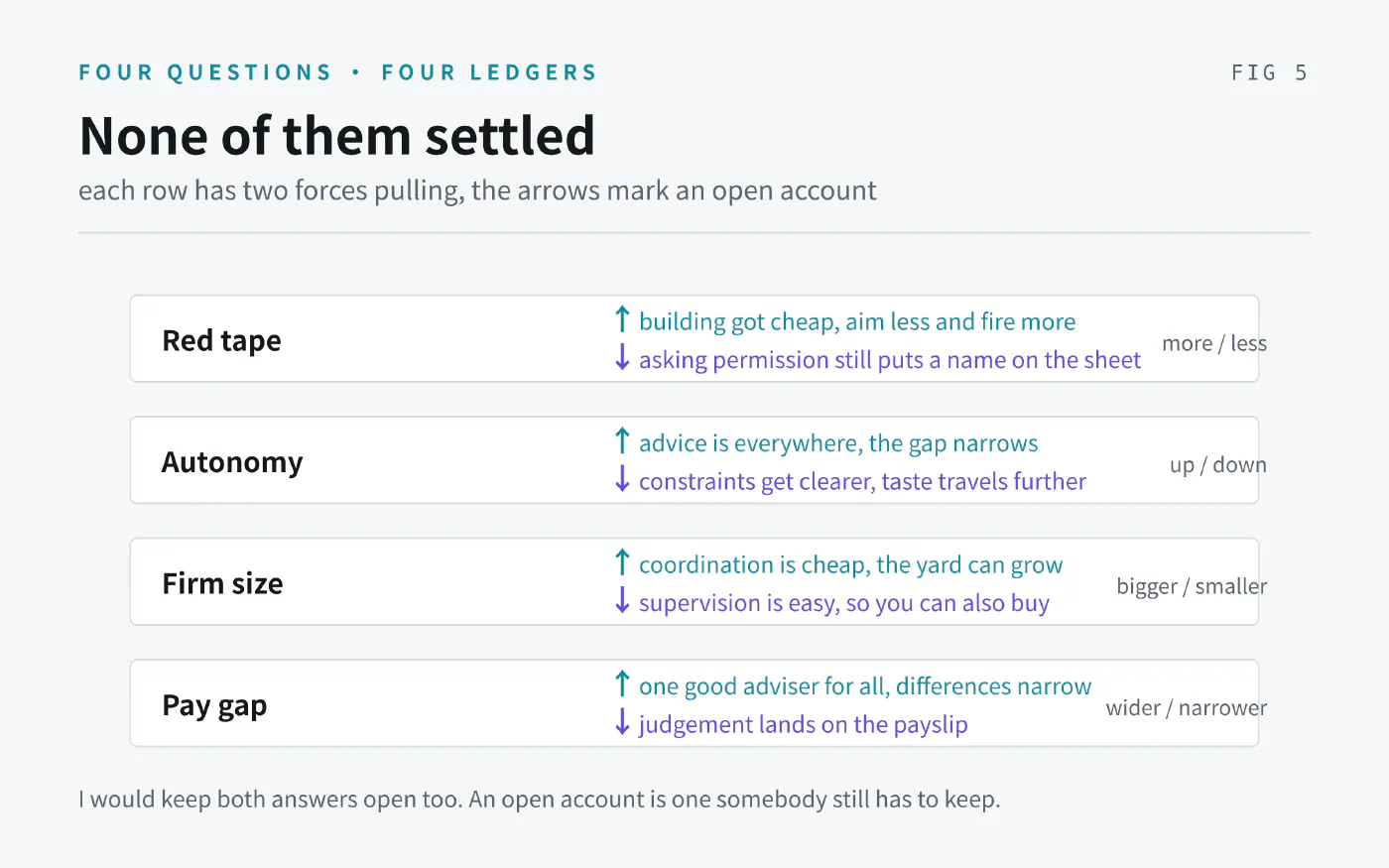
The piece closes with four ledgers and settles none of them. I will copy them out and keep its words apart from mine.
The first is red tape. Building anything used to cost enough that you aimed carefully, which is where planning cycles, roadmap reviews and approval committees came from. Now that building is cheap, the piece argues for less aiming and more firing, prototype first and learn from it. It follows the logic to its end, saying that when asking permission costs more than doing the work, the middle layer of managers has no reason to exist. I follow the first half. On the second half I keep a question mark, because asking permission is rarely about being right. It is about somebody’s name on the sheet.
The second is autonomy. If excellent advice is everywhere, the gap in decision quality narrows and managers have less reason to interfere. The piece then reverses itself, noting that the same machinery lets a boss push her taste further out, chain restaurants wanting one menu so they can buy in bulk and so customers can trust the order. Its conclusion is cheerful, that everyone’s scope grows while the constraints become clearer. I accept the wider scope. About clearer constraints I am less sure.
The third is firm size. It starts from Coase in 1937, asking why production happens inside a firm at all. Half the answer is transaction cost, the other half is aligned incentives, which is why an aerospace company buys the engine maker instead of writing a contract the engine maker can shave. With AI as the coordination layer, communication gets cheaper and the yard can grow or shrink. The piece gives reasons for both. I respect that. It refused to invent an answer.
The fourth is pay. If everyone has the same good adviser, differences narrow. If everyone’s staff is ten times bigger, differences in judgement land on the payslip. Two forces pull against each other, and the piece declines to referee. It leaves one question, whether we spend our days making judgement calls or following them.
6. My own sum#
Everything above is somebody else’s arithmetic. Here is mine.
I have only ever kept two kinds of number, work points on a commune ledger and the shift rota. Reading about an extra floor, the first thing I thought of was the extra column that would appear on the rota, and whose name would go in it.
Handovers cost money, and that money is never booked. You give a job to somebody else and you owe them the background, the history, and the words they must not use loosely. Telling it takes about five minutes. Writing it down takes about two hundred words. One person hands over three times a day, so three people do it nine times, which is forty-five minutes and eighteen hundred words. Those numbers are my estimate and section seven marks them as illustrative. To replace them with your own, you need one day and a tally.
Forty-five minutes a day is not much. Over a year it comes to two weeks, spent every day, on no report anywhere.
The piece knows this. It says that putting a model beside every employee leaves thousands of handoffs, and that this patchwork may slow adoption down. It treats the handoffs as an efficiency problem. I treat them as bookkeeping. Efficiency waits for the technology to improve. Bookkeeping waits for somebody to agree to keep the book.
There is one more cost, and the piece admits it. Give the bottom rung to the machine and the apprenticeship loses its road. A young person used to learn the trade by doing the dull work. With the dull work taken, they are supposed to start from judgement, and judgement does not fall out of the sky. The piece says the costs are real and that on balance this is a privilege, since a twenty-four-year-old with a good idea now gets the resources to build it.
I agree with the first half. I will not clap for the second. A privilege has a threshold on its other face, and the twenty-four-year-olds with resources tend to be the ones who had resources.
7. Numbers and where they come from#
| Figure | Value | Source |
|---|---|---|
| The authors’ age | 24 | the piece itself |
| Share of work taken over | nine tenths | the piece’s assumption |
| Scale on the remainder | tenfold | the piece’s assumption |
| Jobs after past automation | did not fall | the piece, citing MIT |
| Output against hours | far more owned, hours barely lower | the piece, citing OWID |
| Firm boundaries | Coase, 1937 | the piece’s citation |
| Output of a solo worker | very little | the piece, citing the Census |
| Cost of one handover | 5 minutes, 200 words | my estimate, illustrative |
Not one number in that table is mine except the last row, and the last row is soft on purpose. It is a number you can check tomorrow with a tally sheet.
8. If I had to give advice#
First, redraw the org chart down to your own rank. Next to each layer write one number for how many people sit under it. Half an hour finishes the drawing.
Second, keep a handover ledger for a week. Who gave what to whom, how many minutes it took, how many lines got written. Four weeks of that shows you the narrowest point.
Third, leave a new person a step they can climb themselves. Give them one real job, even if it takes three times as long. With the dull work gone, somebody has to build that step by hand.
Fourth, ask the adviser for evidence you can open. Whatever will not open is an opinion, and an opinion is not a conclusion.
What I will do tomorrow morning is small. I will take the A4 org chart out of the drawer, write a number beside every layer, and put the sheet under the desk lamp. The lamp is old, the switch is loose, and it takes two presses to light.
References#
- OpenAI, The Future of the Firm, 2026 | https://openai.com/index/the-future-of-the-firm/
- Chinese edition | https://openai.com/zh-Hans-CN/index/the-future-of-the-firm/
- Ronald Coase, The Nature of the Firm, 1937 | https://onlinelibrary.wiley.com/doi/10.1111/j.1468-0335.1937.tb00002.x
- MIT ShapingWork, the history of workplace automation | https://shapingwork.mit.edu/research/why-are-there-still-so-many-jobs-the-history-and-future-of-workplace-automation/
- Our World in Data, output per person against annual hours | https://ourworldindata.org/grapher/annual-working-hours-per-worker
- The Chinese version of this essay | /icorer_blog/posts/essay/future-of-the-firm/