One photon at a time, and a trace too wide for one photon
Turn the light down until a single photon passes at a time, and the screen still grows stripes that take many photons to explain. There are several readings of that, and each one carries its own bill.
One line Turn the light down until one photon passes at a time, and the screen still grows stripes that take many photons to explain. Every reading of that sentence carries a bill.
I keep a laser pointer in a drawer, the sort that costs a few dollars and puts a bright dot on a wall. Put a piece of card in the way with two pinholes in it and the dot turns into a row of light and dark bands. I met that in school and forgot it. What I did not meet in school is that the same row of bands shows up when the light is turned down so far that one photon goes through at a time.
1. A card with holes#
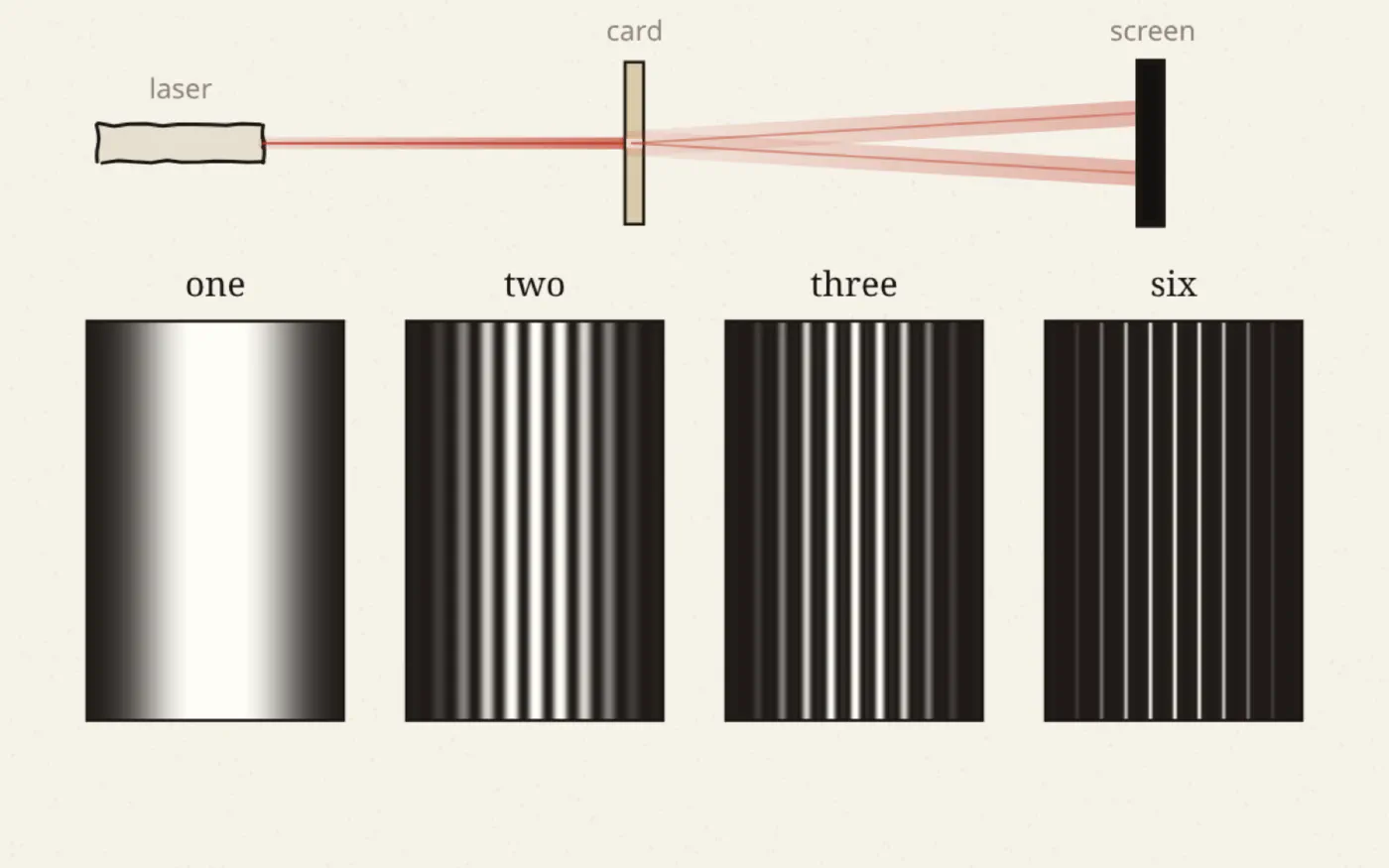
Three things on the table. A card with holes, a laser pointer, and a sheet of white paper standing in for a screen. One hole gives a broad smear of light with soft edges, not a tidy dot. Two holes give a row of parallel bands. Three, then six, and the bands get finer as the dark parts get darker.
People were doing this a century ago. In 1909 an undergraduate at Cambridge dimmed a gas light through a stack of dark glass plates, let the light diffract around a sewing needle, and left the plate exposed for three months. He was testing a claim of the day, that the energy of light is spread unevenly across the wavefront. The fringes came out anyway. The experiment settled very little on its own. What it did was pin two things onto one photographic plate, that the light was extremely faint, and that the fringes were still there.
2. One at a time#
The hard part starts when the light is dimmed further.
From the 1970s there were sources that announced themselves. An atomic cascade emits two photons back to back, so detecting one tells you the other is on its way. In 1986 a group at Orsay aimed those twin photons at a half-silvered mirror and opened the gate on one side only when the other side had fired. The two counters almost never fired together. That rules out the comfortable explanation, that several photons were in the apparatus at once.
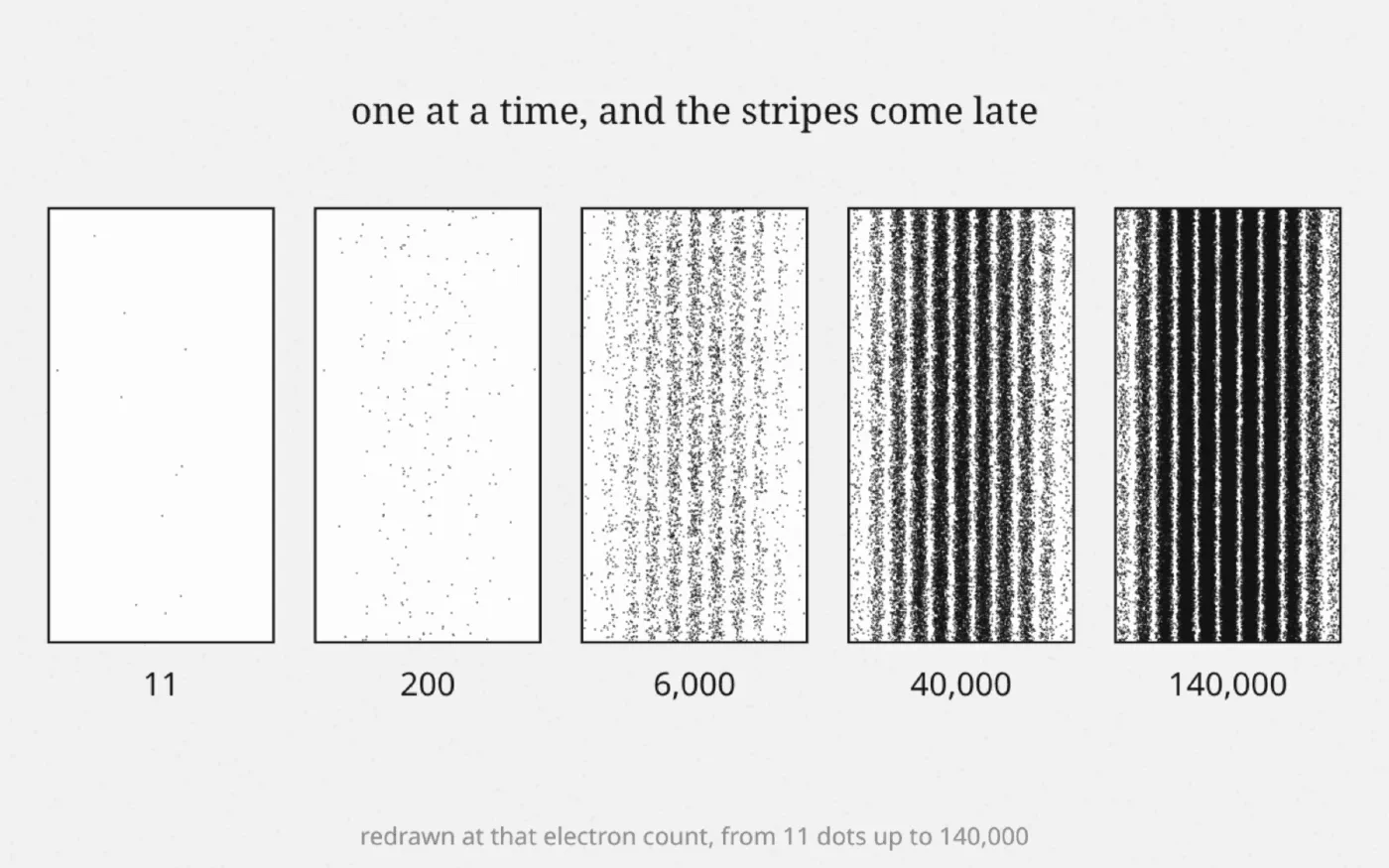
Electrons have the better picture. In 1989 a group at Hitachi sent electrons through a two-slit setup one at a time and recorded each landing. The first frame holds eleven dots, scattered at random. Two hundred, still scattered. Six thousand, and the bands begin to show. Forty thousand, clear. A hundred and forty thousand, and it is the picture from the textbook.
One at a time, each landing unrelated to the last, and the accumulated dots still draw a pattern that takes two sources of waves to produce. Which raises the question. What did the photon interfere with. The one before it had already landed. The one after it had not left.
3. Blocking the other hole#
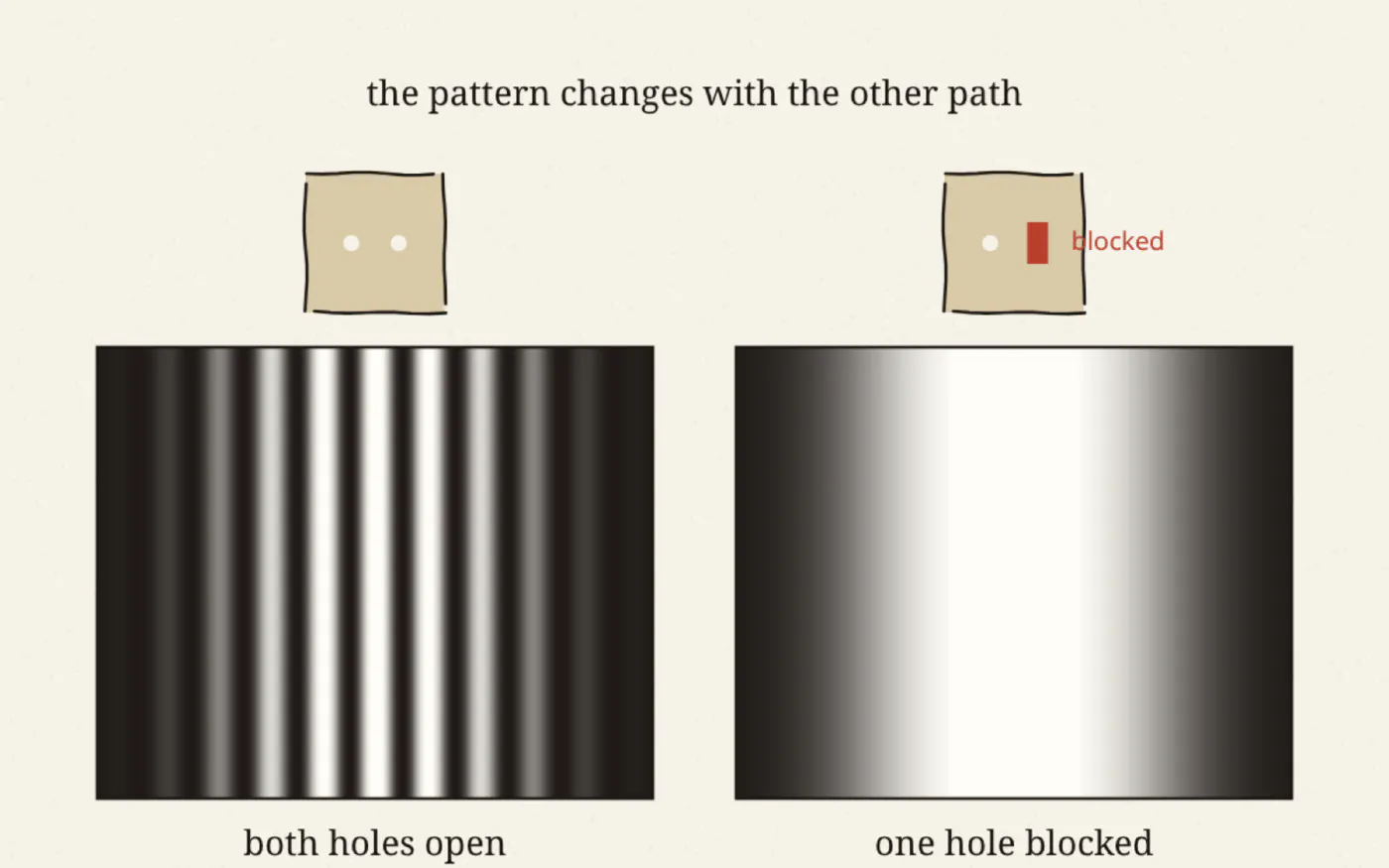
There is a further step, and it is the awkward one. Block the second hole.
A single photon cannot hit the hole you blocked. It still behaves differently depending on whether that hole is open. The pattern is built up dot by dot, and the thing being built responds to a path the photon never took.
People have pushed this into stranger places. In 2007 a group let a random number generator decide whether the interferometer would be closed or open, after the photon had already entered it, with the decision separated from the entry in time. The counts still matched the quantum prediction. In 2013 another group used weak measurements to ask photons which mirrors they had passed, and the answers were odd. The photons left a signal on mirrors that no continuous path would reach. That conclusion is still argued over, the argument being what a signal counts as.
Whatever the reading, one thing is clear from the bench. “The particle went through one of the holes” is a sentence that does not do much work here. Take a word built for continuous journeys and apply it to something with no continuous journey and a live response to the other path, and you are left with a remainder that no wording absorbs.
4. Taking the unseen path literally#
One reading of that remainder is the most literal and the most expensive. Read the wave function as a description of what is there.
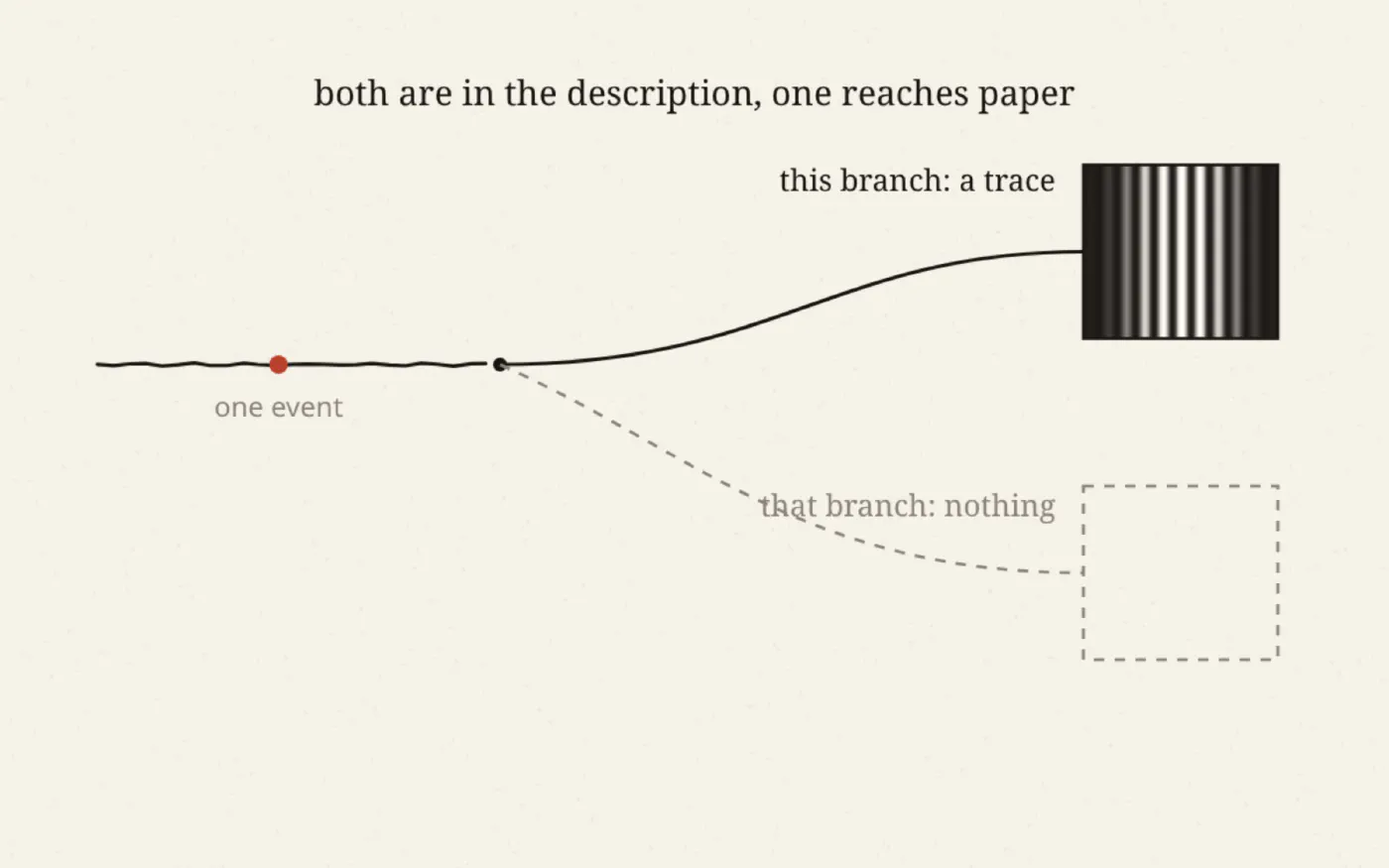
With both holes open, the object that describes the photon is a sum of two paths. Most textbooks stop there and say that measurement makes it settle on one outcome. The other move is to never let it settle. Keep the sum. Then “something went through the other hole” can be true as stated, with the qualifier that the something is not in our branch. Our branch keeps the trace on the screen. The other keeps nothing.
The idea is old. Everett wrote it in his 1957 thesis and called it the relative state formulation, with no splitting anywhere. DeWitt introduced it to a wider audience in Physics Today in 1970 and gave it the name that stuck, many worlds. Everett did not care for the splitting talk. For him the wave function stayed one thing, and what differed was which branch we were in.
The reason you never meet the other you is also on the shelf, and it is called decoherence. A drop of ink in a glass of water is visible for a moment and then spreads until the whole glass is faintly grey. A macroscopic object leaks information into its surroundings without pause, and by the time the leak is done, interfering the two branches back together would take control of every molecule in the glass. Another version of you, if it is in the description at all, is not somebody in the next room.
5. The bill#
Here the readings start paying, and they pay in different currencies.
| Reading | Where the bands come from | What it adds | What it costs |
|---|---|---|---|
| Wave function as a calculating tool | The distribution the sum predicts | A rule that measurement yields one outcome | No account of when the rule fires |
| Many worlds | Branches evolve, we sit in one | The wave function taken literally, plus a weight per branch | The weight has to be argued for separately |
| Hidden variables (the Bohm line) | Particles have trajectories, the wave guides them | An unobservable initial distribution | Nonlocality, and a defence of the extra reality |
Take the middle row first. The bands are statistics. Their spacing comes from a probability distribution, so every reading owes an account of where probability comes from. Many worlds has a specific difficulty here. If every outcome happens, what does it mean to say one is more likely. Its defenders answer from decision theory, arguing that an agent inside a branch, betting on outcomes, must behave as if the Born rule held, a line that runs from Deutsch’s 1999 paper to Wallace’s 2012 book. The objections are not gentle.
Bell, in a 1986 lecture, called the hypothesis extravagant and extravagantly vague, while granting it might have something to say about the EPR puzzle. Later objections are more specific. One line says decoherence does not hand you a preferred basis, so you cannot even say which direction to count branches along. Another says the Everettian probability argument moves in a circle. In 2018 Frauchiger and Renner published a thought experiment with four agents reasoning by the theory’s own rules, arriving at contradictory conclusions, which they read as the theory failing to describe itself consistently. Others read it as a misapplication of the rules.
One thing is easy to check. The physicists have not settled it. A 1997 poll of 48 people at a workshop gave Copenhagen 27 percent and many worlds 17. A 2016 online survey of 149 physicists across eight universities gave Copenhagen 39 percent and Everettian views 6, with 36 reporting no preference at all. In the 2011 poll, 58 percent agreed that personal philosophical prejudice plays a large role in the choice.
6. Pushing the same reading into time#
Deutsch did not stop at the screen. In 1991 he moved the language of quantum computation onto closed timelike curves, the worldlines of general relativity that bite their own tails.
His method is to look for a fixed point. Treat the traveller as a quantum system, send it round the loop, and require the state it brings back to match the state it left with. That consistency condition has solutions in many cases. Having a solution means the paradox does not need a law to forbid it. Physics picks a history that closes.
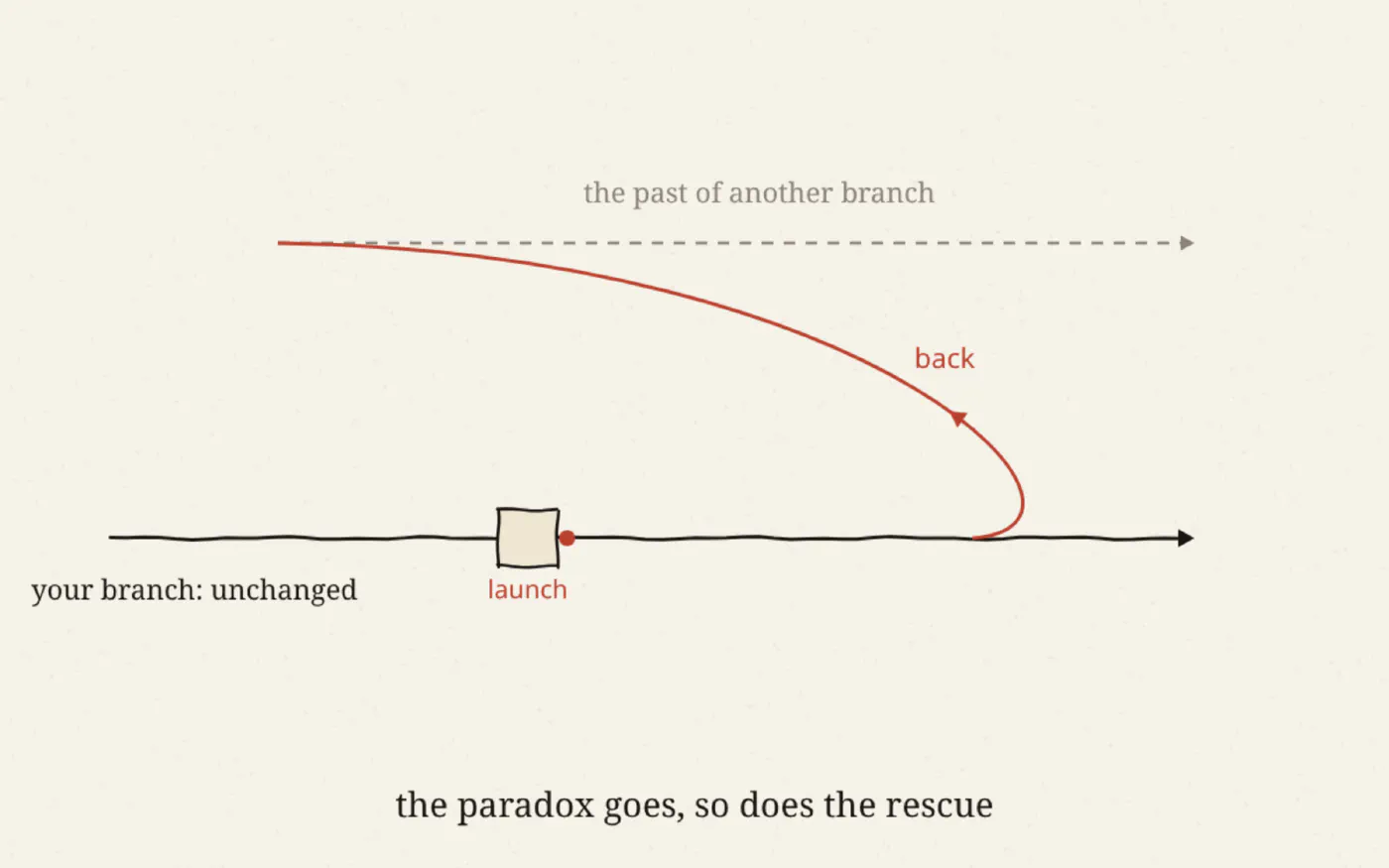
The grandfather paradox then splits in two. You do go back. You do stop your younger self. The young man you stop belongs to another branch. Your own history is untouched, and on it the machine was built and you left.
The price is concrete. The person you wanted to save is not in your branch, and the one you save is someone else’s. When he was asked whether he would step into such a machine himself, his answer was no. That answer is more honest than most of the argument around it.
7. The second bill#
The model also kicked a nest in computation theory.
In 2009 Bennett and colleagues pointed out that it smuggles in nonlinearity. A classical mixture going in does not come out as the matching mixture, a flaw they named the linearity trap. The same year Aaronson and Watrous worked out something worse for the sales pitch. If closed timelike curves existed, quantum computers and classical computers would level out into the same complexity class. Time travel would erase the advantage of quantum computing. In 2011 Lloyd’s group offered a tighter version that replaces the fixed point with postselection, and demonstrated the consistency condition on a photonic circuit. The experiment matched the prediction.
What was simulated is the equation, not the time travel. Nobody has observed a closed timelike curve. General relativity permits them and nature has not produced one.
8. Three things I have not worked out#
First, whether the interference pattern counts as evidence for other branches. It shows that something invisible takes part in where a single photon lands, and every camp concedes that, including the one that treats the wave function as bookkeeping. The disagreement is whether that something gets a reality of its own. Cross that line and you are doing metaphysics. Stay behind it and a sentence is always missing.
Second, whether the probability account will ever close. I can follow every step of the Everettian decision-theoretic argument and I cannot point at a broken one, yet I cannot tell whether it explains probability or quietly redefines the word “I”.
Third, whether physics loses its predictive grip if the time travel model holds. For a traveller who can land in another branch, any claim about what happens when he goes back turns into a claim about what happens in some branch. The shape of a prediction changes, and I want to think about that for a few more years.
I still have that frame with eleven dots on it. The folder is called not figured out yet, and there are a few other things in there. When one of them comes clear I will go back and delete it.