Allegedly the singularity has begun: three sums from an old-fashioned man
One long post says we are already inside the singularity, with five pieces of evidence, a steelmanned opposition and a five-year rota. I will not argue about the word. I only want to redo its three sums — and afterwards you may notice that how clever the machine is matters less than who signs the sheet.
In one line: allegedly we are already inside the singularity. I will not argue about the word. I want to redo the three sums the argument rests on — who writes the code, how cheap intelligence has become, and what is left in the human column.
A note on method: this is a reading note. The source is a long post on X (Miles Deutscher, 2026). The author says he spent two days on it and that nobody is ready for what comes next. I do not know him and I do not vouch for him; every number below is his, and section seven lists where each one came from. I have exactly one job here: the arithmetic.
1. Who I am, briefly#
I have lived through several new eras.
The first one was called the information superhighway. I was at a friend’s flat, watching him push a telephone cable into a humming box while characters crawled down the screen, a little faster than a snail. He said: soon every library will be in there. We were thrilled. Then we went home and ate dinner, and the dinner was the same dinner.
Others followed: multimedia, e-commerce, Web2, the metaverse. Each one in a greater hurry than the last. So I developed a habit. When I hear this time it is different, I do not ask whether it is true. I ask how the sums work.
This post is worth doing sums over, because it is not vague. It has numbers: 80%, 16 hours, −99.7%, −29%, +62%. Numbers are hard currency; adjectives are not. So I will not fight the author over whether we are inside the singularity — the word has no agreed meaning, and that argument ends as an argument about a definition. I will take his three sums, one at a time, and put them under a lamp.
Arithmetic is not a noble activity, but it is honest. As a young man I once kept work points in the countryside: one day’s labour was ten points, and how much a point was worth in money was not decided by the team leader but by the ledger. I have trusted ledgers ever since, and not slogans.
2. The first sum: who writes the code#
The first piece of evidence reads like this: by May 2026, more than 80% of the code merged into Anthropic’s production codebase was written by Claude, not by human engineers.
I put my cup down when I read that.
This is not the same sentence as AI helps me write code; there is an entire trade between the two. Ninety percent is assistance — a very good autocomplete. Eighty percent is the main force. It is a change of protagonist. When I was young we spoke of an apprentice finishing his training, and finishing meant he could take work on his own. This apprentice now takes four times the work his master does.
The author adds two more numbers, and I think they matter more than the first.
One is task length. In 2025 the best model could finish, unaided, a job that would take a person six and a half hours; in 2026 that figure is over sixteen hours — two and a half times. The other is judgement: asked to propose the next research step, the model made the better call 51% of the time in November 2025, and 64% of the time in April 2026.
Put the three together and a shape appears.
Researchers have a name for it — recursive self-improvement: AI good enough to help build better AI, and better AI building better still, the loop turning faster each time. It explains something I never understood: the tone those CEOs use. They are not forecasting. They are reporting.
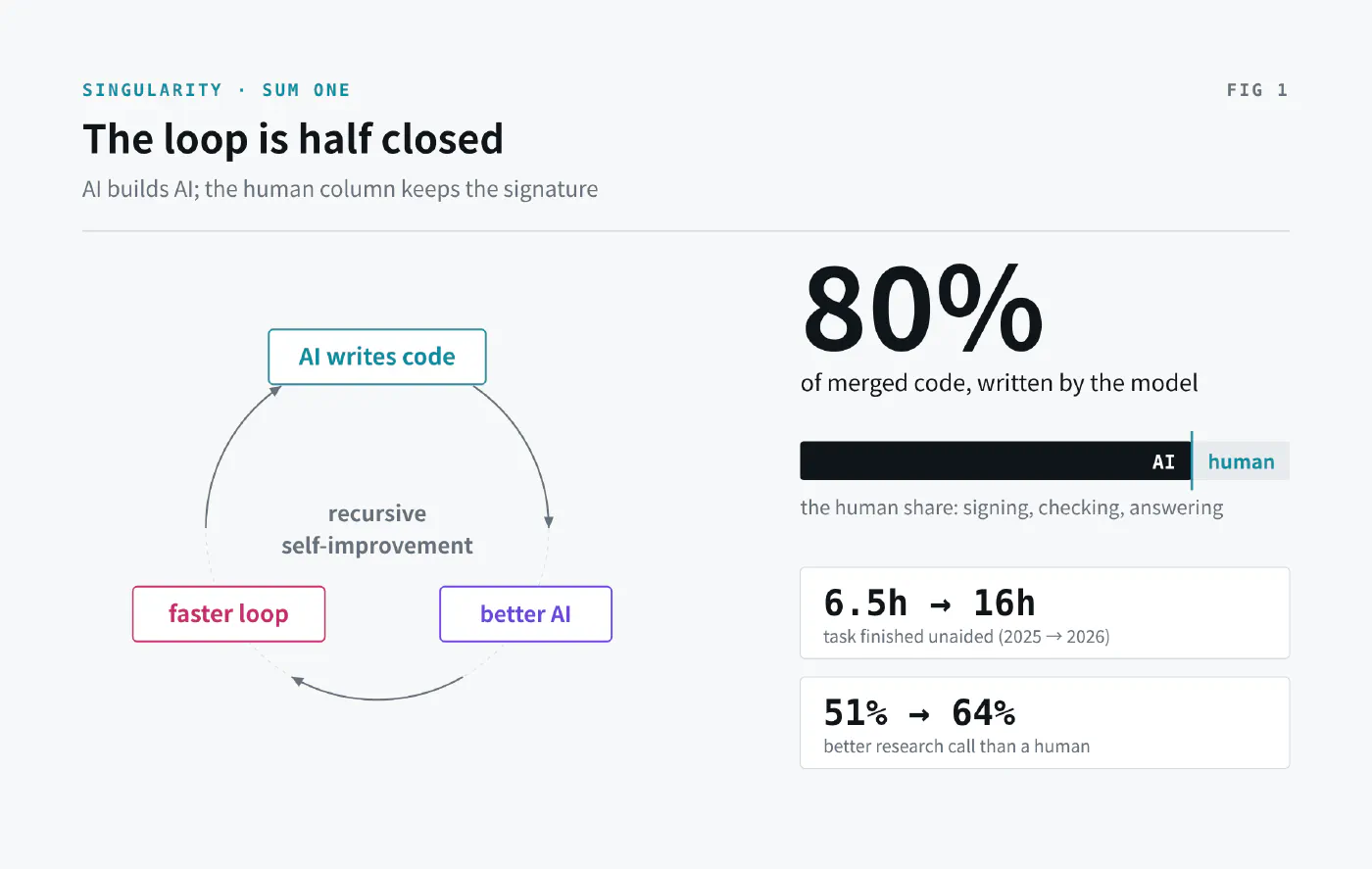
Now an unfashionable remark. I believe the 80%. But how much of that 80% is delete a line, rename a variable, add a log statement — the post does not say, and neither do I. This is not suspicion of the author; it is a bookkeeping habit: the numerator is pleasant, the denominator is quiet. Ten thousand people writing code and a hundred people plus ten thousand generations report the same percentage, and the two mean very different things.
Even halved, though, the sum is frightening, because it moves the person inside the loop. Once we were the protagonist and the machine helped; now the machine works and we watch. Watching is uncomfortable work. In a theatre you may applaud; in a workshop, the man watching is the man being let go.
3. The second sum: how cheap it got#
The fourth point in the post is price: inference costs fell about 99.7% in three years, from roughly $30 per million tokens in early 2023 to $0.10 in early 2026.
I did it on paper. Thirty dollars to ten cents is three hundred times. In everyday terms: when pork is three dollars a pound, three hundred times is one cent. That is not a discount. That is a different world.
I have seen this kind of fall once in my life, and it was not technology, it was the price of grain — in the opposite direction, of course. The year ration coupons were abolished the price jumped and the whole city complained; but after that you could buy grain without queueing, without asking a favour, without watching anyone’s face. What a price change really alters is something else: it turns a thing from important into irrelevant.
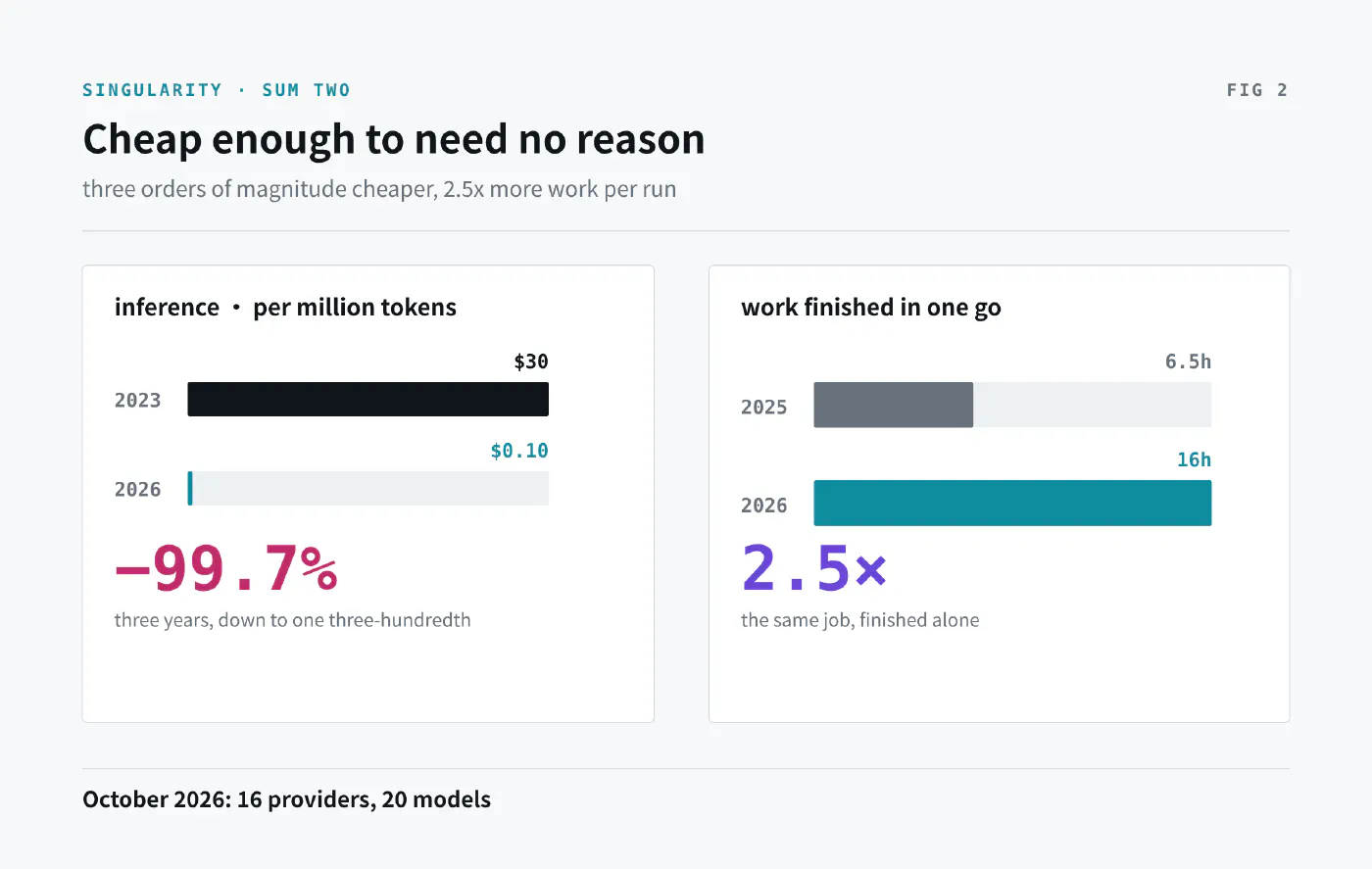
One more fact worth writing down: in October 2026 alone, sixteen providers released twenty models.
Cheap is good; I have never been against cheap. Cheap has a side effect: people stop handling things carefully. As a boy I used a pencil down to two inches and resented sharpening it. Now three new models arrive a month and a bad one is simply swapped out. When a thing becomes too cheap to need a reason, people stop giving it one. That is not a question of morals, it is a question of habit — and habit eventually becomes judgement: you slowly forget what good enough was.
4. The third sum: the human column#
The first two sums are about technology. This one is about us, and it is the section of the post I least wanted to read.
American unemployment sits at 4.3%, which in any year looks fine. But entry-level professional jobs are down about 29% since January 2024, and unemployment among young college graduates has climbed to 5.3%.
Put the three numbers together and they say one thing: this time it is not firing, it is not hiring.
Firing is news. People cry, people bang the table, the union speaks, the papers carry it the next day. Not hiring is not news. Not hiring is a twenty-five-year-old who still has no first job in the second spring, and who gradually stops mentioning it.
There is a sharper number in the post too: people who can use AI already earn about 62% more than people who cannot.
It stings because it changes the question. We used to worry that machines would take our jobs. This number says a threshold has appeared between people. The first worry sounds like science fiction. The second sounds like Monday’s staff meeting.
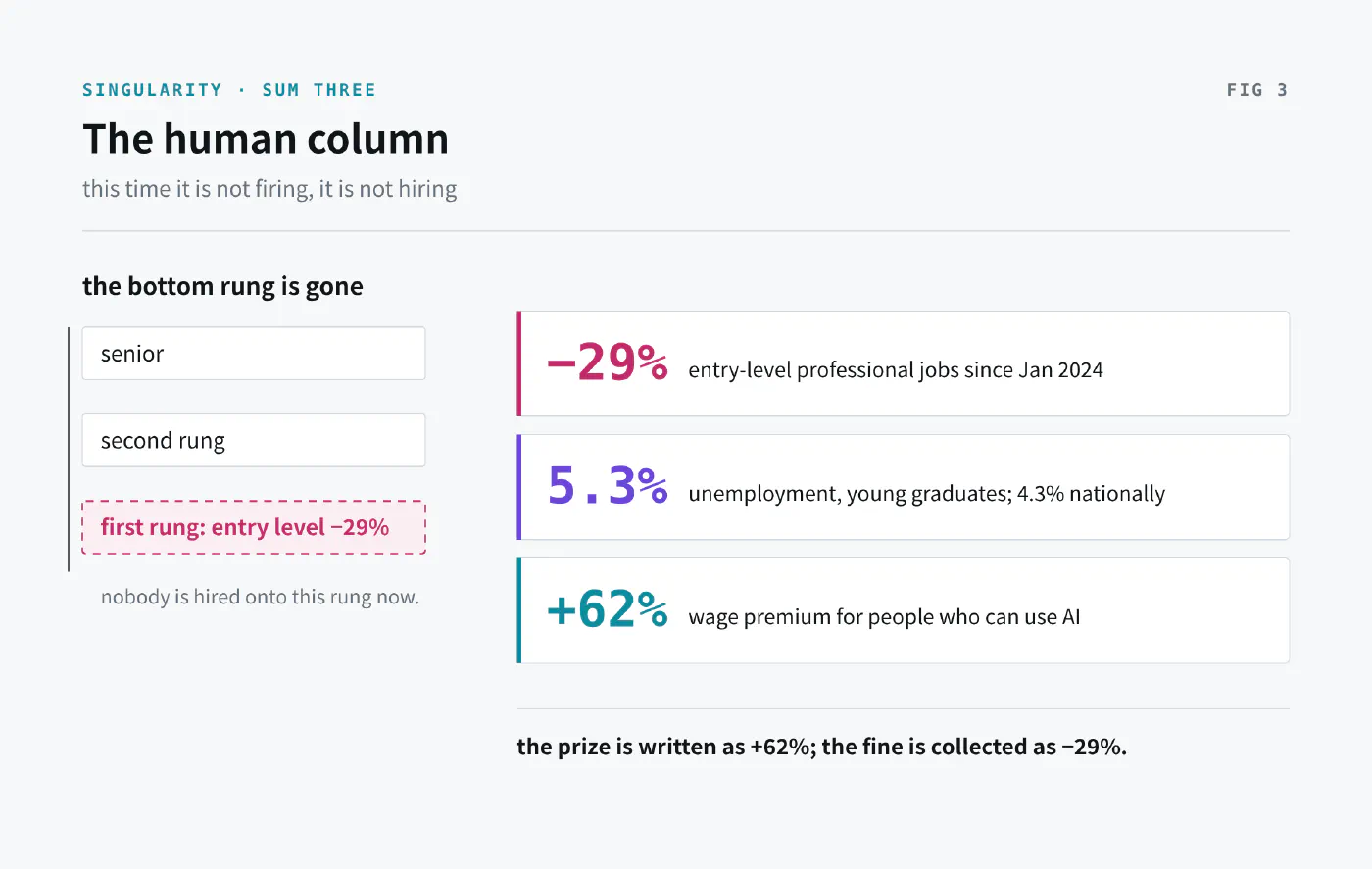
I believe only half of this third sum, for a very plain reason: I have watched a premium become a requirement. Knowing how to use a computer was a premium in the nineties — you were paid more for it. Today it is a requirement; without it there is no job. Twenty years, one round trip. The +62% looks like an opportunity now. In five years it will probably sound like how does this person not know that yet.
The −29% matters more than the +62%. A premium is a prize for those who can; the −29% is a fine collected from those who cannot. Nobody objects to a prize. A fine is never negotiated.
5. The other side, which I also hear#
The post is generous enough to devote a section to the opposition. I copy its four arguments here, with my own note after each.
One: nobody agrees what the singularity is. For some it is AI better than the best human at everything; for others it is technological growth that outruns human control; for others still it is brains wired to machines (Kurzweil’s version). With no agreed definition, the goalposts can move at any time. I agree completely.
Two: the people building it say it is not here yet. In June 2026 Anthropic published When AI builds itself, and their own words were: we are not there yet, and recursive self-improvement is not inevitable. That cold water weighs more than any bystander’s, because the man throwing it owns the servers.
Three: the physical world is hard. Chips, data centres, power grids, data — all of it, or none of it works. Software can double every week; factory floors cannot. The author concedes this himself: if the singularity were real, it would be hard to imagine the physical world feeling nothing.
Four: incentives. Every CEO announcing the singularity is, at the same time, raising capital or selling a product. The post says it plainly: they are, generally, motivated to talk their technology up.
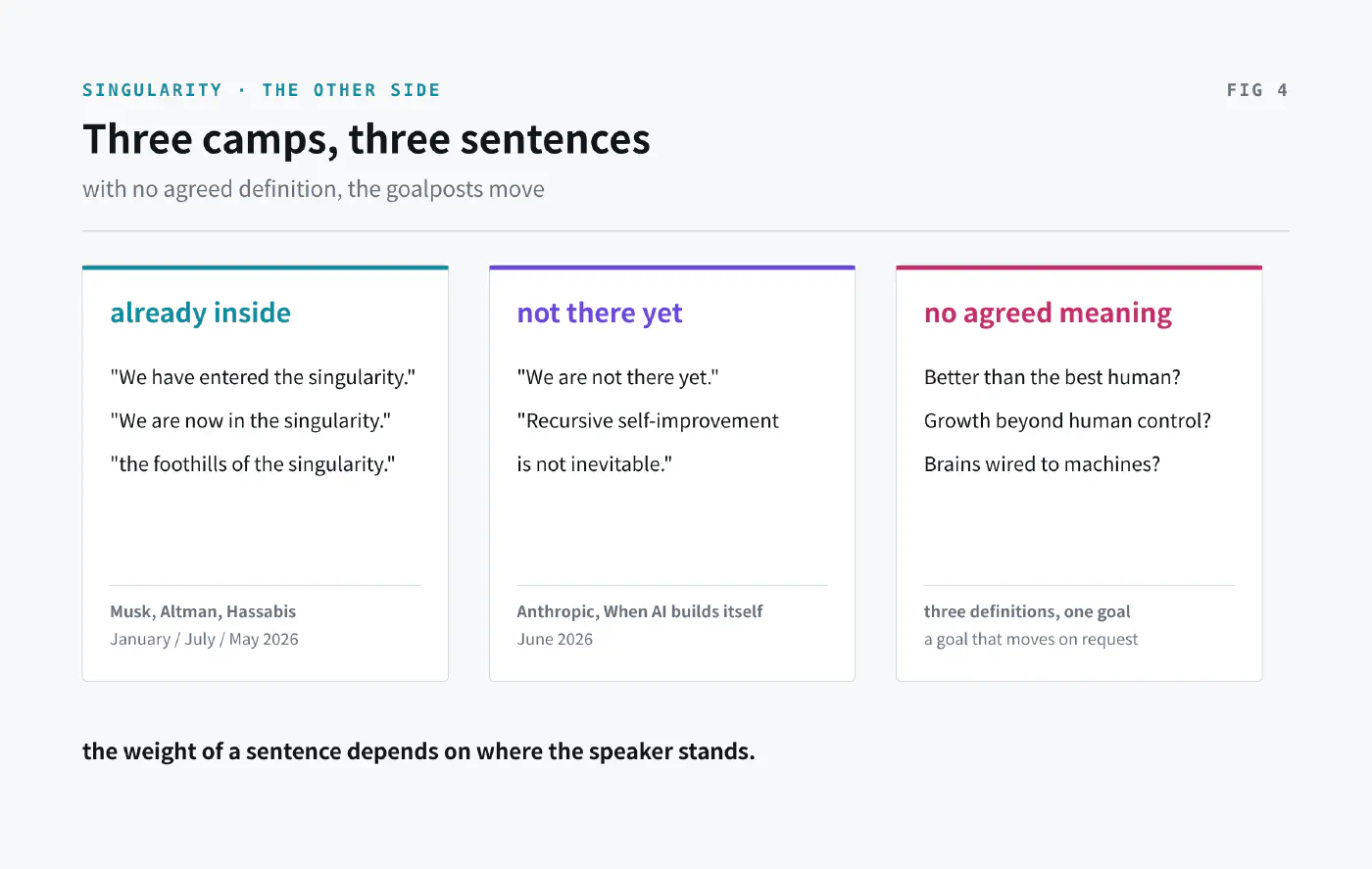
Of the four, the second and the fourth are worth the most. The second is an insider’s sentence; the fourth is market-stall common sense — the melon seller says the melon is sweet, which is not a lie, it is a trade. Put the two side by side and you get a modest conclusion: the weight of a sentence depends on where the speaker is standing. I learned that at a vegetable market. No papers required.
I am not going to join the opposition on that basis, though. Its strongest argument — the physical world — proves something else: if the loop really closes, it closes in the machine room first, and only later in the street. The street feeling nothing does not mean the machine room is idle.
6. The five-year rota#
The third section of the post gives a rota from 2027 to 2031.
- 2027 — the AI employee. AI takes week-long tasks; the first automated coder arrives, one person covering an engineering team; the first humanoid robots reach the public.
- 2028 — AI starts doing AI research. Research taste — knowing which question to ask — is the last gap.
- 2029 — human-level AI, by most definitions. By then the bottleneck is no longer the model but chips and power.
- 2030 — the economy restructures. The price of digital services and knowledge work collapses; people learn to manage fleets of agents.
- 2031 — the loop closes, or the curve bends. By that year we are either inside the singularity by any definition, or we have hit a real physical wall.
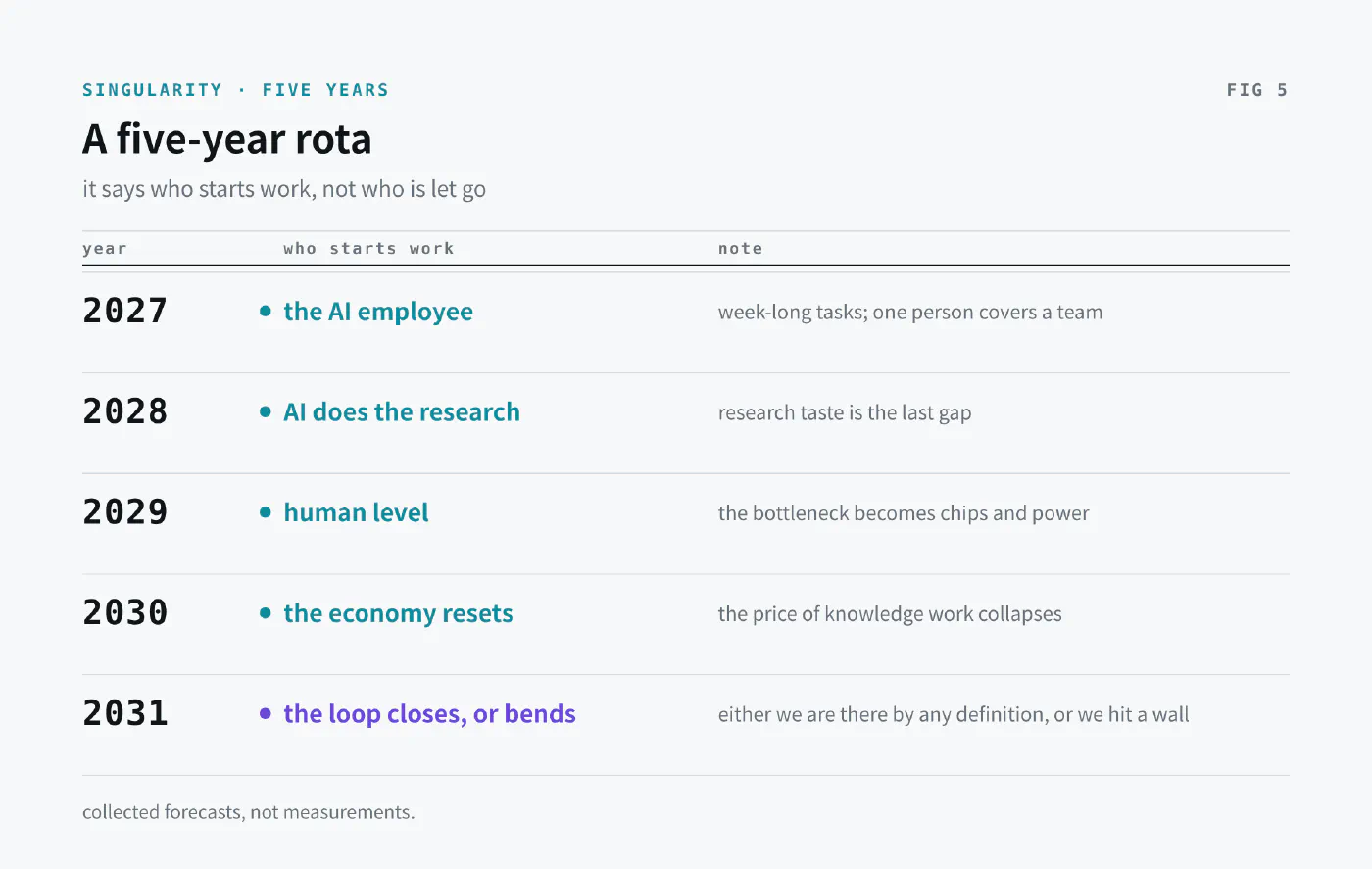
I read that table three times. The first time it was too fast, the second time too slow, and the third time I recognised a rota: it says who starts work, and says nothing about who is let go.
There is one sentence in the post that is passed over lightly, and I think it is the heaviest in the whole piece: within a few years the most powerful models will be locked away, no longer available to everyone as they are today.
That sentence is about the shape of power. That you and I can both use the best model right now is a very short moment in history — short enough that we mistake it for normal. When it passes, capability will split into two layers: one inside the building, one on the phone. The gap between those layers is the real gap.
7. Numbers and where they came from#
| Metric | Value | Source |
|---|---|---|
| Share of merged code written by AI | over 80% (May 2026) | post citing Anthropic internal figures — not independently re-measured |
| Task length a model can finish unaided | 6.5 hours → over 16 hours | post, 2025 vs 2026 |
| Better research call than a human | 51% → 64% | post, Anthropic research-session test |
| Inference cost | $30 → $0.10 per million tokens (three years, −99.7%) | post |
| Model release density | October 2026: 20 models from 16 providers | post |
| Entry-level professional jobs | about −29% since January 2024 | post |
| Unemployment | young graduates 5.3%; national 4.3% | post |
| AI skills wage premium | about +62% | post citing PwC |
| Five-year rota | section six | experts’ forecasts, collected by the post — not measured |
Not one number in that table is mine. I label the column because of something I know: a number without a source grows its own authority.
Three opinions of my own, unfashionable ones.
First, the singularity is not a day. Altman’s line — there is no single tipping point, you only notice afterwards — I believe. It matches what I know about growing old: no single morning makes you old; you find a photograph from five years ago and see what your face was like then.
Second, I do not argue with we are already inside it. I only note that once you are inside, the days still have to be got through. Groceries still get bought, children still get taken to school, and somebody still has to do the sums. Every new era ends up as days. Only the part that dissolves into days turns out to be real.
Third, and this is the one I care about: the question that matters is whether the people who do the sums become fewer. Anything nobody audits can be said freely. My motive for writing this is plain enough: I do not want to be one of the people who stopped doing the sums.
8. If advice is required#
The post closes with four pieces of advice. Here they are in my words, each with a note of my own.
One — learn to direct it, not just to use it. Using is pressing a button. Directing is saying what you want, how it will be checked, and what happens if the check fails. The difference is roughly that between driving a car and repairing one.
Two — build leverage while it is cheap. Today’s intelligence is like land in the old days, except there is no down payment. It will get expensive — it must, because chips and electricity do not fall in price on request — and whatever you accumulate now will be the capital then.
Three — hold on to something it cannot take. Distribution, trust, relationships, the few things only you know. The post calls this the direction value is moving in, which is true and need not be said so politely: it means collecting reasons why people have to come to you.
Four — spend an hour a week standing at the edge. Not once a year. People who look once a year come back the next year and cannot follow the conversation. That is not a question of intelligence. It is vocabulary.
One last thing of my own, and then I will stop.
I am not afraid of the singularity. I am afraid of the day when everyone says we are already inside it and nobody can say how the sums work once we are. On that day this old-fashioned man will probably still be at the lamp, doing the old arithmetic: what a pound of pork costs, what an hour of a person costs. The difference between those two figures is where people stand.
The difference keeps moving. While it moves, somebody has to do the sums.
References#
- Source: Miles Deutscher, “The Singularity Is Here”, long-form post on X, 2026 — https://x.com/milesdeutscher/status/2118741112726888533
- Anthropic, “When AI builds itself”, June 2026 — https://www.anthropic.com/institute/recursive-self-improvement (cited by the post, not independently re-measured)
- PwC, AI skills wage premium — cited by the post, not independently re-measured
- 中文版 (the version we maintain first): /icorer_blog/posts/essay/singularity-three-ledgers/