In one line: once AI drives the cost of writing code to near zero, a language’s value moves from how it reads to how it is reviewed — and every trade-off Go made in its first fifteen years sits on the review side.
The two source posts landed in the same month, from different authors, different starting points, and the same conclusion. Google’s Go team published Why Go is an Ideal Language for AI-Assisted Software Engineering on August 11; Steve Francia at spf13.com started from TypeScript 7.0’s port to Go and argued the other face of the same thesis. Neither is a benchmark; both are arguments. So every claim below carries who made it and whether anyone re-measured it.
1. The problem, as a scene
Here is the loop a coding agent runs:
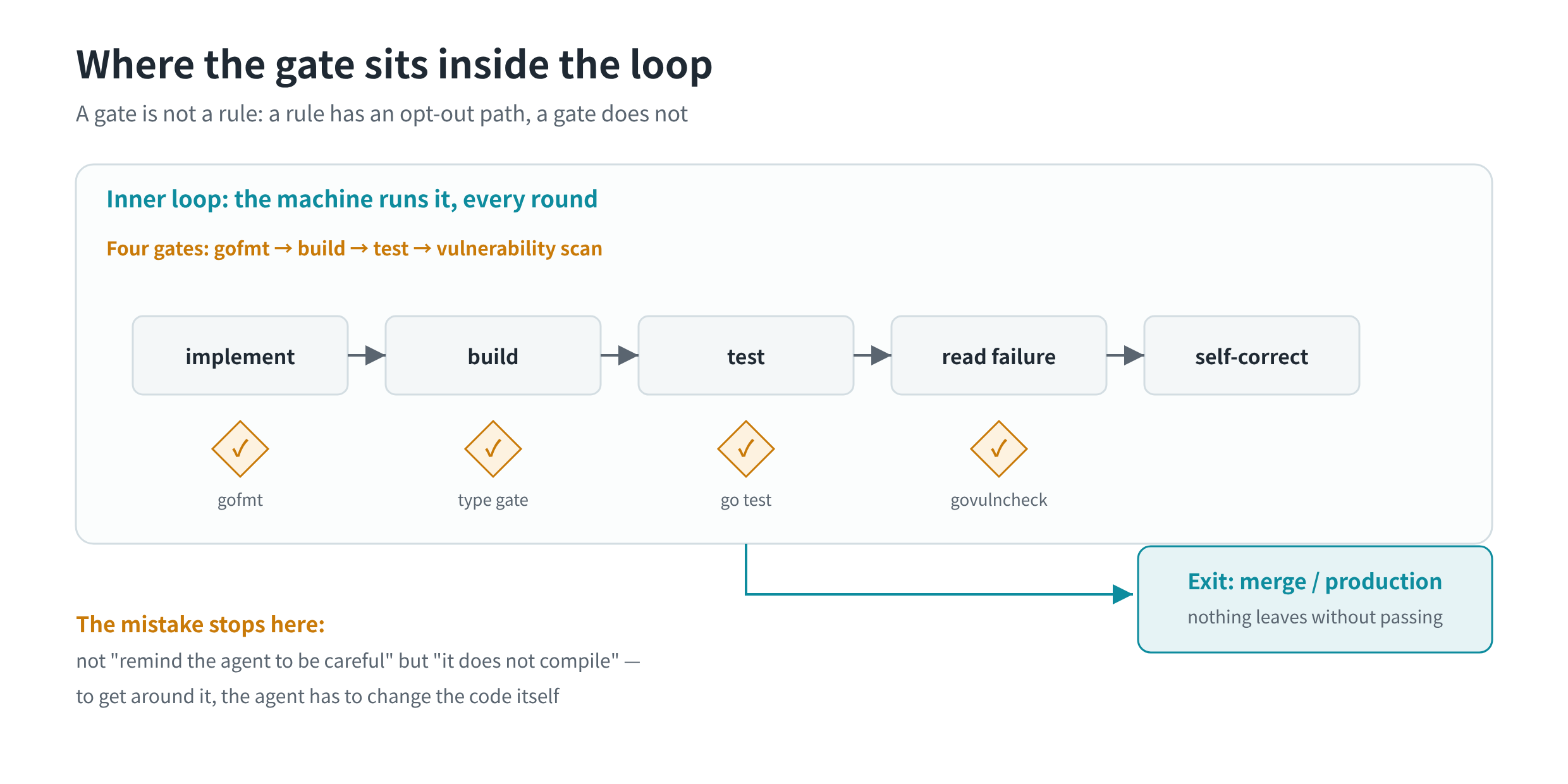
1implement → build → test → read the failure → self-correct → back to step one
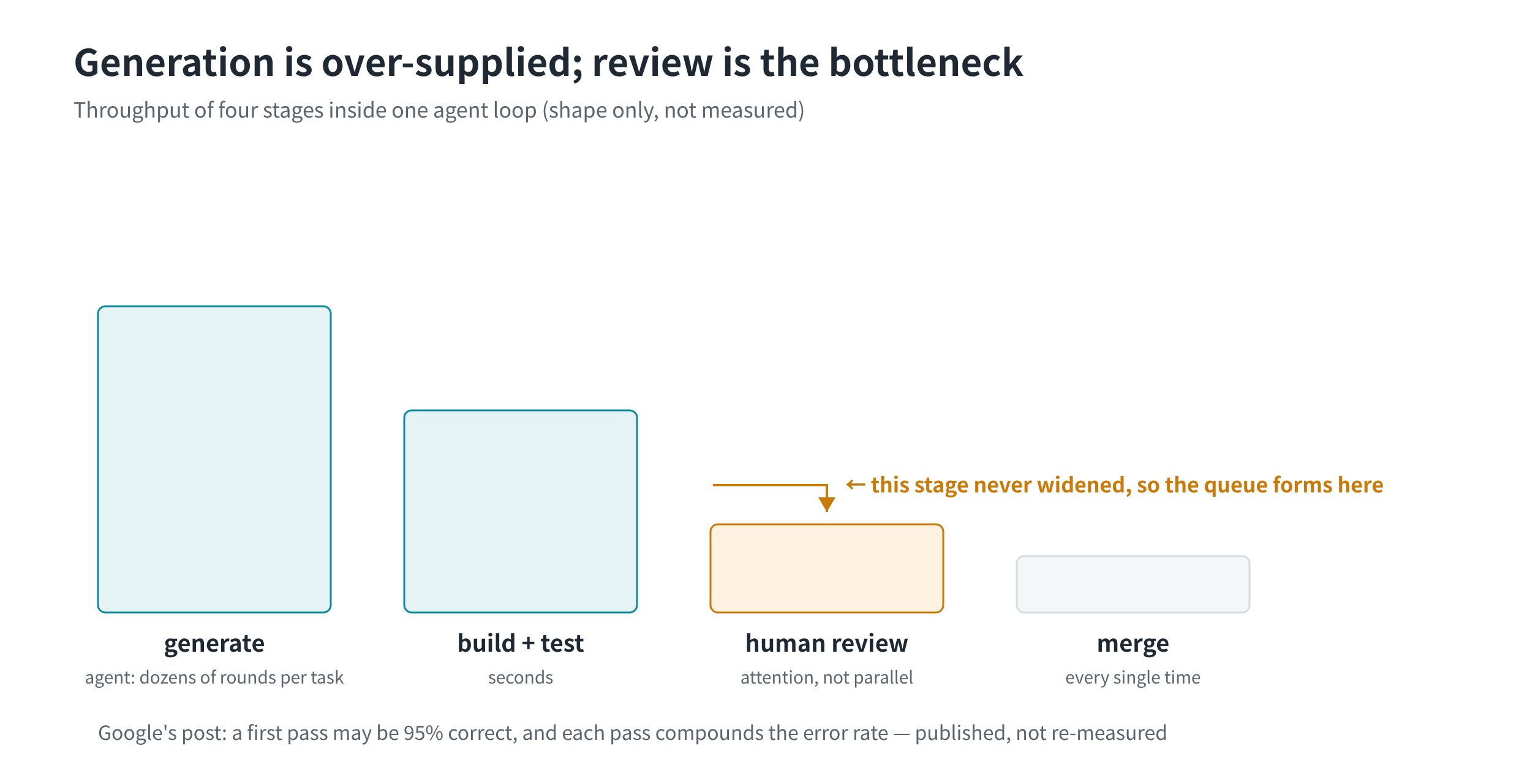
A human runs that loop a dozen times an hour. An agent runs it dozens of times per task. The loop’s cost gets multiplied by its iteration count, so whichever step is most expensive decides which language you pick.
And the most expensive step is no longer generation:
| Step | Cost in 2023 | Cost in 2026 | Who pays |
|---|---|---|---|
| Writing a line | high | near zero | the model |
| Reading a line | medium | medium, on ten times the volume | human attention (not parallelizable) |
| A failed loop | medium | high: context + API + time | you, and your token bill |
| A bug that ships | high | higher: the mistake is copied into every later round | production |
The Google post states it plainly: an agent asked to refactor iteratively without external validation is maybe 95% correct on the first pass, but each successive pass compounds the error rate and pollutes the context window, so accuracy drops while token cost rises. No measurement method is attached — it is an engineering observation — but if you have run a few long agent tasks you will recognize the shape.
Jesse Vincent, writing about agent orchestration, puts it harder:
A rule has an opt-out path (I can rationalize “I’ll do it after this one thing”). A gate doesn’t — the next action is blocked until the gate condition is met.
That is what language choice now means. Not “which language can an agent type faster in”, but which language blocks the agent before the agent notices it should be blocked.
2. Where the industry stands
Be clear about what this is not: it is not a story about Go being fast. The TypeScript port works precisely because Go is not fast here — it is easy for both a human and a machine to read. Microsoft’s published number is roughly an order of magnitude on build times, and Anders Hejlsberg’s stated reasons were pragmatic: the existing compiler’s function-heavy style ported nearly one-to-one, both compilers lean on garbage collection, and native code with shared-memory concurrency is where the 10x came from. The announcement never mentions AI. The reason a 1:1 port was possible at all is the set of properties it does mention: simple functions, no hidden magic, code a team can hold in its head.
Worth keeping separately: a language designed for human teams turns out to be designed for machine iteration too.
Then look at who writes the platform layer. The list argues better than any benchmark:
| Project | What it is | Language |
|---|---|---|
| Ollama | the standard way to run local models | Go |
| Weaviate | the vector store behind RAG and agent memory | Go |
| Temporal | durable execution for long-running agent workflows | Go |
| Charm Crush | an AI coding agent CLI | Go |
| github/github-mcp-server | the reference implementation for agent→GitHub | Go |
Claim → consequence, for the agent loop specifically:
| Claim | Consequence inside the loop |
|---|---|
| Read-first, not write-first | one idiom per problem, so review attention goes to logic, not style |
| The language is a platform: gofmt, go test, go mod, govulncheck, pprof, pgo ship with it | fewer “install this, configure that” failure points per iteration |
| Compatibility promise: Go 1.0 code still compiles, and there will never be a Go 2.0 | an agent’s training snapshot does not expire; no re-verification of APIs every task |
| go.sum + checksum database + one version selected per build | deterministic installs, no install-time code-execution hook |
| A complete standard library | one fewer third-party dependency is one fewer hallucination entry point |
3. The design, stated as requirements
Strip “Go suits agents” down to checkable requirements and there are four:
- One shape. One idiomatic way per problem. Human-written, machine-written, and decade-old code look like the same thing.
- Immediate rejection. Type errors, non-existent methods, unsupported operations are refused at compile time, never deferred to runtime.
- Deterministic dependencies. One
go.modresolves to the same tree on a laptop, in CI, in a container; a dependency cannot execute code at install time. - No drift over time. Code does not break when you upgrade, and old idioms have one deterministic upgrade path.
Two principles carry those four:
- Optimize for the reader, not the writer. Rob Pike, Robert Griesemer, and Ken Thompson settled this twenty-odd years ago: developers spend far more time reading code than typing it. True of people. More true of models.
- Turn rules into gates. A rule has an opt-out path; a gate does not. The constraint comes from “it does not compile”, not from a paragraph in a style guide.
That second principle is why Go’s any is not TypeScript’s any. TypeScript’s switches the checker off for everything it touches. Go’s is an alias for interface{}: every use site is still checked, and getting a concrete type out requires an assertion the compiler verifies.
4. The implementation: where the gate sits in the loop
4.1 The compiler is the cheapest gate in the loop
Go compiles in the “orders of magnitude faster than Java, C#, Rust” range, per the Google post — published, no benchmark attached. The value is not in writing code; it is that the speed lets an agent run a full check every single round.
A typical failure looks like this:
1// from the spf13 post: even Go's escape hatch is checked
2func ProcessData(data interface{}) int {
3    return data + 1 // compile error: invalid operation (mismatched types interface{} and int)
4}
The same mistake in a dynamic language waits for runtime:
1# same logic: no error here; the error fires after the agent has built three layers on top
2def process_data(data):
3    return data + 1
The difference is not the error. It is when the error is discovered. Go moves discovery to before the agent runs anything; a dynamic language defers it until the agent has already spent context and built more work on the broken line. That is compound interest, in engineering form.
4.2 Context budget: one less abstraction is one fewer distractor
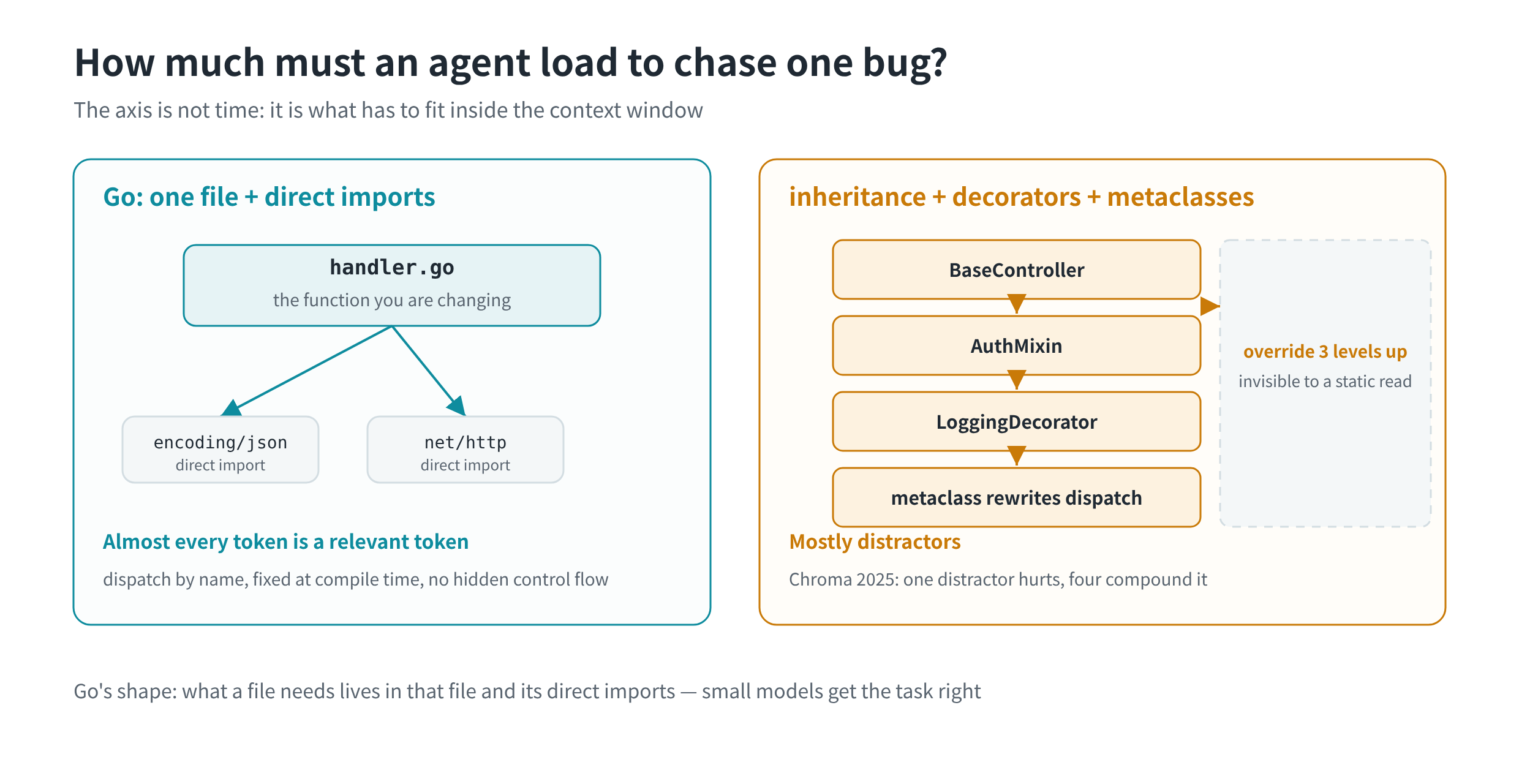
Chroma’s 2025 study across 18 models (GPT-4.1, Claude 4, Gemini 2.5, Qwen3) tested whether longer input hurts performance while holding task difficulty constant. It does — even on trivial tasks — and the biggest driver is what the researchers call distractors: content topically related to the task but not the answer. One distractor measurably hurts; four compound it.
For an agent tracing a bug, an inheritance chain, a mixin layer, a decorator stack is a field of distractors. A super() call resolving through diamond inheritance, a metaclass rewriting behavior at runtime, an override buried three classes up: none of that is the logic it needs, but it has to load, weigh and rule out all of it — inside the same window where its reasoning is already degrading.
Go’s shape: what a file needs lives in that file and its direct imports. No inheritance chains, no mixins, method dispatch by name alone, fixed at compile time. The tokens Go code needs are almost entirely relevant tokens.
There is a second-order effect: the model tier a task requires drops. A bug that fits in 20,000 clean tokens does not need frontier reasoning to fix, which means the cost structure survives the end of subsidized inference.
4.3 One format, zero style debates
gofmt ships with Go and the whole community runs it, so every Go file — human, generated, ten years old, or written by an agent this morning — is structurally identical. Simon Willison, who has spent real time building AI-assisted Go tools, put it well: “I’m enjoying how there’s generally one obvious way to do things and the resulting code is boring and readable — and something that LLMs are very competent at writing.”
For an agent there is a second use: gofmt seeds it before it starts. Point it at the standard library (encoding/json, net/http, io) and it produces idiomatic code without guessing black versus yapf or isort versus ruff. In review, attention goes to logic instead of formatting noise.
4.4 Dependencies, supply chain, and the maintenance years
- Dependencies.
go mod tidyis deterministic across laptop, CI and container;go.sumpins checksums; the checksum database blocks a man-in-the-middle swap; there is nopostinstall-style execution hook. - Vulnerabilities.
govulncheckreports only the vulnerable symbols your code actually calls. Low noise matters most for agents: a noisy alert stream trains an agent to ignore alerts. - Tests.
go test ./...needs no framework choice,_test.gosits next to the package, fuzzing is built in. If you want an agent to run TDD, this gate is deterministic. - Maintenance. The rebuilt
go fixnow carries modernizers — dozens of pre-built deterministic rewrites that pull old idioms forward. Withgopls, an agent can restructure packages and clear technical debt by rule rather than by “looks right”.
5. Trade-offs, with their costs
None of this is free. The bill:
| Decision | Alternative | Why | Cost |
|---|---|---|---|
| Static types + a compile gate | Python / TypeScript | errors surface at compile time, not in production | more verbose; generics far less expressive than Rust (no higher-kinded types, no lifetimes) |
| One idiom per problem | multi-paradigm languages | lowest review cost; human and machine read the same shape | expressiveness traded away: type-level programming, DSLs, macros are mostly out |
| Built-in toolchain | pick your own ecosystem | fewer failure points per iteration | a narrower space for ecosystem innovation; one dominant framework style |
| Compatibility promise | major-version evolution | training snapshots do not expire; old code never breaks | slow language evolution; the historical baggage stays forever (there will be no Go 2.0) |
| Default for the systems layer | Rust | fast compiles, refactors stay local | when you need peak performance, no GC, or a kernel embedded in a Python wheel, Rust is the better fit; Go 1.26 cut cgo call overhead by ~30%, still short of the PyO3 path |
| Context-friendly | Java / TS abstraction layers | high ratio of relevant tokens; smaller models can cope | you lose reuse from inheritance and mixins; more boilerplate |
One counter-example has to stay, or the whole table becomes marketing: Rust’s position was not taken. Pydantic’s validation core, Polars, HuggingFace tokenizers, Astral’s uv — all Rust, because they want a zero-cost C ABI, no GC, and a shape that embeds in a Python wheel. That is precisely Go’s weakest cell historically. Rust’s compiler errors are also genuinely instructive, which is real signal for an agent. The split shows up in cost: Rust compiles slowly, and lifetimes plus trait bounds make “a local change” ripple outward at refactor time — and refactor frequency is the variable agentic development multiplies most.
6. Where it stands
The evidence comes in layers, ordered by how checkable it is:
- Checked against a third party: TypeScript 7.0’s Go port, roughly an order of magnitude on build times (Microsoft’s numbers).
- Already running in production: the platform-layer list above — Ollama, Weaviate, Temporal, Crush, github-mcp-server.
- Appeared this year, not independently re-measured:
go fixmodernizers, and repositories likego-skillsthat pre-load Go knowledge for agents. - One honest, counter-intuitive case: a team at PayPal rewrote a C++ database in Go with about ten engineers; the Go system outperformed the original in production and cost far less to maintain. Go is not faster than C++, so what won was not code speed — it was that the team could read, change, and extend it. Realized performance beat theoretical performance.
The division of labour looks like this:
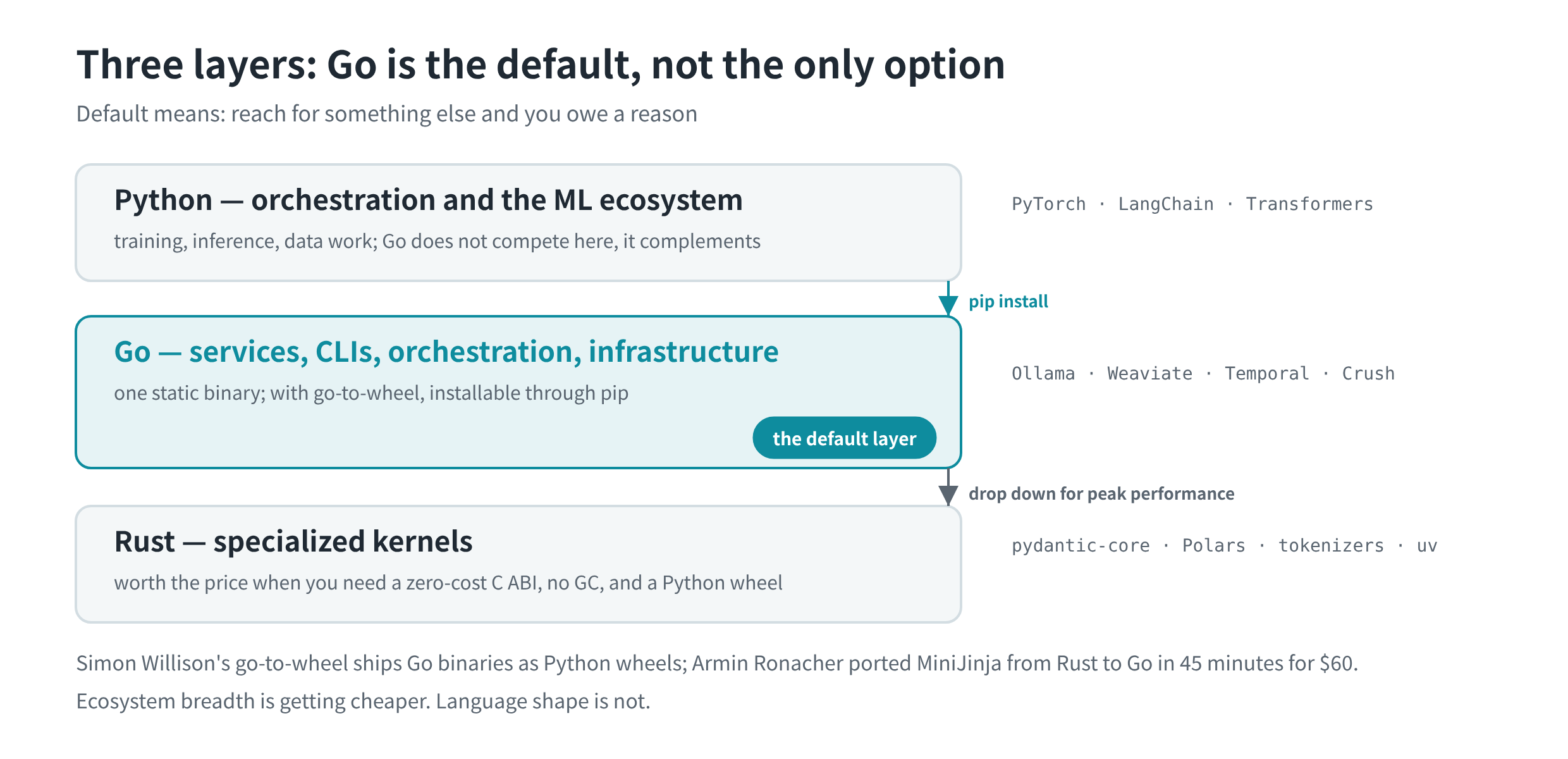
Python orchestrates, Go executes underneath; it is not either/or. Simon Willison’s go-to-wheel packages compiled Go binaries as Python wheels, so any Go binary becomes a pip install or a uvx one-liner — his own sqlite-scanner ships that way. Armin Ronacher makes the same point from the other side: porting MiniJinja from Rust to Go cost 45 minutes and $60 in API calls, which is why he argues the cost of coding is falling so fast that ecosystem breadth matters less.
7. Numbers, with sources
| Metric | Value | Source |
|---|---|---|
| TypeScript 7.0 build time | ~10x improvement | Microsoft, published; not re-measured |
| Go 1.26 cgo call baseline overhead | ~30% lower | go.dev release notes, published |
| Go compiler speed | orders of magnitude faster than Java, C#, Rust | Google blog, no benchmark given |
| Chroma context study | 18 models; accuracy degrades as input grows; one distractor hurts, four compound | Chroma 2025, third-party published |
| Go 1.0 code | compiles unchanged on the latest toolchain | compatibility promise, published |
| PayPal C++ → Go rewrite | ~10 engineers; production performance above the original | team case reported in the spf13 post |
| MiniJinja Rust → Go port | 45 minutes, $60 of API calls | author’s own report |
| Octoverse 2025 | TypeScript leads monthly contributors; JavaScript still files roughly twice as many new repos | GitHub, published |
| Iterations per agent task | dozens; a human runs a dozen an hour | order-of-magnitude estimate, illustrative |
8. What this buys you
Make the gate a single command and put it inside the agent’s loop, mandatory every round:
1# four gates in one line: format → static check → tests → vulnerabilities
2gofmt -l . | (! grep .) && go vet ./... && go test -count=1 ./... && govulncheck ./...
Then run a 15-minute experiment. Do not trust anyone’s conclusion, including both source posts:
- Same agent, same task: a CLI that reads 100k lines of JSON, aggregates, writes CSV.
- Implement it in Go, then in Python (or TypeScript). Three runs each.
- Record three numbers: iterations-to-green, total tokens, human review time.
- Keep
-count=1; without itgo test’s cache will lie to you.
You will most likely see fewer rounds, fewer tokens per round, and faster review on the Go side; Python produces a first draft faster but needs more rounds. If your task is mostly ML library calls, the result inverts — which is the tell that it belongs in Python’s layer, not the systems layer.
9. Roadmap and open questions
Two questions I cannot answer today:
- Does Go’s lower expressiveness cost more tokens, not fewer? No inheritance, no mixins, restrained generics means more boilerplate for the same feature. Boilerplate is predictable and readable, but it is still real tokens. There is no public same-task, two-language, total-token comparison — which is exactly what the experiment in section 8 measures.
- Do the compatibility promise and modernizers cancel each other out? The promise keeps old code compiling forever, which keeps old idioms compiling forever; an agent’s training snapshot preferring those idioms could turn
go fixfrom an optional cleanup into a mandatory step. If so, the maintenance cost of “toolchain consistency” is higher than the Google post implies.
And a more basic one: are we using language to compensate for model weakness? If self-verification improves enough over three years, the payoff from static guarantees narrows, and “designed for review” narrows with it. If iteration counts keep climbing instead, gates only get more valuable. Those two futures imply opposite language strategies, and nobody currently has the data to tell them apart.
References
- Google Developers Blog, Why Go is an Ideal Language for AI-Assisted Software Engineering (2026-08-11)
- Steve Francia, Why TypeScript 7.0 Was Rewritten in Go (spf13.com; published as “Go: the agentic language”)
- Microsoft, A 10x faster TypeScript
- Chroma, Context Rot: How Increasing Input Tokens Impacts LLM Performance
- Wes McKinney, Agent ergonomics
- Jesse Vincent, Rules and gates
- go.dev, Go 1 compatibility promise / Go 1.26 release notes
- Armin Ronacher, A language for agents