Five Kettlebell Moves on Three Axes
Five kettlebell movements divide across three axes, hips, shoulders and the diagonal, and the snatch sits where all three meet. Each move broken down to joints, muscles and the order of force, with a coverage table for eight movement patterns and three dose plans you can schedule as written.
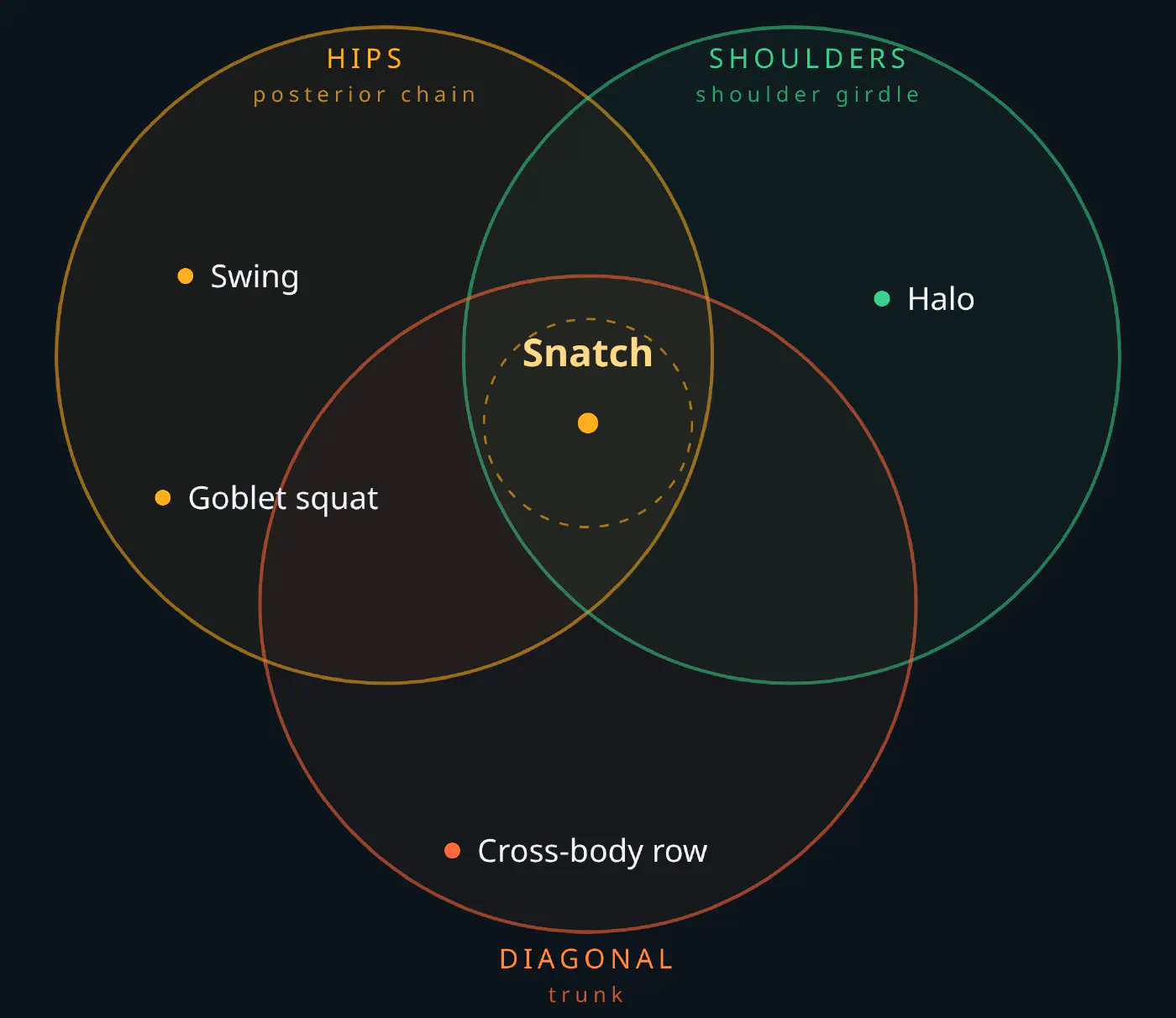
Five movements land on three axes. The hips produce the power, the shoulders buy the range, the diagonal carries force across the trunk. The snatch sits where all three meet, which is why it is the one you cannot swap out.
The film runs 26 seconds with no voice-over. The labels on screen are the language of this page. Each segment lasts three to eight seconds and plays two cycles of the movement.
1. Putting the five moves on one diagram#
Gym pushing and pulling live in two planes: sagittal for presses and rows, frontal for lateral raises. These five kettlebell movements leave both planes, and the division of labour between them is unusually clean.
| Axis | Moves | What it trains |
|---|---|---|
| Hips | Swing, goblet squat | Posterior-chain power and strength |
| Shoulders | Halo | Scapular circling and thoracic extension |
| Diagonal | Cross-body row, snatch | Diagonal force transfer and anti-rotation |
The snatch uses all three axes at once. On the diagram it sits at the intersection, and it is the only one of the five that cannot be replaced by moving to another movement. The other four each own one end of one axis. Swap one out and the axis is still there.
Lay the same five moves over the basic movement patterns and the edges show up. Of eight patterns, three are fully covered, two are half covered, three are missing.
| Pattern | Move | Covered | Note |
|---|---|---|---|
| Squat | Goblet squat | Yes | Bilateral, anterior load, good depth |
| Hip hinge | Swing | Yes | Ballistic, not maximal strength |
| Horizontal pull | Cross-body row | Yes | Unilateral, with rotation |
| Vertical push | Snatch lockout | Half | Stability only, no loaded progression |
| Horizontal push | none | No | Add push-ups or a bench press |
| Loaded carry | none | No | Farmer carry, rack carry |
| Single leg | none | No | Lunge, split squat |
| Rotation and anti-rotation | Halo, cross-body row | Partial | Trunk control, not ballistic rotation |
That table decides how to use the set. It fills in the posterior chain, the shoulder and the rotating trunk. It leaves out pushing and single-leg work. Used as a full programme, it needs two more movements. Used as a patch, it bolts straight onto whatever you already run.
2. The swing trains hips; the arms only pass force along#
The line between a swing and a squat sits at the knee. At the bottom of the backswing the shins stay close to vertical, the knee flexes somewhere between 20 and 30 degrees, the pelvis travels straight back and the trunk tips forward as one board. Bend the knees further and the movement becomes a squat, and the hip power leaks out of the chain.
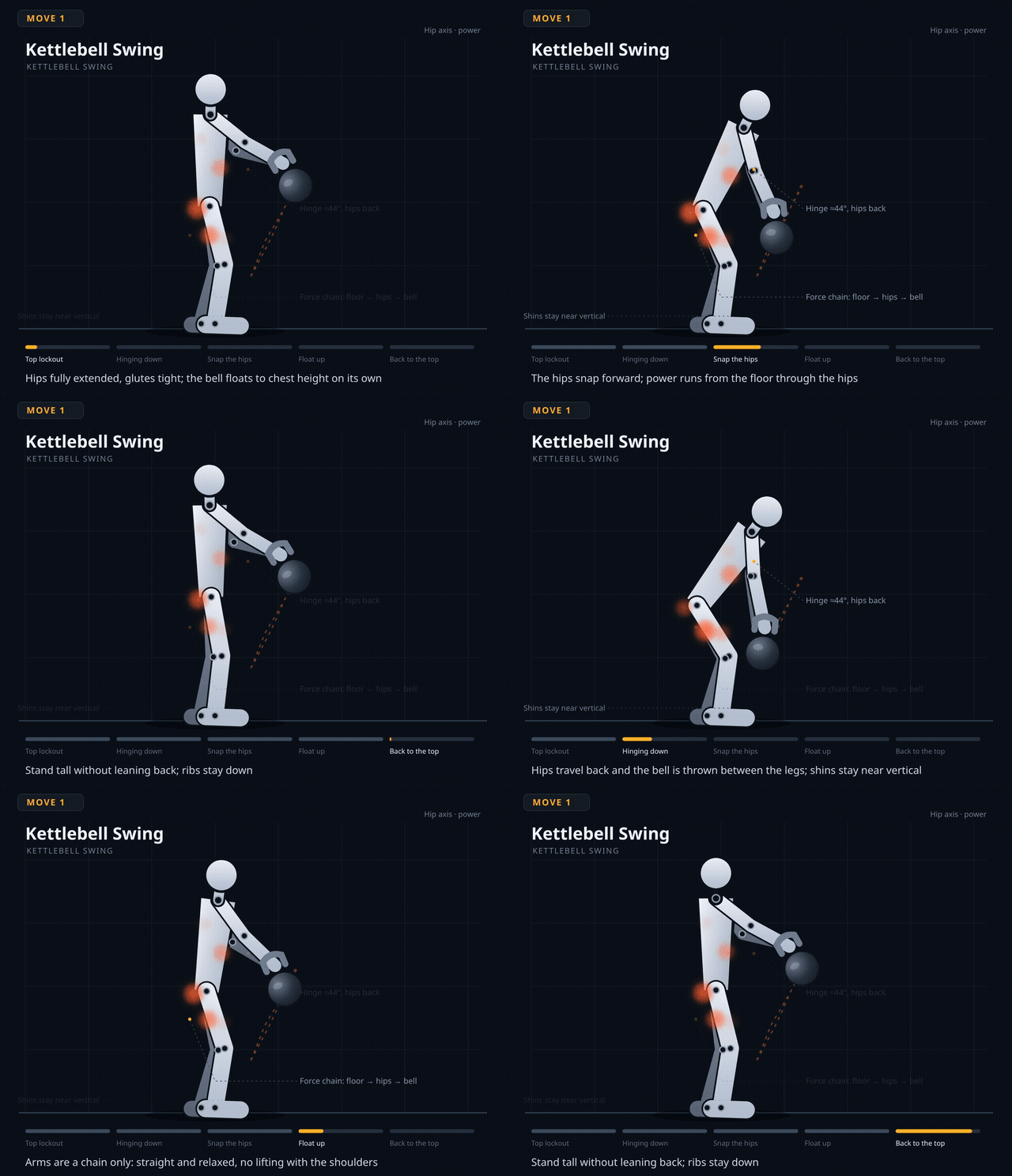
The hip snap ends when you stand tall. Hips extend fully, glutes squeeze, ribs stay down. Go past that point into a lean and the load moves from the glutes to the lumbar spine. The bell reaches chest height on momentum; the shoulder blade follows passively and does not lift.
Two faults show up most. One is turning the swing into a squat, where the trunk stands upright, the knees sink and the bell hangs at the shins. The other is lifting with the shoulders, bending the arms to haul the bell up. Both end in the same place, with the power gone.
Soreness works as a diagnostic. Sore glutes and hamstrings means the pattern held. Sore quads and lower back means too much squat, or the back took over from the hips.
3. The goblet squat: the load in front changes the trunk angle#
Moving the load from the back to the chest is the oldest and least fussy way to teach a squat. The weight in front pushes the combined centre of mass forward, and to stay balanced the trunk holds itself more upright while the hips settle down more easily. Most people reach a deeper squat this way than they can with bodyweight, with less torque on the lumbar spine.
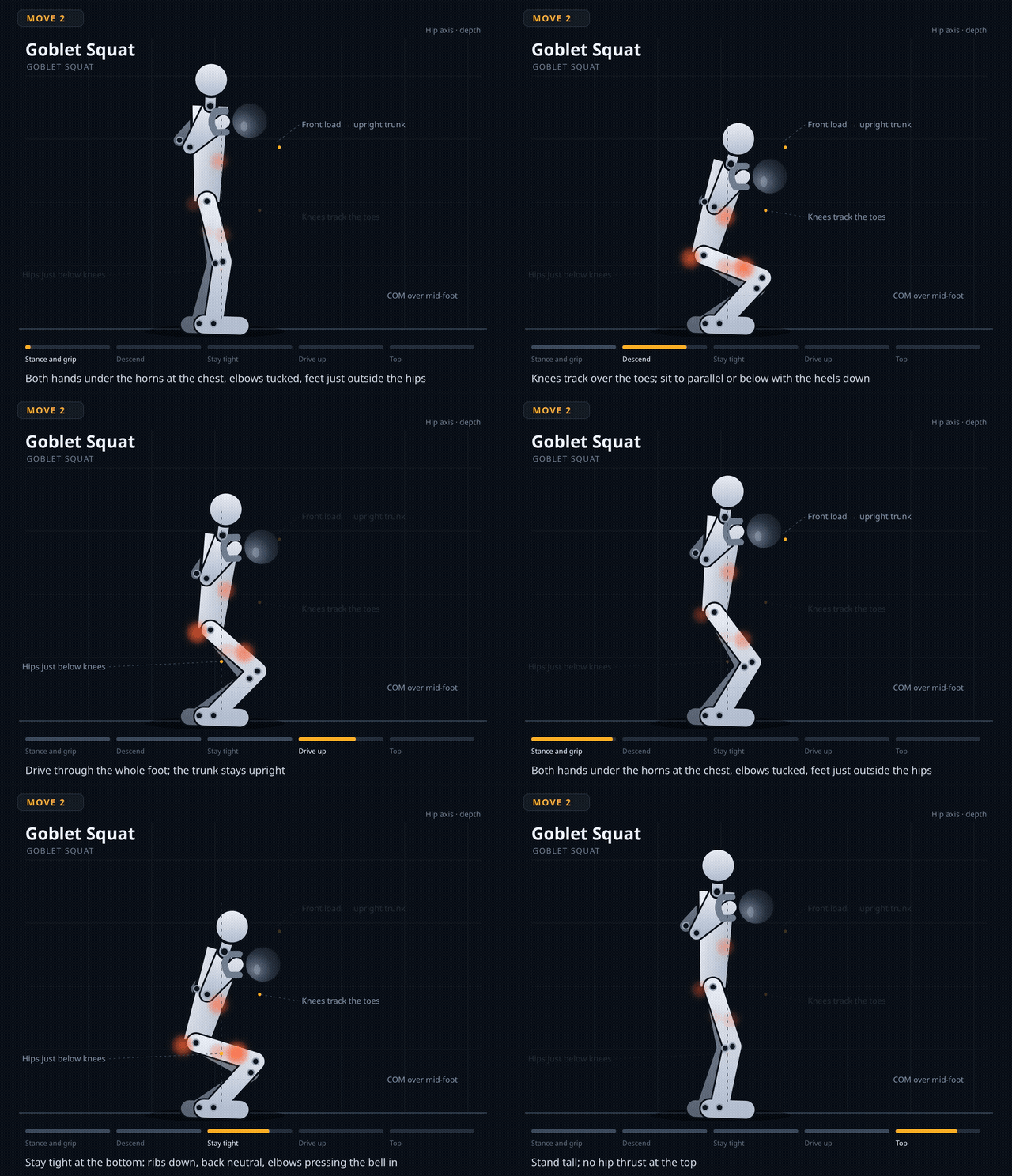
Two costs come with it, and neither appears in the coaching cues. An anterior load lengthens the lever arm on the trunk, so the same weight demands more trunk stability. And the weight you can hold at the chest caps the load, which makes this a medium-light, high-quality movement by construction. It does not replace a heavy back squat.
Three positions decide the quality: the elbows, the bell, the feet. The elbows travel inside the knees, so the knees get pushed out without anyone shouting at them. The bell stays against the sternum; hold it further away and the lever arm grows until the back rounds. The heels anchor, so the cue on the way up is to push the floor away rather than lift the body.
Depth stops where tension stops. If the pelvis tucks under and the lower back rounds at the deepest point, the right depth is one inch higher.
4. The halo covers the shoulder’s third plane#
A shoulder circling through a full range simultaneously abducts, externally rotates and extends. Pressing and pulling never produce that combination. This is why the halo earns a slot: it is a mobility drill and an isometric trunk-control drill in the same rep.
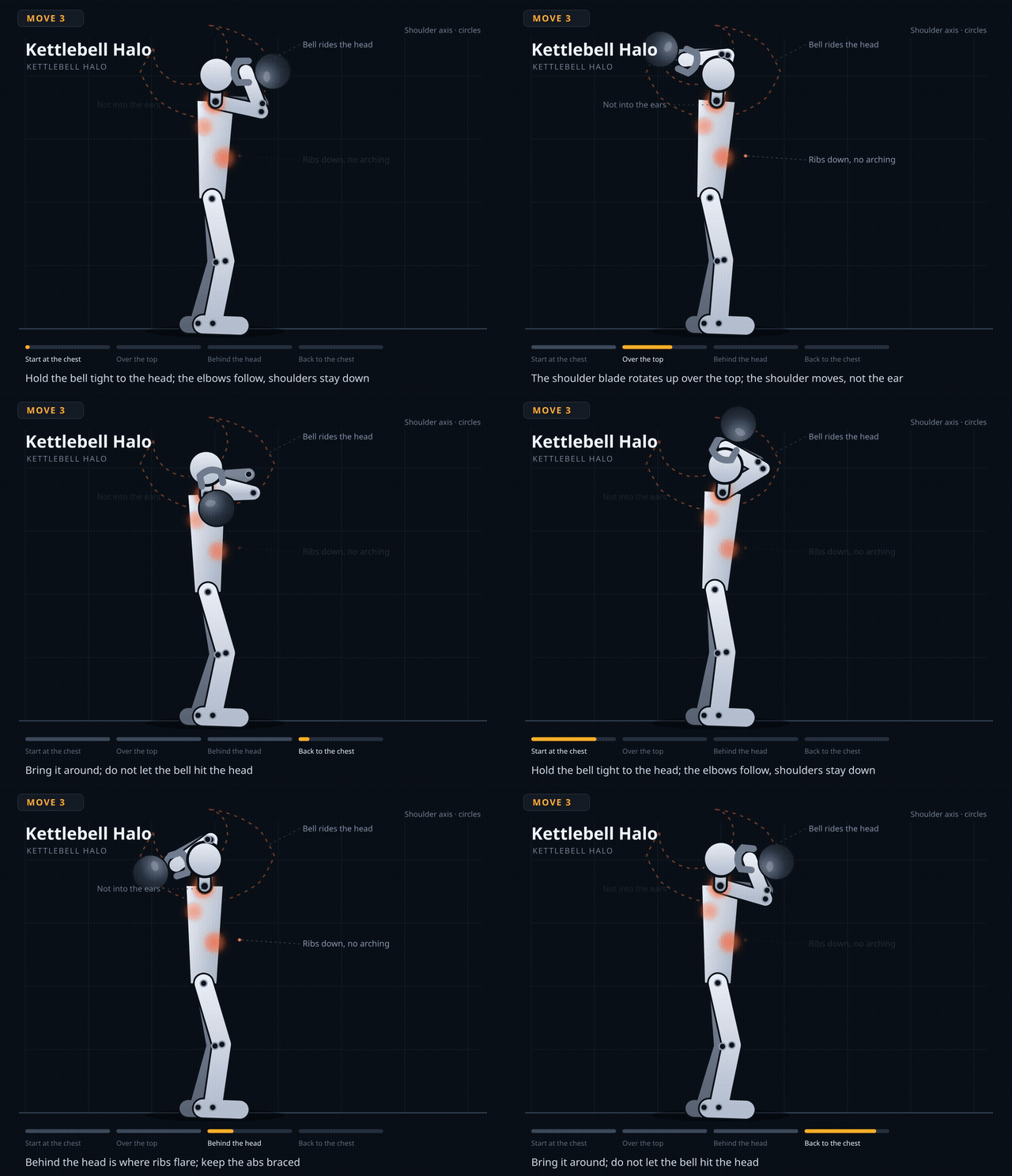
One thing has to hold for the whole movement, the ribs stay down. The moment they tip up, the lumbar spine starts compensating and the halo becomes a back movement. The self-check is a hand on the lower ribs. It should not push forward at any point in the circle.
Keep the bell close and do not throw it. A smaller radius means less centrifugal force and more controllable tension through the rotator cuff; let it drift and you are swinging, not circling. The eyes follow the bell and the neck does not. The head stays in the middle so the bell travels around it.
Pick a light bell. Four to eight kilos for most women, eight to twelve for most men. This is a range-and-stability movement, not a strength lift. Work half the reps in each direction; almost everyone has one direction that fights back, and that side is the one to do more of.
5. The snatch is decided in the last 20 centimetres#
The first sixty per cent of a snatch is a swing. Until the bell reaches chest height the arm should not fire. The last forty per cent is the snatch itself, and it is decided by whether the hand gets out of the way at the right moment.
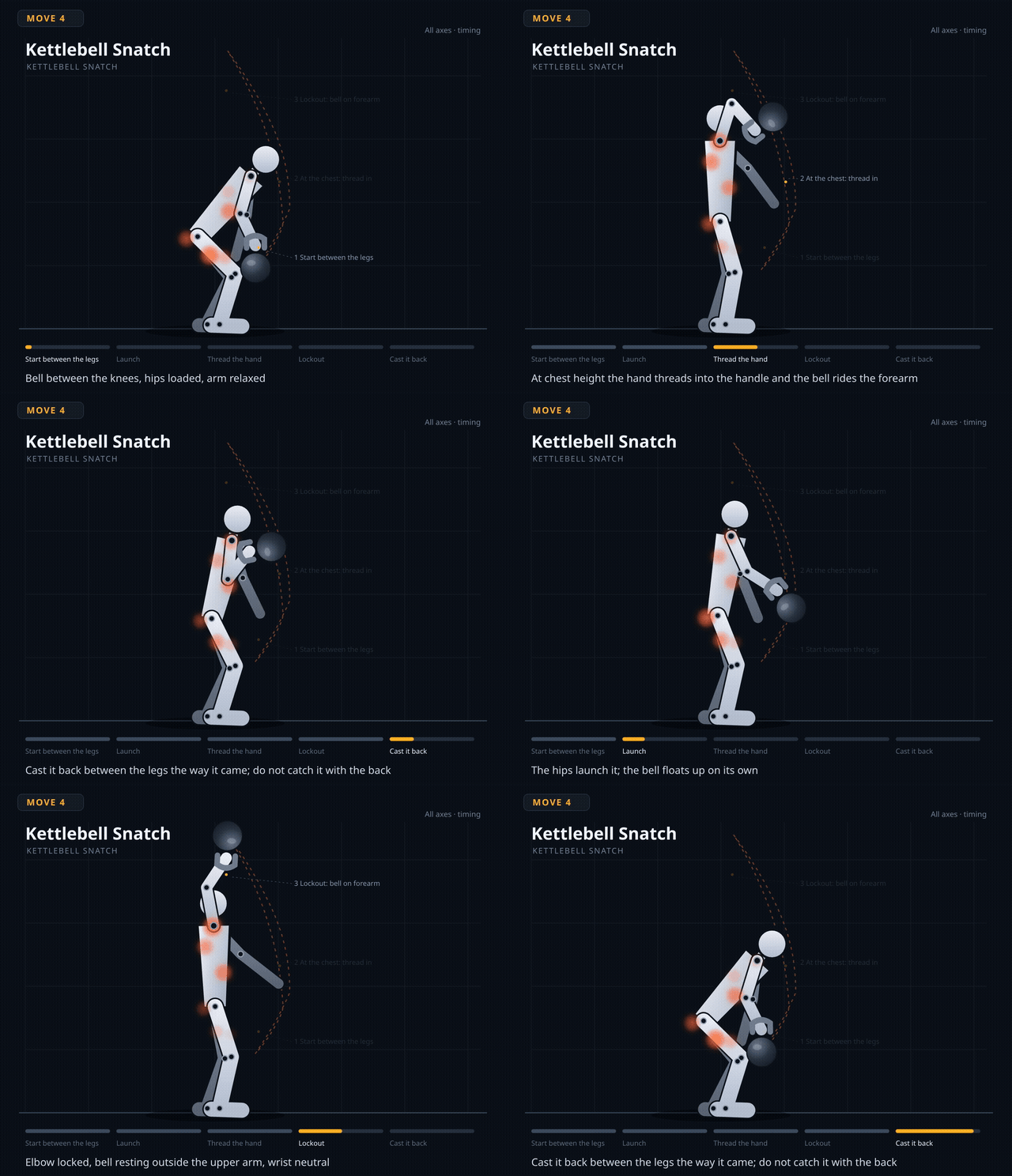
Hold the handle in a death grip and the bell’s rotation levers against the wrist and slams the bell into the forearm, which is why forearms bruise. The fix is to open the fingers as the bell passes chest height, let the handle turn half a rotation inside the palm, and let the bell body come up from below. It lands on the outside of the forearm with the wrist neutral.
So the snatch is not only a power test. It is the one movement here that needs timing: the hips supply the initial speed, the hand decides where the bell ends up. Done right the bell is caught. Done wrong it is dropped onto you. The lowering phase is where most injuries happen, so cast the bell back along the path it came up and never let it free-fall.
Earn the speed before adding weight. Ten clean reps per side at eight kilos with no wrist banging is the gate for going heavier.
6. The cross-body row is one diagonal line#
Back training has been owned by the sagittal plane for so long that rows, pulldowns and pull-ups all pull front to back. The cross-body row changes the direction of the pull: the bell starts at the floor by the far foot, travels on the diagonal up to the hip, and returns slowly.
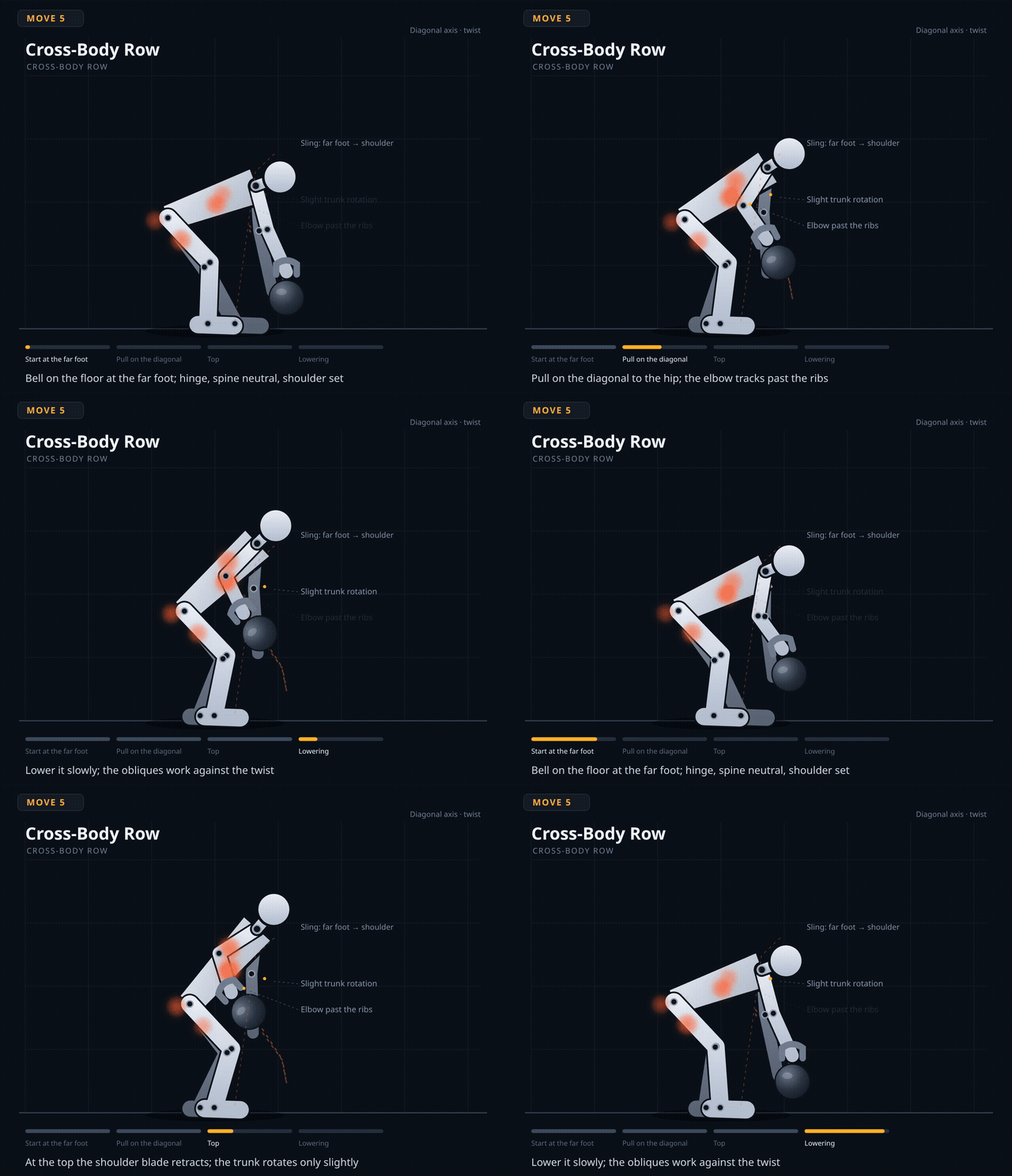
Most trunk muscles are not oriented vertically. The internal and external obliques cross at an angle and, together with the lats and glute medius, form a sling from the opposite hip to the same-side shoulder. Throwing, swinging a racquet and turning with a heavy box all run through that sling. One published analysis puts roughly 87.5 per cent of the trunk musculature along diagonal or horizontal lines.
Rotation belongs to the thoracic spine. The lumbar spine rotates through a handful of degrees, and loading it in rotation is a common route to low-back pain. The feeling is the chest turning toward the pulling side; the hard part is not letting the waist come apart during the pull. Actively wrenching the low back is the error, not the goal.
Lead with the elbow. Think of reaching back toward a pocket behind you, with the wrist as a hook. At the top the shoulder blade retracts and settles, hold for a second, then lower over two to three seconds. That eccentric stretch is the part the obliques are actually trained by.
7. Scheduling it#
The movements carry no parameters of their own, so here are three plans. They share one ordering rule: power first, strength after. The swing and the snatch want a fresh nervous system and sit early in a session; the squat and the row go later; the halo goes in the warm-up.
| Plan | Frequency | How it lays out |
|---|---|---|
| A, starting out | Twice a week | Halo warm-up, goblet squat 3×10, cross-body row 3×10, swing 5×10 to finish |
| B, advancing | Three times a week | Strength day squat 4×8 and row 4×10; power day swing 8×8 and snatch 5×5; a mixed third day |
| C, as a patch | Inside your current plan | Halo in the upper-body warm-up, swing as an activation set before squatting, snatch as a ten-minute finisher, row as the second pull |
There is a workable rule for weight. Use a bell you could swing fifteen times for sets of ten. Use the heaviest goblet you can hold with the chest up. Halo with something lighter than you think. Start the snatch at a weight you can do ten times without a bruise.
| Movement | Sets and reps | Starting weight |
|---|---|---|
| Swing | 5×10 | 12 to 16 kg men, 8 to 12 kg women |
| Goblet squat | 4×8 | Heaviest you can hold with the chest up |
| Halo | 8×2 each direction | 8 to 12 kg men, 4 to 8 kg women |
| Snatch | 5×5 each side | 12 kg men, 8 kg women |
| Cross-body row | 4×10 each side | 16 to 24 kg men, 8 to 16 kg women |
8. The edges#
All five movements share one set of prerequisites: hips that hinge, ankles that dorsiflex, a thoracic spine that extends, shoulders that go overhead. Miss any one of the four and the movement distorts, and it usually distorts by dumping load into the lumbar spine.
- Swing. Fatigue turns it into a back lift. Learn the hinge unloaded first, facing a wall and pushing the hips back, then add the bell. With a history of low-back pain, build the pattern with Romanian deadlifts.
- Goblet squat. Poor ankle dorsiflexion lifts the heels, moves the centre of mass forward and raises knee shear. Put a thin plate under the heels before squatting; if the position improves, the ankle was the limit.
- Halo. Limited shoulder range or a history of subacromial pain means a heavy bell is loaded at the joint’s most exposed angle. Use an unloaded circle or a band instead.
- Snatch. Forearm bruising, wrist sprain and rotator-cuff irritation all trace back to a missing hand insertion. Build a high pull and a clean first, and rehearse the insertion two hundred times on its own.
- Cross-body row. Rotation through the lumbar spine is the main injury path. Sore back and obliques afterwards is right; soreness on one side of the low back means stop and check the position.
A kettlebell’s mass sits off the handle, and that is both where its training value comes from, since an unstable load forces more muscles into stabilising, and why it is harder to learn than a dumbbell. At the same weight, the kettlebell asks more of the movement.
9. Where the numbers come from#
| Number | Value | Source |
|---|---|---|
| Moves, axes, intersection | 5 moves, 3 axes, 1 intersection | The classification in this post, drawn from reconstructed joint paths |
| Pattern coverage | 3 covered, 2 partial, 3 missing | Counted row by row in the table above |
| Swing knee flexion | 20 to 30 degrees | Coaching convention, indicative |
| Diagonal share of trunk musculature | about 87.5% | Santana 2000, anatomical analysis |
| Snatch split | 60% swing, 40% snatch | This post’s decomposition, indicative |
| Doses and weights | the tables in section 7 | Training recommendation, adjust to tolerance |
| Film length | 26 seconds, 3 to 8 seconds per segment | Rendered from the animation cycles, measured |
| The skeletons in the figures | Schematic, not anatomical | Reconstructed from key poses to show joint paths and the order of force |
References#
| Source | Link |
|---|---|
| McGill, S. M., Marshall, L. W. Kettlebell swing, snatch, and bottoms-up carry: back and hip muscle activation, motion, and low back loads. J Strength Cond Res, 2012, 26(1), 16 to 27 | https://journals.lww.com/nsca-jscr/Fulltext/2012/01000/Kettlebell_Swing,_Snatch,_and_Bottoms_Up_Carry_.3.aspx |
| Lyons, B. C. et al. Electromyographical comparison of muscle activation patterns across 3 commonly performed kettlebell exercises. J Strength Cond Res, 2017, 31(9), 2363 to 2370 | https://doi.org/10.1519/jsc.0000000000001771 |
| Del Monte, M. J. et al. Hamstring myoelectrical activity during three different kettlebell swing exercises. J Strength Cond Res, 2020, 34(7), 1953 to 1958 | https://journals.lww.com/nsca-jscr/fulltext/2020/07000/hamstring_myoelectrical_activity_during_three.18.aspx |
| Santana, J. C. The serape effect: a kinesiological model for core training. Strength Cond J, 2003 | no online copy |
| NASM. The Goblet Squat: A Trainer’s Coaching and Programming Guide | https://www.nasm.org/resource-center/blog/training/how-to-perform-goblet-squats |
| Breaking Muscle. How to Master the Kettlebell Snatch | https://breakingmuscle.com/how-to-master-the-kettlebell-snatch/ |